Spain took the lead in the 30th minute through Fabian Ruiz, but Belgium equalised through Charles De Ketelaere before the break and Merino sealed the victory just two minutes after coming off the bench. It was a stunning knockout win that showed once again Spain’s ability to land a late blow when it counts.
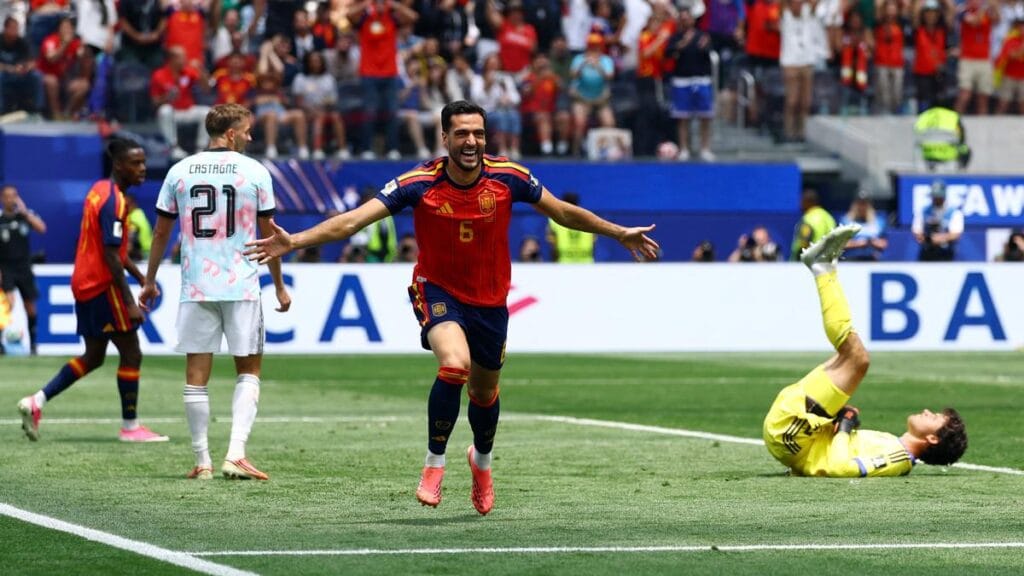
Spain celebrate after Mikel Merino scores a late winner against Belgium in the FIFA World Cup quarter-final. Image Credit: The Hindu
FIFA World Cup 2026: Spain produced a hard-fought 2-1 victory over Belgium in the FIFA World Cup quarter-final on Friday, July 10, 2026, advancing to the semi-finals, where they will meet France in Dallas on Tuesday, July 14. Fabian Ruiz opened the scoring for Spain in the 30th minute, Belgium responded before halftime through Charles De Ketelaere’s header, and substitute Mikel Merino struck the decisive goal late in the game to send Spain through.
The match had the feel of a classic knockout contest: tight, tactical and decided by fine margins. Belgium stayed alive for long stretches and equalised at a key moment, but Spain kept pushing and got its reward through a sharp late finish. Yeh win Spain ke liye kaafi important hai because it shows both resilience and depth at the biggest stage.
Match Summary
Spain started the game with greater control and managed to turn that into the opening goal through Fabian Ruiz. The goal came in the 30th minute after a rebound shot, which underlined Spain’s willingness to stay alert around the box and attack second balls. That kind of goal is often the result of persistence rather than one perfect move. The story was also covered by The Hindu.
Belgium did not allow the game to slip away. Just before halftime, Charles De Ketelaere rose to score with a header in the 41st minute, bringing Belgium level and changing the momentum of the match. For a while, that equaliser looked like it could push the game toward extra pressure on Spain.
But Spain found the decisive answer late. Mikel Merino was introduced after 86 minutes and scored just two minutes later after pouncing on a loose ball. That finish decided the quarterfinal and gave Spain another example of how a well-timed substitution can change a knockout match in an instant.
How Spain Won
Spain’s victory came down to patience, structure and the ability to keep believing even after Belgium equalised. In tournament football, this matters a lot. A team can dominate territory or possession for long spells, but unless it keeps its focus in both boxes, the result can still go either way.
Fabian Ruiz’s opener was important because it gave Spain something to build on rather than chase. Belgium’s equaliser, however, forced Spain to prove it could win under pressure. That is where the late introduction of Merino became decisive. Fresh legs, sharper movement and better timing helped Spain find the final breakthrough.
Substitutions often determine knockout matches, and this was a textbook example. Merino did not need a long time to influence the game. He came on late, read the moment quickly and finished when the loose ball arrived. That kind of impact is what coaches dream of in a World Cup quarterfinal.
Belgium’s Response
Belgium did enough to stay in the game and even bring it back to level terms before halftime. De Ketelaere’s header was a reminder that Belgium remains dangerous in set-piece and aerial situations. The equaliser made the contest more open and kept pressure on Spain for much of the rest of the match.
Still, Belgium could not turn that momentum into a winner or even force Spain into a prolonged collapse. In knockout football, that often becomes the difference between a brave performance and a victorious one. Belgium fought hard, but Spain showed better late-game composure.
The result will likely feel frustrating for Belgium because the match was still very much alive deep into the second half. But they were undone by a late lapse and Spain’s sharper reaction in the final moments. Against elite opponents, even a small defensive opening can prove fatal.
Merino’s Big Moment
Mikel Merino’s goal will be remembered as one of those late knockout strikes that changes the tone of a tournament. He came off the bench in the 86th minute and scored almost immediately after. That is not just good timing — it is the mark of a player ready to make an instant impact.
For Spain, this kind of contribution is crucial because World Cup runs are often built on squad depth, not just starters. A bench player who can decide a quarterfinal gives the team another layer of threat. It also sends a message to opponents: even if you stop the main attacking names, Spain can still hurt you in the final moments.
This was also a mental victory for Spain. When a team scores late after being held level, it often reflects composure and belief. Spain did not panic after Belgium’s equaliser. Instead, they stayed in the match and found the opening when it mattered most.
Background and Context
Spain’s run to the semi-final is part of a wider pattern of strong tournament football. Reaching the last four in a World Cup is never easy, and doing so through a tense quarterfinal win adds to the momentum. Spain’s style has often been built around control, movement and technical sharpness, and this game showed those qualities under pressure.
Belgium, meanwhile, came into the quarterfinal with the hope of producing a major upset. Their equaliser showed they were capable of matching Spain in key moments, but the contest also exposed the small gap that often separates elite knockout sides from the rest. Spain took their chance late; Belgium could not do the same.
The upcoming semifinal against France now gives the tournament another heavyweight clash. Spain versus France is the kind of match that draws global attention because both teams have the quality, pace and experience to reach the final. That makes this quarterfinal result even more meaningful.
Timeline
30th minute: Fabian Ruiz scores a rebound goal to put Spain ahead.
41st minute: Charles De Ketelaere heads in Belgium’s equaliser.
86th minute: Spain bring on Mikel Merino as a substitute.
88th minute: Merino scores the winning goal from a loose ball.
Friday, July 10, 2026: Spain wins 2-1 and advances to the semifinal.
Tuesday, July 14, 2026: Spain is set to face France in Dallas.
Why This Matters
This matters because World Cup knockout football is decided by moments, and Spain showed they can create and finish those moments under pressure. A quarterfinal win is not just a result; it is a statement about mentality, squad depth and game management. Spain’s ability to win late may become one of the defining themes of their tournament.
It also matters because the semifinal pairing with France now adds huge weight to the rest of the tournament. Matches like Spain versus France are not just football games — they are global events. Fans, broadcasters and analysts will all focus on that clash as one of the tournament’s biggest fixtures.
For Belgium, the loss is painful because they were close enough to believe. For Spain, the victory could become a major confidence boost. In tournaments, momentum matters as much as form, and this sort of late win can carry a team a long way. Yeh point bahut important hai because confidence often decides the next round before the ball is even kicked.
India Angle
For Indian football fans, this match is a reminder of why World Cup knockout football is so popular. The speed, tension and late drama make it easy to follow even for casual viewers. In Hinglish, seedhi baat yeh hai: aise matches dekh kar football ka thrill aur bhi strong ho jaata hai.
Spain’s style also appeals to many Indian viewers who enjoy possession-based football, while Belgium’s fightback adds the kind of unpredictability fans love. The semifinal against France will likely attract even more attention in India because both teams have star power and a history of big-tournament performances. This is the kind of football content that travels well on social media, highlight clips and late-night sports discussions.
The match also shows young Indian fans how valuable depth is in modern football. A substitute changed the game, which is a lesson that applies in every level of sport. It’s not always the biggest name who wins it; sometimes it is the player who comes on at the right time and stays alert.
Analysis
My opinion as a news writer is that Merino’s goal gives Spain exactly the kind of narrative momentum editors and readers love in a World Cup. A late winner, a bench impact and a semi-final against France — that is premium tournament storytelling. It also helps that the match had a clear structure: Spain leads, Belgium replies, and Spain decides. That makes it easy to follow while still feeling dramatic.
From a tactical angle, Belgium will likely regret not protecting the final moments better. Spain did not need many openings, and that is the danger of playing a top side that can stay calm for 90 minutes. If Belgium had kept the game level for longer, the psychological pressure might have shifted. Instead, Spain found the final touch and closed it out.
The bigger takeaway is that Spain now looks like a team that trusts its bench and its plan. That matters in a long tournament. When a squad can change the game late, opponents have to prepare for every phase of the match, not just the opening hour.
What Next
Spain now moves on to the semifinal in Dallas on Tuesday, July 14, where France awaits. That match will almost certainly be more intense, more tactical and more physically demanding. Spain will need the same composure they showed here, but probably with a stronger defensive response if France takes early control.
Belgium, meanwhile, will have to regroup and reflect on a quarterfinal that slipped away late. They showed enough quality to stay competitive, but the next step is turning that into wins against top-tier opposition. That usually comes down to details, especially in knockout football.
For viewers, the road ahead is simple: Spain versus France is now one of the most anticipated fixtures of the tournament. If Spain can carry this late-winning momentum into the semi-final, they will become even stronger contenders for the title.
Conclusion
Spain’s 2-1 win over Belgium was a classic quarterfinal decided by fine margins and a late moment of quality. Fabian Ruiz gave Spain the lead, Belgium hit back through De Ketelaere, and Mikel Merino finished the match with a decisive late strike after coming off the bench. The victory sends Spain into a blockbuster semifinal against France, adding even more excitement to the tournament’s closing stages. Spain showed patience, depth and composure when it mattered most, and that is exactly what knockout football demands.
Written By A. Jack