In a bid to ensure that children from migrant Agariya and desert communities do not miss their education, Gujarat has rolled out 28 solar-powered mobile classrooms under its new “School on Wheels” initiative. The program, called Ranshala, aims to bring learning directly to remote settlements in four districts and to cut dropout rates.
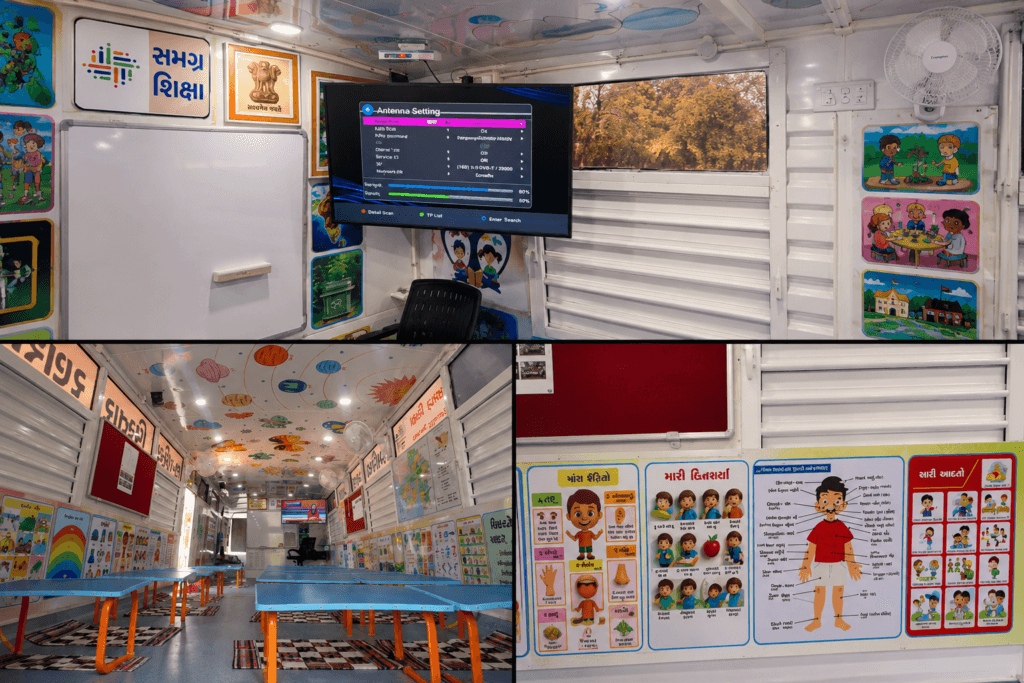
Gujarat’s “School on Wheels” solar-powered buses have been turned into mobile classrooms for migrant children in desert areas.
The Gujarat government on Tuesday converted 28 retired state transport buses into solar-powered mobile classrooms to help children from migrant Agariya communities in a major education initiative. The report said that the buses were launched at the Pathikashram ST Depot in Gandhinagar by Deputy Chief Minister Harsh Sanghavi.
The step comes in the wake of seasonal migration still disrupting schooling for children in Surendranagar, Patan, Kutch and Morbi districts. With the launch of the Ranshala programme, the state is trying to bring education closer to families who move frequently for salt production work. Yeh move kaafi practical lagta hai because it directly addresses a long-standing gap in access to schooling.
What The Programme Does
The School on Wheels model is about taking the old GSRTC buses and converting them into fully equipped learning spaces. Each bus reportedly carries over 20 children and has a 43-inch smart television, Dish TV educational channels, FM radio, LED lighting, fans, digital clocks and learning aids.
The vehicles are also fitted with portable tables, foldable shade nets, detachable blackboards and whiteboards, purified drinking water systems, wash basins, storage tanks, teacher cabins and even library space. Officials said the buses are powered by solar energy, making them especially useful in remote areas where infrastructure may be limited. GSRTC shared the inauguration video on X.
The design is not limited to classroom-style learning alone. The buses also include recreational items such as Ludo, Snakes and Ladders, swings, slides and basketball equipment, which can help make learning more engaging for younger children. That mix of education and play is important because it keeps children interested while they are studying in difficult conditions.
Why This Was Needed
The programme is aimed at children aged six to 14 from families that seasonally migrate to salt-producing regions. In these communities, education often gets interrupted because families move with the work cycle, making regular school attendance difficult.
This is where the idea of a mobile classroom makes sense. Instead of making children travel long distances or miss school during migration, Gujarat is taking the classroom to the community. That is a neat answer to a particular social problem.
“The goal is to reduce dropout rates among children of Agariya and desert communities,” officials said. In practice this means fewer children falling behind, fewer school years lost and a better chance of staying connected to formal education.
How The Idea Came Together
The launch coincided with the state’s Shala Praveshotsav, the school enrollment drive in Gujarat. The timing is important as it ties the mobile classroom project into a larger movement to improve access to education and school attendance.
Deputy Chief Minister Harsh Sanghavi said the project demonstrates how unused GSRTC buses can be converted for public benefit. The Ranshala model, he said, was a novel way of bringing education to children living in remote desert areas.
He also said that children of families working in salt production would no longer need to travel far for lessons, as the education would now come to them. In essence, the government is trying to convert a transport asset into an education asset. That is a strong example of reuse with public value. Check here for more latest news from all over india.
Background And Context
Seasonal migration has long been one of the biggest barriers to schooling in pockets of western India. When parents move for work, children often lose access to regular classrooms, textbooks and continuity of learning.
The problem for communities like the Agariyas, who are directly tied to salt production, is not only the distance but also the stability. Static education systems based on attendance often lag behind mobile livelihoods. This is why mobile schools or alternative learning models are becoming increasingly relevant.
The Gujarat initiative is part of a wider public education drive as it integrates the Samagra Shiksha campaign, the Education Department and GSRTC. Such multi-department coordination matters as education problems in remote areas usually cannot be solved by one agency alone.
Why This Matters
This is important because access to education should not be dependent on whether or not a child’s family is migratory or settled. Inequality grows over time when children are forced to miss school due to work patterns they cannot control.
A mobile classroom may look like a minor intervention, but its social impact can be significant. This can help prevent dropout, improve literacy and keep children connected to a structured learning environment. In remote desert regions, for children, that connection can shape the rest of their lives.
It also matters because this approach could become a model for other states facing similar migration-linked education gaps. If successful, it could inspire more flexible education delivery systems across India.
India-Focused Angle
This is a very relevant story for India, where many states have migration-linked learning gaps. Children are often left behind when families move, whether it is seasonal labour, construction work, agriculture or salt production.
Gujarat’s model shows that public education can take place outside the classroom. Sometimes the answer is mobility, flexibility and adaptation to the local. Yeh soch kaafi useful hai kyunki India ki education challenges aksar geography aur livelihood patterns se driven hain, sirf school availability se nahi.
The use of solar power is also important in the Indian context. In remote and hot areas, energy access can be inconsistent, so solar-powered classrooms offer a cleaner and more reliable solution.
Inside The Mobile Classroom
The buses have been designed to support both online and offline education. They also feature study materials, learning displays, wall fans and digital clocks, as well as smart TVs and educational channels.
Features for safety and hygiene are emergency exits, fire extinguishers, first aid kits, dustbins and sanitization kits. There are also health-monitoring tools such as digital weighing scales, height measurement systems and BMI charts, which show that the project is looking beyond academics alone.
That’s a nice touch, because kids in underprivileged areas tend to have disadvantages around education and health. A bus that combines learning, recreation and basic health monitoring is more than a classroom—it becomes a small support hub.
Analysis
The strongest part of this initiative is that it is practical. Instead of building entirely new schools in areas where families may not stay in one place, the government is using existing buses and adapting them for a specific need.
There is also a sustainability element here. Recycling retired buses reduces waste and extends the life of public assets. This makes the project not only socially useful but also environmentally reasonable.
At the same time, long-term success will be about execution. Mobile classrooms can work well if you have trained teachers, schedules that can be depended on, ongoing maintenance and trust in the community. A good idea can lose its steam without it.
Timeline
Gujarat to establish 28 solar-powered mobile classrooms Tuesday
Same day: Deputy Chief Minister Harsh Sanghavi to flag off buses in Gandhinagar
Launch period: The launch coincides with the state enrollment drive, Shala Praveshotsav.
Present deployment: Buses are allocated to Surendranagar, Patan, Kutch and Morbi districts.
Next step: If the model works, more buses could be added.
The timeline shows this project isn’t a one-off stunt for publicity but part of a wider education campaign. The real test will be whether the model holds up after the initial launch period.
What Next
Next will be to monitor the performance of the buses in actual field conditions. Officials will need to see if attendance picks up, children stay engaged and families react positively to the mobile school model.
If results are good, Gujarat may extend the programme to more areas or add more buses. The state has already indicated that more such buses will be prepared in future so that no child in a remote area is deprived of education.
The program could also spur similar programs in other states that have migrant or rural populations. If that happens, Ranshala could become more than a local education story; it could become a national example.
Conclusion
Gujarat’s School on Wheels initiative is an imaginative response to a real and persistent problem in education. The state is turning 28 retired buses into solar-powered mobile classrooms to reach children whose schooling is often disrupted by seasonal migration.
The idea is simple but powerful: if children cannot always come to school, school should come to them. This approach may be especially valuable in remote desert communities where access, distance and mobility have long been barriers to education.
–Written by A. Aisha–