In an encounter, police arrested Jitendra Pathak alias Viraj, the accused of murdering a one-and-a-half-year-old boy in Uttar Pradesh’s Firozabad after his marriage proposal was rejected by the child’s mother. The case has shocked the local community and raised serious questions about obsession, violence and child safety.
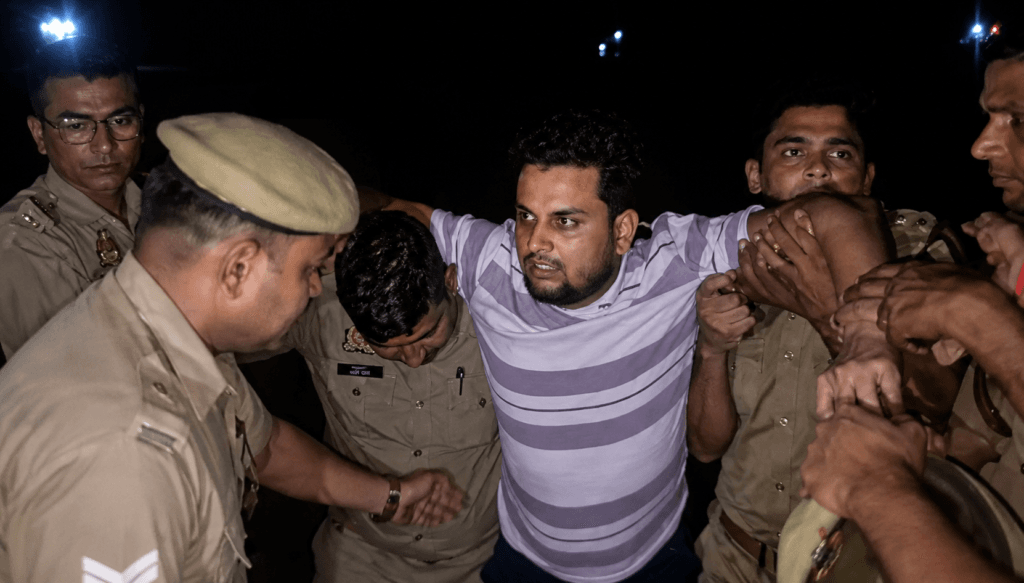
Police escort the accused after the Firozabad encounter linked to the murder of a one-and-a-half-year-old boy.
A deeply disturbing case from Firozabad has come to light after police arrested a man accused of murdering a one-and-a-half-year-old child and later being injured in an exchange of fire with police. The accused, identified as Jitendra Pathak alias Viraj, was taken into custody after suffering a gunshot wound to his leg during the encounter near Mainpuri Road.
According to police, Viraj admitted that he wanted to marry the child’s mother, Rati, but she refused because she already had a child. Investigators said he saw the woman and her son, Aarav, as obstacles to his marriage plan. What followed was an act of extreme violence that has shocked the district and drawn widespread condemnation. Yeh case kaafi disturbing hai because it involves not just murder but a complete breakdown of basic human decency.
What Happened
Police say the crime unfolded on Saturday when Viraj took Aarav away on the pretext of buying him toffees. Instead of returning safely, the child was killed by being repeatedly slammed against the ground. By the time the family realized what had happened, it was too late. Aarav was rushed to a hospital, where doctors declared him dead.
Viraj had fled the scene after the killing. The child’s mother later told police that he had been pressuring her to marry him for some time. She said he had taken her son away by promising to buy him sweets, which makes the crime even more cruel because it involved deception as well as violence. NDTV has covered the full story.
After the murder, police registered a case and launched a search operation. The accused was eventually traced to an area near Bhudha Bharthara intersection on Mainpuri Road, where he was reportedly hiding in bushes. A four-member police team was sent to arrest him, and the area was cordoned off.
The Encounter
According to police, when officers tried to apprehend Viraj, he suddenly opened fire on the team. The police retaliated, and the accused was hit in the leg before being taken into custody. Officials said a country-made pistol, five live cartridges, and two spent shells were recovered from his possession.
The encounter adds another layer to an already horrific case. While the original crime was brutal enough, the chase and firing incident underlines how quickly violent offenders can escalate when cornered. In such situations, police generally describe the firing as retaliatory action after the suspect opens fire first. That is the version officials have given here as well.
The fact that the accused was found hiding in bushes suggests he was attempting to avoid arrest rather than surrender. Police also appear to have acted on intelligence before reaching the spot, indicating that the search was active and targeted rather than random.
What the Accused Revealed
During interrogation, Viraj reportedly confessed that he wanted to marry Rati, but she had refused repeatedly. Her reason was simple and firm: she already had a son and could not agree to the relationship. Investigators say that frustration over this rejection turned into a deliberate decision to kill the child.
That detail is critical because it shows motive. This was not a random act of violence or a crime committed in a fit of sudden rage. It was allegedly planned after repeated refusal and built around the idea that the child was blocking the relationship. Such motive makes the crime even more horrifying because it shows intent and calculation.
Police said they are now collecting all necessary evidence so that a charge sheet can be filed quickly. Superintendent of Police (City) Ravi Shankar Prasad said the force would try to ensure the court gives the accused the strictest punishment. That statement reflects the seriousness of the case and the pressure on police to build a strong prosecution file.
Background and Context
Cases involving rejected relationships turning violent are sadly not new in India. When obsession turns into entitlement, women and children often become targets. This case stands out because the victim was a very young child, and the attack appears to have been motivated by the accused’s inability to accept refusal.
In many parts of India, such crimes expose a larger social problem: the idea that a woman’s “no” can be treated as a challenge rather than a final answer. Here, the violence was not only directed at the mother emotionally but also at the innocent child physically. That makes the case a tragic example of how personal obsession can become public horror.
The Firozabad case will likely be remembered because of both the brutality of the murder and the police encounter that followed. The timeline is short but devastating: refusal, pressure, abduction on the pretext of sweets, murder, escape, tracking, encounter, and arrest. Every step adds to the seriousness of the crime.
Timeline
Before the crime: Viraj repeatedly pressures Rati to marry him.
Saturday: He takes Aarav away on the pretext of buying toffees.
Shortly after: The child is killed by being slammed against the ground.
Later: Aarav is taken to the hospital but declared dead.
After the murder, Viraj flees, and a murder case is registered.
Encounter stage: Police trace him near the Bhudha Bharthara intersection.
During arrest: He opens fire; police retaliate and injure him in the leg.
After arrest: Police recover a country-made pistol and cartridges.
Also Read: Delhi Fire at Ministry of Education Office Triggers Swift Rescue Response
Why This Matters
This matters because the victim was not just a child — he was a toddler who had no role in the adult conflict that led to his death. Crimes like this shake public trust because they show how vulnerability can be exploited in the cruelest way possible. If a child can be used as leverage in a personal dispute, then the entire community feels unsafe.
It also matters because it highlights the importance of swift police response. The encounter and arrest prevented the accused from disappearing further, and the recovery of weapons strengthens the investigation. Yeh issue kaafi important hai because it shows why law enforcement must act fast when a violent suspect is on the run.
The emotional impact is huge too. For families and ordinary citizens, this story is not just about crime news; it is about fear, grief, and the shock of seeing innocence destroyed by adult obsession. That emotional reaction is why this case is already drawing strong public attention.
India Angle
The India angle is strong because this story touches on child safety, women’s autonomy and police response — all major public concerns across the country. In Indian society, relationship pressure and rejected proposals sometimes lead to stalking, threats or violence, and such incidents often escalate when boundaries are ignored.
In Hinglish, the seedhi baat yeh hai: kisi bhi woman ka “no” final hona chahiye, aur uska badla bachche par lena toh aur bhi ghinauna hai. This case is a grim reminder that obsession can turn dangerous when entitlement is left unchecked. For Indian readers, it also reinforces why child protection, quick police action, and legal accountability are so crucial.
Analysis
My opinion is that the most alarming part is not only the murder, but the motive behind it. The accused allegedly killed a toddler because he could not accept the mother’s refusal. That tells us this was a crime rooted in control, not emotion. The police encounter may satisfy immediate public anger, but the real test will be in court, where the evidence must establish motive, sequence and intent clearly. The investigation should be thorough, because cases like this need more than outrage — they need airtight legal work. If the prosecution is strong, the accused should face severe punishment. If not, the case risks becoming another tragic headline without full accountability.
What Next
The next step will be the completion of the charge sheet and a detailed court case. Police will likely record statements from the child’s mother, family members, medical staff, and officers involved in the encounter. Forensic evidence, weapon recovery, and post-mortem findings will also matter in building the case.
If the charge sheet is filed quickly and the evidence is strong, the court may move the matter forward without delay. The police have already said they want the strictest punishment, and public sentiment will likely support that demand. In the coming days, more details may emerge about the accused’s movements before the crime and the exact sequence of events that led to the child’s death.
Conclusion
The Firozabad case is a heartbreaking reminder of how obsession can spiral into deadly violence. A rejected marriage proposal allegedly led to the murder of a toddler who had no connection to the adult dispute, leaving a family shattered and a community stunned.
Police say they have now arrested the accused after an encounter and recovered weapons from him. The next phase will be about evidence, prosecution, and justice. But no legal outcome can fully undo the loss of a one-and-a-half-year-old child. That is what makes this case so painful and so important to follow closely.
Written By A. Jack