
The incident took place between 4:40 pm and 5 pm at a welding garage in RCF, Chembur. Two injured workers, Faiyaz Khan and his son Mohammad Arkam, are being treated at Shiv Hospital in Laxmi Nagar.
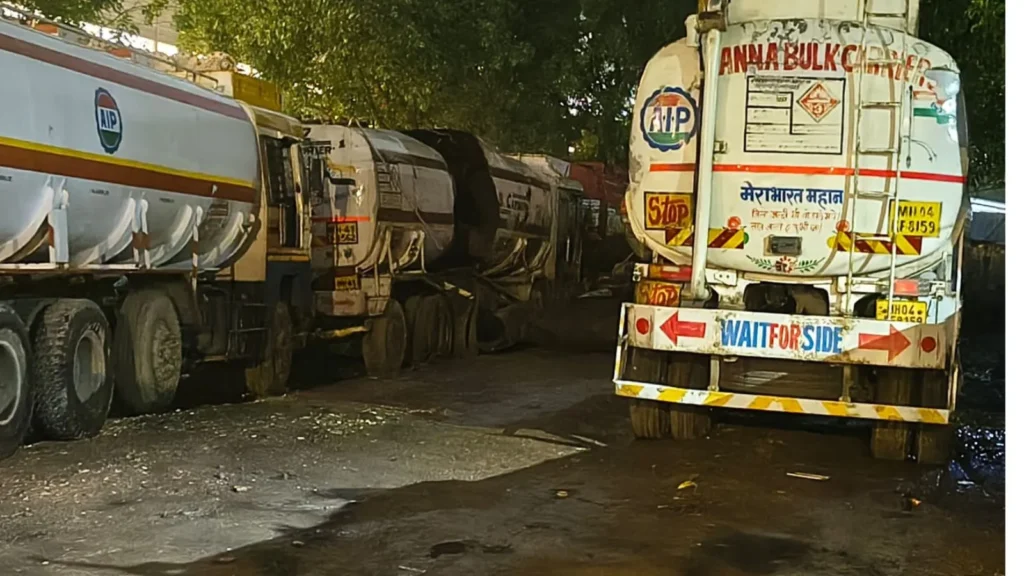
This image is only for illustrations. image credit: The IndianExpress
A tragic industrial accident in Mumbai’s Chembur area claimed one life and left two others injured on Friday evening after an empty gas tanker exploded during welding work at a garage. The blast took place near the HPCL building in Mukund Nagar, inside the RCF area, between 4:40 pm and 5 pm.
The tanker driver died on the spot in the explosion, while two welders, identified as Faiyaz Khan and his son Mohammad Arkam, suffered injuries and were rushed to a nearby hospital. They are currently undergoing treatment at Shiv Hospital in Laxmi Nagar. Police have begun an investigation to determine what triggered the blast and whether safety protocols were followed at the site. Yeh incident kaafi serious hai because even an “empty” gas tanker can become deadly if proper gas-freeing and safety checks are not done before welding.
What Happened at the Garage
According to the initial details, welding work was underway on the tanker when the explosion occurred. The key point here is that the tanker was described as empty, but in industrial terms that does not always mean safe. A tank that has carried gas may still contain vapours or residue that can ignite if exposed to heat, sparks or open flame. This story was also covered by the IndianExpress.
That is why welding on such containers requires strict safety procedures. Tanks are usually supposed to be completely cleaned, ventilated and tested before any hot work begins. If those steps are missed, the risk of explosion rises sharply. In this case, the impact of the blast was strong enough to kill the driver immediately and injure two workers nearby.
At this stage, the exact cause has not been officially confirmed. It may involve residual gas, poor ventilation, a spark during welding or some other technical failure. But whatever the final finding turns out to be, the incident points to a serious safety breakdown. Seedhi baat yeh hai: jab flammable material ya gas tanker ke saath kaam hota hai, ek chhoti si lapse bhi fatal ho sakti hai.
Emergency Response and Medical Treatment
After the explosion, the injured welders were taken to a nearby hospital and later shifted to Shiv Hospital in Laxmi Nagar for treatment. The quick transfer suggests that people at the site responded fast after the blast. In accidents like this, every minute matters because burns, blast injuries and trauma can worsen quickly.
Police and other authorities are now expected to review the site, examine the tanker condition and check whether safety precautions were in place. In industrial incidents, investigators often look at whether the garage had the required permits, whether the container had been properly cleaned, and whether workers were wearing protective gear. Those details will be crucial in deciding whether this was an unavoidable accident or a preventable one.
The presence of a driver at the site is also significant. The report says the tanker driver was killed on the spot, which raises questions about whether he was inside or near the tanker at the time of the blast. That point will likely be clarified as the investigation progresses.
Why Welding on Tankers Is Dangerous
Welding on a gas tanker is among the most dangerous kinds of repair work because heat and sparks can ignite leftover fuel vapours or residue. Even when a tanker is called “empty”, traces of flammable material can remain in the container or valves. If those vapours are not fully removed, a welding torch can create an instant explosion.
Industrial safety norms usually require multiple precautions: gas freeing, pressure checks, ventilation, isolation of the tank, fire protection equipment and supervision by trained personnel. Skipping even one step can create a dangerous situation. That is why incidents like this are often investigated not only as accidents but also as possible safety violations.
In India, where repair work in small garages is common, such risks are often underestimated. Workers may assume that an empty tanker is harmless or that a quick repair job will be fine if done carefully. But a gas tanker is not just a metal shell. It is a container that may still carry invisible danger. Yeh issue kaafi important hai because industrial shortcuts can cost lives in a matter of seconds.
Background and Context
Chembur is one of Mumbai’s key industrial and residential zones, with a long history of factories, depots, transport activity and service workshops. Because of that, the area sees a mix of heavy vehicles, repair garages and fuel-related operations. That industrial character makes strict safety enforcement especially important.
Across India, gas tanker accidents and industrial blasts often have a similar pattern: routine maintenance, inadequate safety checks and a sudden ignition source. These incidents rarely happen without warning signs. Usually, there is some gap in protocol, training or supervision. The challenge is that the consequences are often irreversible by the time the mistake is noticed.
This latest blast also adds to the broader concern around workplace safety in informal or semi-formal repair environments. Smaller garages may not always have the equipment, training or oversight found in larger industrial facilities. Yet the risks can be just as serious, especially when handling fuel-related vehicles. That is why even a local incident in Chembur matters to a much larger national conversation on safety compliance.
Timeline
Friday, around 4:40 pm to 5 pm: Welding work is underway on an empty gas tanker at a garage near the HPCL building in Mukund Nagar, Chembur.
During the work: The tanker explodes.
Immediately after the blast: The driver dies on the spot.
Soon after: Welders Faiyaz Khan and Mohammad Arkam are injured and rushed to hospital.
Later: They are treated at Shiv Hospital in Laxmi Nagar.
Now: Police begin investigating the cause of the explosion.
Also Read: Pune Contractor Death by Suicide: Ex-Shiv Sena MLA Ravindra Dhangekar, Wife and 12 Others Booked
Why This Matters
This matters because the death occurred in a preventable-sounding industrial setting, not in a natural disaster or random street accident. When a tanker explodes during routine repair work, it raises immediate questions about whether basic safety procedures were ignored. The loss of life and the injuries are a reminder that workplace safety is not optional. Yeh issue kaafi important hai because a single lapse in a garage can affect families, workers and the wider community.
It also matters because such incidents can happen in many Indian cities where repair work is done under pressure and often on tight budgets. If safety checks are skipped to save time or money, the public pays the price. A blast like this is not only a workplace tragedy; it is a warning sign for the entire industrial ecosystem.
There is also a local safety angle. Chembur is a busy and sensitive area where industrial and residential spaces exist close to each other. A blast in such a zone can have wider consequences if fire spreads or if more people are nearby. Even when the damage is limited to a garage, the risk to surrounding neighbourhoods is real.
India Angle
For Indian readers, this story is a clear reminder that industrial safety still needs a lot more attention at the ground level. In Hinglish, seedhi baat yeh hai: “empty” ka matlab “safe” nahi hota. That lesson matters in every city where fuel tankers, chemical containers or gas vehicles are repaired.
Across India, workers often handle hazardous materials under difficult conditions. Sometimes there is time pressure, sometimes there is a lack of proper equipment, and sometimes safety is treated as an afterthought. This incident shows why better enforcement and awareness are necessary. Small workshops and garages need to understand that welding on a tanker is not an ordinary repair job.
The case also matters because Mumbai is one of India’s most crowded and industrially active cities. A blast there quickly becomes a public concern, not just a local one. People living nearby will want to know whether the site was following proper rules and whether similar garages are being checked. That concern is justified, because safety failures in one place often reveal larger weaknesses elsewhere.
Analysis
My opinion is that the real story here is not just the explosion but the likely safety lapse behind it. Empty tanks are not automatically safe for welding, and any professional handling such work should know that. If investigators find that standard precautions were skipped, this could turn into a significant case of negligence. That is why the investigation matters so much.
I also think this incident will resonate because it feels preventable. Readers often react strongly to industrial blasts when they happen during routine work rather than a major accident. The sense that a normal repair job turned deadly makes the story more alarming. From a reporting perspective, that is a key reason this case deserves serious attention and not just a brief accident note.
There is also a policy angle. India needs a stronger compliance culture in small and medium repair units, especially those dealing with fuel-related vehicles. Training, inspection and certification should be more visible. Otherwise, workers remain exposed to high-risk tasks without adequate protection. If this case pushes authorities to tighten checks, some good may come from a terrible event.
What Next
The next step will be a detailed investigation into the garage, the tanker and the sequence of work being carried out before the blast. Officials will likely check whether the tanker had been properly purged of gas vapours, whether welding was authorised and whether the workers had the right safety equipment.
Police and safety officers may also speak with witnesses, hospital staff and the garage owner, if applicable. Their findings will help determine whether any negligence or violation of safety norms took place. If wrongdoing is found, legal action could follow.
For workers and small garages, the incident may serve as a warning to stop treating gas tanker repair as ordinary welding work. More care, more training and stricter supervision are likely to be demanded after this. If the investigation leads to enforcement action, it could also lead to broader checks on similar facilities in Mumbai.
Conclusion
The gas tanker explosion in Mumbai’s Chembur is a tragic reminder that industrial work can turn fatal when safety is not treated as a priority. A driver lost his life and two welders were injured when an empty gas tanker exploded during welding at a garage near the HPCL building in Mukund Nagar. While the exact cause is still under investigation, the incident already highlights the danger of hot work on fuel-related vehicles without full safety clearance. As authorities probe the case, the larger lesson is clear: in industrial repair work, shortcuts can cost lives.
Written By A. Jack