
The Brihanmumbai Municipal Corporation had blamed contractors and exonerated its officials but the mayor said the findings were not acceptable and demanded a re-enquiry with two corporators on the panel. The victim’s family has demanded a fair and transparent probe.
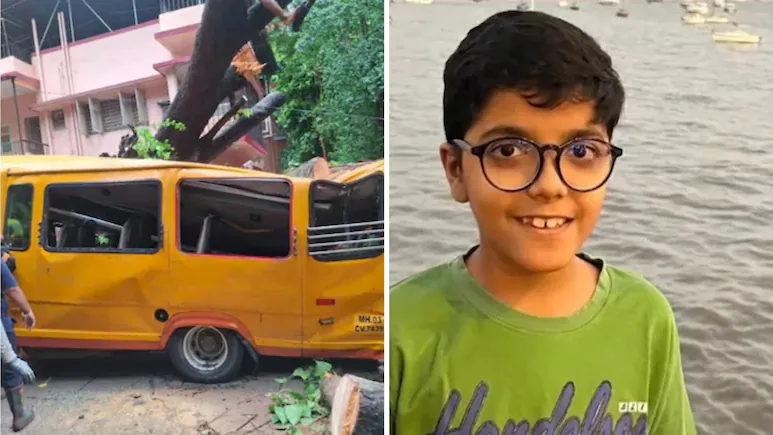
The Chembur tree collapse case that killed 11-year-old Vihaan Srivastav. Image Credit: NDTV
Mumbai’s tree collapse controversy has taken a sharper political turn after Mayor Ritu Tawde on Friday rejected the Brihanmumbai Municipal Corporation’s inquiry report into the death of 11-year-old Vihaan Srivastav, who was killed on June 30 when a large tree fell on his school bus in Chembur. The mayor said the report was unacceptable, tore up the copy, and ordered a re-enquiry into the incident.
The BMC’s report had reportedly held contractors responsible while giving a clean chit to its own officials. That finding has now triggered strong disagreement from the city’s leadership and renewed grief for the family. In her remarks, Tawde said she had personally visited the road ahead of the monsoon and warned the site engineer about weak trees. Yeh matter kaafi important hai because it is no longer just about one tragic accident — it is now about accountability, civic negligence, and how Mumbai prepares for monsoon risks.
What the Mayor Said
Tawde’s comments were unusually direct. She said the corporation unanimously rejected the administration’s report and that the report copy had been torn up. She also announced that the administration has been asked to conduct a fresh enquiry and include two corporators in the panel.
One of her strongest objections was to what she described as the report setting a “price of Rs 7 lakh” on a lost life. According to her, that kind of framing is deeply offensive to the victim’s family and does not reflect the seriousness of the loss. She said, “I am also a mother. Their child is gone. Their home is devastated.” That statement underlines the emotional weight of the case and why the report sparked such a strong reaction. This story was also covered by NDTV.
Tawde’s remarks suggest that the civic body’s internal findings did not satisfy the political leadership, especially because the report reportedly placed responsibility on the contractor and supervising consultant while exonerating the roads and garden department. Her criticism was not just procedural; it was moral and emotional as well. Seedhi baat yeh hai: jab ek bachcha mar jaata hai, toh family ko sirf compensation nahi, jawab chahiye.
What the BMC Report Said
The inquiry committee submitted its report on Monday. It recommended fines of Rs 5 lakh on the road work contractor and Rs 2 lakh on the supervising consultant. At the same time, it found no negligence on the part of the roads and garden department.
That conclusion is now at the centre of the dispute. Critics may see it as an attempt to push responsibility onto external contractors while shielding internal civic officials from blame. Supporters of the report could argue that the committee found a direct link between construction supervision and the incident, which is why the contractor and consultant were penalised. But the mayor’s rejection means the findings are far from settled.
This is especially significant because tree-related accidents in a city like Mumbai are not random events. They often involve pruning, monsoon preparation, road works, utility lines and municipal responsibility. When an inquiry clears the department in charge, public suspicion naturally rises. That is why Tawde’s demand for a new probe has quickly become a major civic issue.
The Chembur Tragedy
Vihaan Srivastav was killed on June 30 when a huge tree fell on his school bus in Chembur. The incident shocked the city because it involved a child, a school vehicle and a clearly public space. Families send their children on school buses expecting a basic level of safety, so an accident like this hits a raw nerve in Mumbai.
The victim’s father, Gaurav Srivastav, told NDTV that he hoped the findings would lead to a fair and transparent re-enquiry. He argued that the matter should be treated as man-made negligence rather than a natural disaster. His demand is important because it reflects a larger public concern: if tree collapses are only seen as bad weather incidents, then the system may never fix the real problems.
He also said that if accountability is fixed properly, future monsoons may not produce the same tragedy for another family. That line captures exactly why this case matters beyond one household. The tragedy has become a test of civic responsibility, especially in a city where monsoon-related risks are recurring and predictable. Yeh issue kaafi serious hai because if this is treated casually, the next accident could be even worse.
Background and Context
Mumbai has always faced monsoon-related civic challenges: waterlogging, falling trees, potholes, traffic chaos and infrastructure damage. Tree collapses, in particular, have long been part of the city’s rainy-season risk profile. But public tolerance for such accidents is low because many of them are preventable with better inspection, trimming and coordination.
The timing also matters. Mayor Tawde said she had visited the road before the monsoon and warned the site engineer about weak trees. That claim, if accurate, raises questions about whether warnings were ignored or not acted on in time. It also suggests that the problem may not have arisen suddenly on the day of the accident. Instead, it may have developed over time as part of a broader maintenance failure.
The fact that the inquiry report singled out contractors and consultants while clearing civic departments only deepens the political and administrative tension. In India, especially in big cities, responsibility often gets divided among multiple agencies and contractors. That can make accountability blurry. When tragedy happens, everyone points at someone else. This case shows exactly why those chains of responsibility need to be transparent.
Timeline
Ahead of monsoon: Mayor Ritu Tawde says she visited the road and warned about weak trees.
June 30: A large tree falls on a school bus in Chembur, killing 11-year-old Vihaan Srivastav.
Following days: BMC forms an inquiry committee to examine the incident.
Monday: The committee submits its report, blaming contractors and consulting staff, while clearing civic department officials.
Thursday: Vihaan’s father speaks to NDTV and calls for a fair re-enquiry.
Friday: The mayor rejects the report, says it was torn up, and orders a fresh probe with two corporators on the panel.
Also Read: Gas Tanker Explosion in Mumbai’s Chembur Kills Driver, Injures Two Welders
Why This Matters
This matters because the case is about much more than compensation or departmental blame. It is about whether a city can protect children using its roads, trees and public infrastructure. When a school bus is struck by a falling tree, it is not an unavoidable act of nature in the public mind — it feels like a civic failure. Yeh issue kaafi important hai because citizens need to know that life-and-death negligence will not be buried under committee language.
It also matters because the report’s framing can shape future policy. If the issue is treated as contractor fault alone, municipal systems may avoid deeper reforms. But if the enquiry exposes gaps in inspection, warning response, tree maintenance and monsoon planning, then real corrective action becomes possible. That is what the family appears to want: not just punishment, but change.
There is also a human and emotional dimension. The mayor’s statement that she is a mother herself was not just political rhetoric; it was a way of connecting with the grief of the family. In a situation like this, formal language is never enough. People want to see that the loss is being felt, understood and acted upon.
India Angle
For Indian readers, this story strikes a familiar chord because monsoon negligence is a recurring issue in urban life. From Mumbai to other metro cities, people often see falling branches, clogged drains and damaged roads as part of the rainy season. But when a child dies, the entire conversation changes. In Hinglish, seedhi baat yeh hai: “monsoon accident” bol dene se responsibility khatam nahi ho jaati.
This is especially relevant in India because municipal accountability is often tested during the rainy season. Public works, tree pruning, road repairs and contractor oversight all come under pressure at the same time. If one part fails, the consequences can be deadly. Mumbai, being one of the country’s most visible cities, becomes a national example of how urban governance should or should not work.
The case also touches a broader Indian concern: whether civic systems protect ordinary citizens or only protect themselves after a tragedy. Many families in India feel that official reports often soften the blame. That is why the family’s demand for transparency has struck such a chord. People want to believe that public institutions can admit fault when they are wrong.
Analysis
My opinion is that the mayor’s intervention will force the issue back into public debate, which is probably necessary. When an inquiry report is rejected so publicly, it signals that the internal process lacked enough trust. The phrase about “setting a price” on a lost life will likely stay with readers because it is emotionally sharp and morally charged. In a case like this, language matters. If the public feels the report is bureaucratic or cold, confidence drops immediately.
I also think the fresh probe should focus on whether warning signs were ignored. The mayor’s claim that she had already alerted the site engineer, if proven, would be significant. It would suggest the collapse was not merely sudden but preventable. That is the key question the new inquiry must answer: was the accident a natural failure of an old tree or a man-made failure of planning and response?
What Next
The next step is the re-enquiry ordered by the mayor, with two corporators reportedly being included in the panel. That fresh investigation will likely revisit the site, the roadwork timeline, monsoon preparations and the role of the roads and garden department. If new evidence emerges, the earlier findings may be revised again.
The family will likely continue pressing for a transparent outcome. Their demand for accountability may keep the issue in the public eye, especially if the new enquiry takes time. There may also be political pressure from the opposition and civic watchdogs to ensure the next report is not seen as another cover-up.
For the BMC, this is a moment of institutional self-check. If the revised inquiry is seen as fair and evidence-based, it may restore some trust. If not, the controversy could deepen and become an even bigger criticism of civic governance in Mumbai.
Conclusion
The Chembur tree collapse that killed 11-year-old Vihaan Srivastav has now become a wider test of accountability for Mumbai’s civic administration. Mayor Ritu Tawde’s rejection of the BMC report and her order for a re-enquiry show that the issue is far from over. With the family demanding fairness, the mayor insisting the report was unacceptable, and the original findings blaming contractors while clearing civic officials, the case has become about more than one tragic accident. It is about whether Mumbai can honestly confront preventable loss and learn from it before the next monsoon brings another crisis.
Written By A. Jack