Indian Air Force Mourns Loss of Five Brave Air Warriors as AN-32 Transport Aircraft Crashes in Assam; Court of Inquiry Ordered
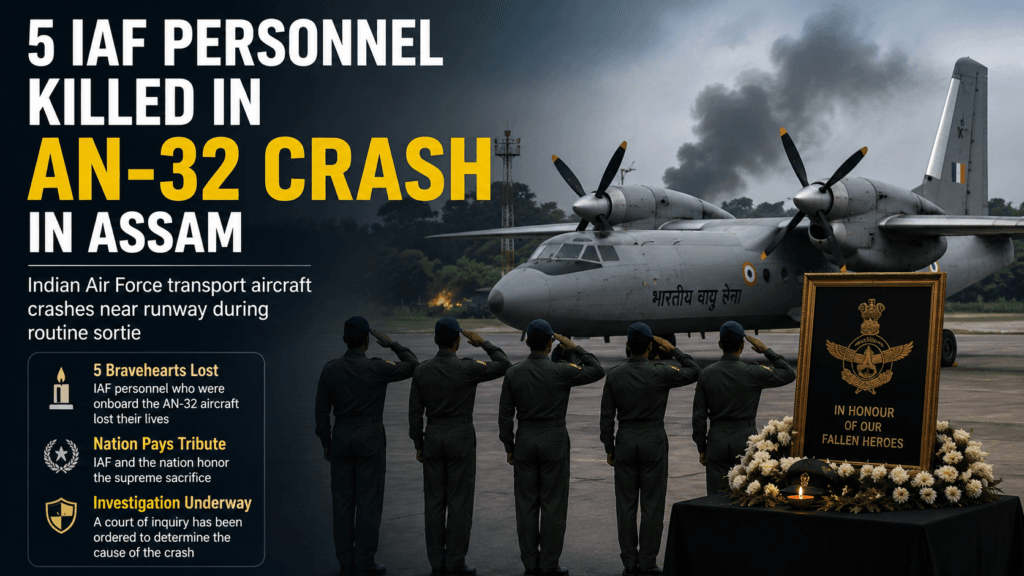
This image is only for illustrations. Stale Rasgullas | Generated by AI
In yet another military aviation tragedy, five Air Force personnel were killed when an Indian Air Force (IAF) AN-32 transport aircraft crashed at the Jorhat Air Force Station in Assam on June 13, 2026. The accident occurred during a routine sortie and has sent shock waves through the defence community and the nation.
An accident occurred while the aircraft was landing at the Jorhat airbase in Assam, the Indian Air Force said in an official statement. Five personnel on board died in the line of duty; the co-pilot survived and is being treated medically. The IAF has ordered a Court of Inquiry to look into the exact cause of the crash.
For the Indian military aviator, tragedy is a daily risk, even on routine operations. It also raises new questions on aviation safety, aircraft maintenance, and the future of the AN-32 fleet, which has been serving the Indian Air Force for over four decades.
How the Tragic Accident Happened
Initial reports indicate that the AN-32 transport aircraft was on a routine operational mission before the mishap. The crash occurred when the aircraft was attempting to land at the Rowriah Air Force Station in Jorhat.
Some reports say the aircraft may have suffered a technical fault shortly after take-off and returned to the airbase. The aircraft reportedly skidded off the runway on landing and caught fire. Other reports suggest an explosion may have taken place during the taxiing operations following the landing. Investigators are examining all possibilities to determine exactly what happened.
Firefighters and senior Air Force officials responded to the scene immediately after the crash along with emergency response teams. Rescue operations were started within minutes, but despite all efforts, five personnel could not be saved.
The plane reportedly had extensive structural damage, with photos from the scene showing debris scattered across the airbase.
The Brave Personnel Who Lost Their Lives
The Indian Air Force later announced the names of the five personnel who made the supreme sacrifice in the service of the nation.
Those killed were Squadron Leader Prashant Singh, Flight Lieutenant Shubham Kumar, Sergeant Jitendra Sharma, Agniveervayu Khemaram Kumawat, and Agniveervayu Danish Alam. Their loss is a big blow not only to the families but also to the fraternity of the Indian Air Force.
Each of these individuals gave his or her life for the country, conducting critical missions under challenging conditions. Their sacrifice reminds us of the dangers military personnel face even when they are not in combat situations.
Statements and Reactions
The Indian Air Force expressed deep sorrow at the loss of its personnel and conveyed its condolences to the bereaved families.
“The Air Force deeply regrets the loss of the five personnel and stands firmly with their families during this difficult time,” the Air Force said in an official communication. A Court of Inquiry has been constituted to ascertain the cause of the accident.
“Military aviation remains one of the safest forms of transport thanks to rigorous operational procedures, but no system can be entirely immune from technical failures, human factors, or unforeseen circumstances,” defense analysts have said.
In similar cases, a former Air Marshal said that every aviation tragedy should be viewed as an opportunity to learn and improve safety procedures to avoid such tragedies in the future.
The AN-32 and Its Role in the Indian Air Force
The AN-32 is a twin-engine military transport aircraft of Soviet origin and has been an important component of India’s tactical airlift capability since the 1980s. The aircraft has been instrumental in ferrying troops, equipment, supplies, and humanitarian aid across India, especially in remote and mountainous areas, and is built for high-altitude operations and difficult terrains.
The aircraft has been particularly useful in supporting operations in the Northeast, Ladakh, Siachen, and other strategically important locations where bigger transport aircraft may not always operate efficiently.
Even with the introduction of newer transport aircraft like the C-130J Super Hercules and C-17 Globemaster III, the AN-32 remains a significant contributor to India’s logistical missions.
But the aircraft has also been criticized for its safety record. Saturday’s crash is thought to be the third major crash involving the AN-32 plane with major loss of life in the last decade, bringing the focus back to fleet modernization efforts.
Timeline of Events
On 13 June 2026, the AN-32 transport aircraft took off from Jorhat Air Force Station for a routine sortie. Reports say the aircraft either had a technical problem after take-off or had problems during the landing phase. The aircraft then crashed within the airbase area, causing a fire and heavy damage.
Emergency teams immediately set about rescue operations. The Indian Air Force later confirmed five personnel had died and one crew member survived and was hospitalized. Soon after, the Air Force said it had constituted a Court of Inquiry to probe the incident.
Also read: IAF Microlite Aircraft Force-Lands Near Prayagraj Pond: Pilots Safe, Locals Rescue Heroes
Why This Matters
This accident is important for many reasons. For one, it underscores the huge risks that military personnel take when performing even routine duties. Unlike civilian aviation, military operations are often conducted in difficult terrains, demanding weather conditions, and specialized missions, which increase operational complexity.
Second, the incident raises questions about the long-term sustainability of aging military transport fleets. The AN-32 has served India well for decades, but repeated accidents naturally raise questions about modernization and replacement strategies.
Third, every military aviation accident has an impact on operational readiness, safety procedures, training standards, and maintenance protocols. Understanding what caused the crash will be crucial for preventing future incidents.
Above all, this issue is very important, as it concerns the lives of well-trained personnel who work for the security of the country. They deserve to be recognized for their sacrifice and accountability through a thorough investigation.
India Angle: Why the Nation Is Watching Closely
The Northeast region remains strategically important for India because of its geographical location and proximity to international borders. The role of the Air Force in Assam is of utmost importance in terms of logistics, troop movement, disaster response, and national defense.
The Jorhat airbase has long been an important operational hub for the military in the region. So anything that happens to the planes that are stationed there is, of course, a matter of national interest.
There is also an emotional resonance for ordinary Indians in the tragedy, as the personnel who died came from different parts of the country and from disparate backgrounds. Their service is that spirit of unity and sacrifice which is the hallmark of the armed forces.
In many ways, these air warriors are considered sons of India who gave their lives in service of something bigger than themselves.
Analysis
From a journalism and defense-analysis point of view, this accident again brings to the fore the delicate balance between operational necessity and fleet modernization.
The AN-32 has a reputation as the Indian Air Force’s dependable workhorse. But repeated accidents inevitably raise questions about aging aircraft infrastructure, maintenance challenges, and replacement timelines.
Until the investigators have completed their findings, it is too early to point fingers. The majority of aviation accidents are due to a number of factors rather than a single failure. Anything from technical problems to environmental conditions, decisions taken during operation, or wear and tear on a machine can cause mishaps.
But one thing is clear: ongoing investment in safety upgrades, maintenance systems, pilot training, and fleet renewal is still vital to operational excellence.
As a news writer, my take on this tragedy is that it should not be seen only as an aviation accident but also as a reminder of the unseen dangers military personnel face every day in service to the nation. this is also covered by The Hindu
What Happens Next?
The first step will be the Court of Inquiry ordered by the Indian Air Force. Investigators will determine the precise cause of the accident by reviewing flight records, maintenance and crew communications, technical systems, and witness accounts.
Depending on the results, the Air Force could issue new safety directives, conduct fleet inspections, or implement further operational safeguards.
The probe could also be a part of wider debates on the future of the AN-32 fleet and the speed with which newer transport aircraft should be inducted.
The families of the deceased personnel will go through a period of mourning in the next few weeks. The country is expected to remember the sacrifices of these brave air warriors.
Conclusion
Tragedy strikes. The crash of the Indian Air Force AN-32 aircraft at Jorhat Air Force Station is among the most tragic military aviation incidents of 2026. Five employees lost their lives while performing their duties, leaving behind grieving families and a nation in shock.
As investigators try to determine what caused the accident, the tragedy is a stark reminder of the courage and dedication displayed every day by India’s armed forces. The sacrifice of Squadron Leader Prashant Singh, Flight Lieutenant Shubham Kumar, Sergeant Jitendra Sharma, Agniveervayu Khemaram Kumawat, and Agniveervayu Danish Alam will be remembered with respect and gratitude.
While India mourns this loss, the focus now shifts to the investigation, lessons to be learned, and the measures that can help ensure the safety of those who continue to serve the nation in the skies.