PM says armed Maoist rebellion is nearly over but warns “dimagi Naxals” still seek to create violence; opposition cries foul as youth protests simmer in background.
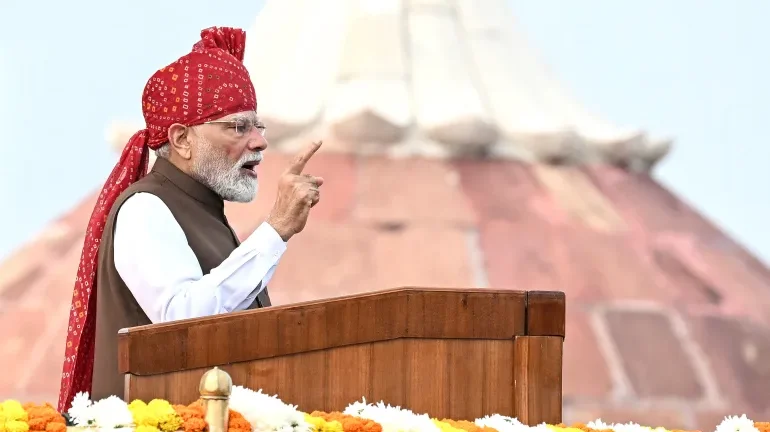
Prime Minister Narendra Modi addresses the nation from the Red Fort on India’s 80th Independence Day, August 15, 2026. Image Credit: Al Jazeera
On Saturday (August 15, 2026), addressing the nation from the ramparts of the Red Fort in New Delhi on the 80th Independence Day, Prime Minister Narendra Modi said India has largely eliminated the armed Maoist rebellion that plagued central and eastern India for decades but warned that the movement’s ideological backers—whom he termed “dimagi Naxals” (intellectual Naxals)—still pose a threat.
Modi alleged that while “weapon-wielding Naxals” have been dealt with in the forests, people with a Maoist mindset remain embedded in different parts of the system and are waiting for opportunities to foment violence, create discord, and drag society “on the wrong path.” He called on citizens to “identify these dimagi Naxal, isolate them, and bring the youth together for a developed country.”
The remarks come just weeks after the youth-led Cockroach Janta Party (CJP) protests over exam scandals emerged as a rare, pan-India challenge to the government and helped force the resignation of Education Minister Dharmendra Pradhan in late July. While Modi did not mention the protests by name, he repeatedly highlighted initiatives for young Indians, including AI skills training and free online coaching for competitive exams.
Why and How the “Intellectual Naxal” Warning Took Shape
Modi’s speech framed Naxalism as a two-phase challenge: first, the armed insurgency that controlled large forested tracts and challenged state authority; second, an ideological residue that he claims continues to influence institutions and policy debates.
“We have succeeded in eliminating armed Naxals in the forests and freeing the nation from that crisis. However, while the armed Naxals are gone, ‘dimagi Naxals’ remain, and those who harbour this mindset are waiting for an opportunity,” Modi said, according to multiple reports of the address. This story was also covered by Al Jazeera.
He alleged that these “intellectual Naxals” are “paving the way for violence and discord” and “employing various tactics to drag society down the wrong path,” adding, “We must identify these ‘dimagi Naxals.’ We need to isolate them and align the nation’s youth with the mainstream effort to transform the country into a developed nation.”
The phrase “dimagi Naxal” echoes the politically charged label “urban Naxal”, a term Modi and leaders of his Bharatiya Janata Party (BJP) have previously used for activists, academics, intellectuals, and other government critics. Rights groups and opposition parties have long argued that such labels are used to vilify dissent and justify crackdowns on civil society, a charge the government has consistently denied.
Key Quotes and Statements From the Speech and Reactions
PM Modi’s core warning:
“We have succeeded in getting rid of armed Naxals in the jungles, but the ‘dimagi Naxals’ are looking for opportunities to create violence and unrest. They want to drag the society on the wrong path. These intellectual Naxals have to be identified and isolated.
On Naxalism’s toll:
“More soldiers from the police and other forces had died due to Naxalism than in the armed forces. We had taken a resolve to make India Naxal-free. Places where the land was bloodied are Naxal-free now.”
On youth and development:
Modi repeatedly returned to the theme of youth empowerment, announcing or highlighting measures such as AI skills training and free online coaching for competitive exams, and reaffirming his government’s goal of turning India into a developed nation by 2047, the centenary of Independence.
Opposition pushback:
The Congress hit back at the “dimaagi Naxal” remark, with senior leader Jairam Ramesh calling it a “sure sign of desperation” and accusing the government of vilifying political opponents and dissenters under the guise of national security. Civil society voices are likely to raise similar concerns about the potential misuse of such language to target activists, academics, and students.
Background
India’s Naxalite movement began in 1967 with an uprising in the village of Naxalbari in West Bengal, growing into a decades-long armed rebellion championing the rights of landless farmers, the rural poor, and Indigenous (Adivasi) communities. Thousands of civilians, rebels, and security personnel died in the conflict, which at its peak controlled significant territories across the so-called “Red Corridor” in central and eastern India.
Over the past decade, the government has claimed major successes against armed Maoist groups through a mix of security operations, development initiatives, and surrenders. Modi’s speech reiterated this narrative, saying areas once “bloodied” by Naxal violence are now “Naxal-free”.
Parallel to the security campaign, the term “urban Naxal” gained traction in political discourse, used by BJP leaders to describe urban-based activists, lawyers, academics, and student leaders accused of supporting or sympathising with Maoist ideology. Critics argue the label has been weaponised to delegitimise dissent, while the government maintains it is a legitimate description of those who allegedly support violent extremism through intellectual and institutional channels.
Timeline
1967: The Naxalite movement begins with an uprising in Naxalbari, West Bengal.
1980s–2000s: Maoist insurgency expands across central and eastern India; thousands killed in conflict between rebels, security forces, and civilians.
2010s: Government intensifies anti-Naxal operations; claims significant territorial gains against armed groups.
Late 2010s–2020s: “Urban Naxal” rhetoric enters mainstream political discourse; activists, academics, and students are targeted in various cases.
July 2026: Cockroach Janta Party-led youth protests over exam scandals force resignation of Education Minister Dharmendra Pradhan.
August 15, 2026: In the Independence Day speech, Modi says armed Naxalism is nearly over but warns of “dimagi Naxals” who must be “identified and isolated.”
Also Read: Air India Orders Mandatory Dope Test for All Pilots After Captain Tests Positive for Marijuana
Why This Matters
Yeh issue kaafi important hai kyunki yeh seedha asar pad raha hai national security narrative, civil liberties, aur political discourse par.
Security vs civil liberties: While curbing armed extremism is widely supported, labelling ideological opponents as “intellectual Naxals” risks blurring the line between violent extremism and legitimate dissent.
Chilling effect on dissent: Academics, activists, and students may self-censor if they fear being branded as “dimagi Naxals”, potentially narrowing the space for debate on policy and governance.
Political messaging: The warning reinforces a broader narrative of the government as a strong defender of national security, while painting critics as anti-national or destabilising elements.
Youth context: Coming after the CJP protests, the emphasis on youth initiatives alongside the “intellectual Naxal” warning signals an attempt to win over young voters while discrediting protest leaders.
India Angle
For Indian audiences, this speech touches multiple fault lines:
Exam protests and trust: The Cockroach Janta Party movement showed how quickly youth anger over exam scandals can escalate into a national confrontation. Modi’s focus on free coaching and AI skills can be seen as both a policy response and a political counter-narrative.
Campus and civil society: Universities, NGOs, and rights groups have often been at the centre of the “urban Naxal” debate. The “dimagi Naxal” warning may embolden further scrutiny or action against such spaces.
Federal dynamics: States with lingering Maoist influence—Chhattisgarh, Jharkhand, Odisha, and Maharashtra—will feel the pressure to align with the “identify and isolate” call, potentially affecting local policing and civil liberties.
Agar yeh rhetoric zyada aggressive ho gayi, toh dissent par asar pad sakta hai, lekin government ka stand clear hai: national security aur development ke naam par ideological opposition ko isolate karna.
Analysis
But beyond search, the narrative is politically layered:
Strategic ambiguity: “Dimagi Naxal” is not legally defined, which gives the state flexibility to apply it broadly—from actual Maoist sympathisers to inconvenient critics.
Youth pivot: After the CJP protests, the government is keen to project itself as pro-youth (free coaching, AI training) while framing protest leaders as ideologically tainted.
Long-term framing: This speech fits into a decade-long pattern where national security, development, and anti-Naxal rhetoric are woven together to consolidate a strongman image.
For follow-ups, newsrooms can track any policy or legal moves invoking “intellectual Naxals”, cases against activists or academics using this language, and how state governments interpret the PM’s warning.
What Next
Rhetorical escalation: Expect more BJP leaders and allied voices to adopt the “dimagi Naxal” frame in debates, social media, and campaigns, especially ahead of key elections.
Pressure on institutions: Universities, NGOs, and media outlets may face heightened scrutiny, with some voices potentially targeted under existing laws (UAPA, sedition-related provisions, or funding probes).
Youth outreach vs protest: The government will likely push its youth schemes hard (free coaching, AI skills) while attempting to delegitimise protest movements as ideologically driven rather than grievance-based.
Opposition and civil society response: Congress, left parties, and rights groups are likely to frame this as an attack on dissent, potentially leading to sharper parliamentary and street confrontations.
Conclusion
Prime Minister Narendra Modi’s 80th Independence Day speech will be remembered less for its development announcements and more for its stark warning against “dimagi Naxals”. By declaring armed Naxalism nearly defeated but portraying its ideological remnants as an ongoing threat, the PM has effectively redrawn the map of dissent: from forest guerrillas to urban intellectuals, activists, and critics.
For supporters, this is a logical extension of national security policy. For critics, it is a dangerous broadening of the “anti-national” label that could chill free speech and target legitimate opposition.
Ab dekhna yeh hai ki yeh rhetoric sirf speech tak seemit rehti hai ya iske baad concrete actions, cases, aur policy shifts aate hain—jo ki India ke democratic space ko define karenge.
Written By A. Jack