India has marked a significant milestone in sustainable transportation by launching its first domestically built hydrogen-powered train in Haryana, reinforcing the country’s commitment to clean energy, self-reliance, and greener railway infrastructure.
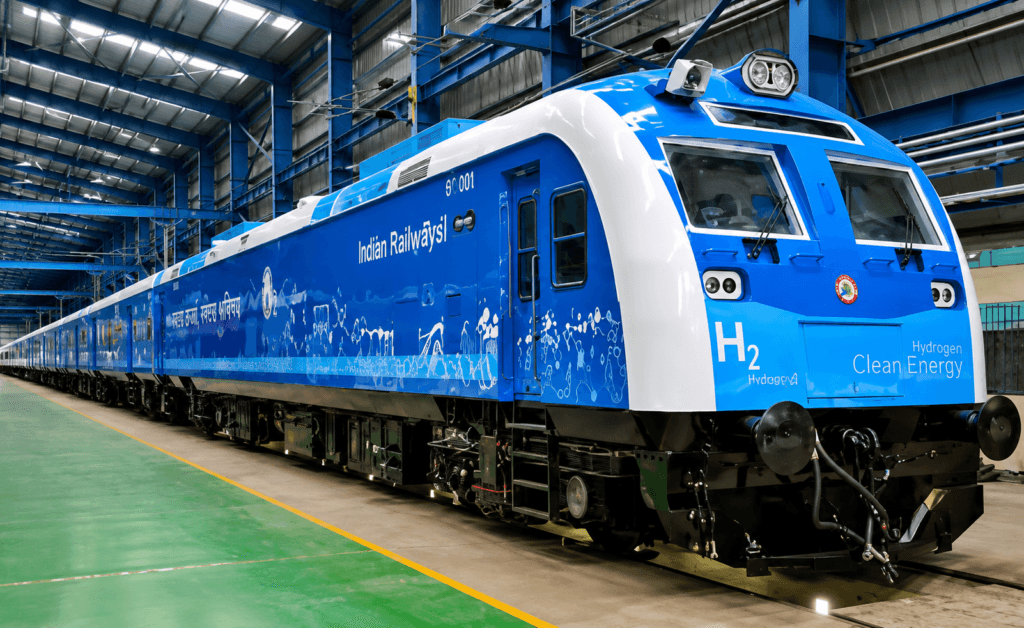
India has formally ushered in an era of green transport through the introduction of the country’s domestically manufactured first hydrogen train. The historical event occurred yesterday at Jind railway station in Haryana when Indian Prime Minister Narendra Modi inaugurated the “NaMo Green Rail.” The venture marks a major step towards upgrading the railway system of India amid attempts to reduce carbon emissions through the adoption of renewable energy technologies.
The launched train is comprised of two hydrogen fuel cells driving engines along with eight coaches used to carry passengers. According to the railway officials, the train is capable of operating at speeds of up to 75 kilometers per hour and can accommodate about 2,600 people. In the beginning, the service will be limited to Haryana only and will function as a test bed of the hydrogen-powered train in India.
In his speech during the inauguration of the train, Prime Minister Narendra Modi hailed the event as a significant step forward on the path towards achieving self-sufficiency and green transport in India.
A Landmark Step Towards Green Mobility
Nevertheless, the launch of India’s first hydrogen train does not mark merely the start of its new train experience. This innovative technology is related to the climate goals of India for coming years.
Hydrogen trains differ from traditional diesel ones because the former generate electricity with the help of hydrogen fuel cells. Hydrogen enters into an electrochemical reaction with atmospheric oxygen inside the fuel cell, creating electricity that will make the train move. As a result of the reaction, no harmful pollutants appear but only water vapor.
Such innovative environmentally friendly technology not only contributes to the decrease of greenhouse gases but also prevents air and noise pollution in those railway sections that have not yet been electrified.
In addition, according to railway officials, there will also be hydrogen storage facilities and refueling infrastructure developed specifically for this pilot project. These facilities are necessary in order to estimate the economic feasibility, operational safety, maintenance and performance of hydrogen-powered trains.
Why India Is Investing in Hydrogen Rail Technology
Indian Railways is one of the most extensive rail systems in the world, serving millions of people every day through thousands of kilometers of track. Although major parts of the railway system have been electrified, there still are some tracks that depend on diesel-engine trains.
In such a case, hydrogen-fueled trains are a very good replacement option, as they do not require any electrification expenses. Therefore, it is especially beneficial for regional and semi-rural railway tracks, as in some cases electrification might be economically unviable in the nearest time.
Furthermore, the introduction of this new technology is going to be useful for implementing the National Green Hydrogen Mission in India that aims at establishing India as a global leader in hydrogen and clean energy production and innovations. In addition to cutting off fossil fuels, India is trying to support its own innovations in the area.
Moreover, the “NaMo Green Rail” technology was developed in India itself as part of the “Make in India” program. The development of railway technologies in India is a very beneficial step for the country’s industry.
Prime Minister Modi’s Statement
The inaugural ceremony was addressed by Indian Prime Minister Narendra Modi, who termed it a milestone moment in the sustainable development process of India.
“This is a very significant day in the direction of self-reliant India and sustainable development,” Prime Minister Narendra Modi wrote on X after the launch of the hydrogen train.
This comment by the leader shows that the government of India attaches great importance to sustainable development as part of economic development.
Global Context
India is yet another nation that has entered the league of many other countries experimenting with hydrogen-powered trains. Countries like Germany, France, China, Japan, Italy, and South Korea have already launched hydrogen trains on some specific railway lines.
Germany was among the first few nations to use hydrogen-powered passenger trains for commercial purposes. These were found to be a success, and many other countries from Europe have joined them to pursue hydrogen rail as part of their efforts against global warming.
The move by India to enter this arena reflects the determination of the country to embrace new-age transport technologies but modify them according to its needs. In light of the vast size of Indian Railways, India may become one of the largest consumers of hydrogen-powered trains in the future.
Background and Timeline
India has gradually increased its investment in sustainable railway transport during the last decade. Indian railways have made considerable investments into electrification of tracks, renewable energy projects, energy-efficient stations and energy-efficient locomotives. A hydrogen-powered train is another step in that direction.
The Indian Government initiated the exploration of hydrogen-powered trains as part of the general plan for clean energy. After engineers and railway specialists designed a pilot project, hydrogen filling stations were built and technical tests were carried out. Now the launch of the train in Haryana enters the operational phase.
During the operational phase of the project, railway authorities will carefully analyze fuel efficiency, costs of maintenance, passenger safety, reliability of operation and other aspects. The experience acquired in the pilot project will be used in the future expansion of the project in other regions of the country.
Why This Matters
India’s first hydrogen train is not only relevant for its railways. Transport continues to be among the biggest sources of greenhouse gases globally, which makes alternative sources necessary.
Using hydrogen-powered trains shows that India is able to develop economically and at the same time preserve the environment. Ye initiative kaafi important hai since it helps to fulfill India’s obligations regarding the climate and promotes innovation.
Using cleaner trains can lead to cleaner air, especially in crowded areas. It will decrease the need for imported fossil fuels and enhance India’s energy security.
Besides, hydrogen technology for rail transportation may inspire using hydrogen in other sectors such as buses, trucks, the maritime industry, and other industries.
India Angle
It is not just a technological feat for Indian people, since Indian railways are the lifeline of Indian transport, linking villages, towns, and metropolitan cities daily.
In case the hydrogen trains become a success, people will experience quiet rides, green stations, and eco-friendly means of transport. It will become possible for rural lines operating diesel trains to become greener without having to electrify immediately.
It will contribute significantly to India’s plans to become the manufacturer of advanced railway technologies. Production of hydrogen trains will provide job opportunities to Indian engineers, scientists, manufacturers, and technologists.
Dekhiye, samajh ke likhiye, toh ye nahi ki ek naya train; ye baat yeh hai ki India apna green future aage badha raha hai.
Analysis
From the standpoint of industry analysis, it is essential to pay special attention to the hydrogen train project in India. Although electrification is the most effective solution in the long term for railway lines that receive a high degree of use, hydrogen-based trains have a great advantage in cases when electrification is unfeasible or too costly.
Piloting of the hydrogen-based trains will give information about how viable these trains are in India’s specific conditions of climate, geography, and passenger flow.
From the point of view of a news writer, I can say that this is an example of the right policy related to sustainable development. The country tries new solutions and technologies by piloting them, which makes it possible to minimize any risks and make proper decisions.
The success of such an innovation would bring recognition for the country as one of the leaders in the field of green transport innovations. As This story is also covered by AP news
What Next
Over the next few months, a lot will depend on how successful the hydrogen train turns out to be. Railway authorities will assess the performance, fuel consumption, maintenance costs, passenger reaction, and the ecological footprint of the train.
In case of success, Indian Railways might think about using more hydrogen-powered trains for those tracks that have not been electrified yet. In order to do so, further investments into the construction of new hydrogen facilities will have to be made.
The experiment can also bring private enterprises into the field of hydrogen technology.
Conclusion
India’s introduction of its first hydrogen-powered train will go down as an important part of its history in transportation. The “NaMo Green Rail” demonstrates how India has embraced sustainable development, innovation in technologies, and a more environmentally responsible approach to development.
While at the present moment it might still be too early to determine just how important and influential this pilot project will be in the long term, its success could have profound implications for rail transportation in the region, help cut down on CO₂ emissions, enhance energy security and place India in the forefront of countries developing hydrogen-powered mobility.
In search of sustainable solutions to the problem of pollution associated with transport, India has made an important step in introducing the hydrogen-powered train.