A 10-member student delegation met a ministerial panel in Ranchi, but assurances that the demands would be considered did not satisfy protesters, who are seeking a CBI inquiry or a probe by retired High Court judges.
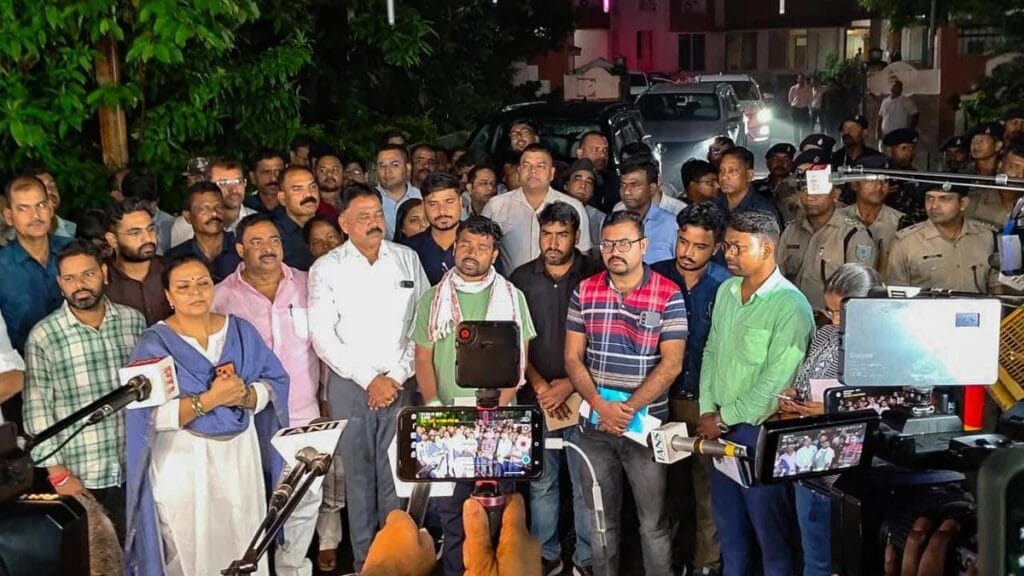
Students gather at Jaipal Singh Munda Stadium in Ranchi during the ongoing protest over alleged irregularities in JPSC and JSSC recruitment examinations. Image Credit: The Hindu
Jharkhand’s recruitment examination protest continued on Friday despite the first formal meeting between student representatives and the state government. A 10-member delegation of the JPSC-JSSC Reforms Manch met a ministerial panel led by Higher and Technical Education Minister Sudivya Kumar in Ranchi to discuss alleged irregularities in competitive examinations for government jobs.
The meeting was described as positive and cordial by both sides, but the discussion did not produce a decision on the protesters’ central demands. Students said the agitation would continue until the government announces concrete steps, including cancellation of the 14th Jharkhand Public Service Commission Combined Civil Services examination and an independent investigation into alleged malpractice.
The protesters have warned that they will march to the Jharkhand Assembly on August 10 if the state government does not provide a satisfactory response by Sunday. The protest has entered its 14th day, with six demonstrators continuing a hunger strike.
What happened during the first talks?
The student delegation met the government’s ministerial panel at the State Guest House in Ranchi on Friday evening. The panel included Higher and Technical Education Minister Sudivya Kumar Sonu and other ministers, including Dipika Pandey Singh.
The meeting followed several days of disagreement over who should represent the protesting students. The students had initially formed an 11-member group that included student representatives, an advocate and technical experts. The government objected to the presence of non-student members and said it would hold talks only with student representatives.
The protesters later revised the delegation to include student leaders alone. The final group included Ravindra Paswan, Piyush Kumar, Rajesh Prasad, Neetu Kujur, Ankit Raj, Kartik Soren, Shalu Kumari and other student representatives. This story was also covered by The New IndianExpress.
After the meeting, student delegation leader Ravindra Paswan said discussions were held in a positive atmosphere, but the protest would continue until all demands were addressed.
“The meeting with the Jharkhand government was held in a positive atmosphere. It assured us that our demands would be considered. However, we have decided to continue our protest till all our demands, including cancellation of the 14th JPSC examination, are met,” Paswan told reporters.
The government’s representatives said they were sensitive to the students’ concerns and would examine their demands.
“We met the delegation of student protesters. The government is sensitive to their demands and is ready to consider them sympathetically. The outcome will be visible soon,” Minister Sudivya Kumar said.
Why the talks failed to end the protest
The main reason for the deadlock is the difference between a promise to consider demands and a binding decision on them. The government has offered dialogue and said the grievances will be examined, but students want a clear timeline and an immediate announcement on the 14th JPSC preliminary examination.
The protesters are asking for:
Cancellation of the 14th JPSC Combined Civil Services examination.
A fresh examination conducted under transparent conditions.
A CBI investigation into alleged irregularities.
An alternative probe by retired High Court judges from outside Jharkhand if the CBI inquiry is not accepted.
Investigation into the JSSC Combined Graduate Level examination and other recruitment tests.
A fast-track court for recruitment-related cases.
Reforms in the Jharkhand Public Service Commission and Jharkhand Staff Selection Commission.
A fixed examination and recruitment calendar.
Students say a state-level investigation will not be sufficient because the allegations involve recruitment bodies and agencies connected to the state administration. They argue that a central agency or external judicial panel would be more credible.
Yeh issue kaafi important hai because talks without a written commitment may not restore trust among candidates who believe the recruitment system has failed them.
Government’s position
Chief Minister Hemant Soren had earlier said that his government was ready to hold discussions with students and would pursue reforms based on their concerns.
“We are ready to hold talks. Every student in the state is welcome to place their grievances before us. We will move ahead with strong reforms in line with students’ demands,” Soren said.
Minister Dipika Pandey Singh said the students’ demands had been conveyed to the Chief Minister.
“The Chief Minister is concerned about students and an outcome will come soon,” she said.
The state government has already taken several steps in response to the controversy. The Criminal Investigation Department is investigating the alleged irregularities, several people have been arrested and JPSC chairman L Khiangte resigned on July 22. The Commission also postponed the Main examination.
However, the government has not accepted the demand for an immediate CBI investigation or announced the cancellation of the preliminary examination.
A separate student group also seeks talks.
Another group of protesters led by Devendra Mahto has also received an invitation from the government and submitted the names of an eight-member delegation for discussions.
Mahto has been on hunger strike for several days, and the condition of some protesters has reportedly become a concern. Reports said six people were continuing the fast as the protest entered its 14th day.
The existence of multiple groups creates a further challenge for the government. While the JPSC-JSSC Reforms Manch is leading the main sit-in, other organisations and activists are also participating in the broader agitation.
The government may need to speak with each significant group or create a common platform for negotiations. If different delegations receive different assurances, confusion could deepen.
The main student body has also clarified that it was not part of a march organised by AISA and AISF, although it welcomed moral support from other organisations. This shows that protesters want to retain control over the movement and avoid being seen as an extension of a political party.
Background to the JPSC-JSSC controversy
The protest began after allegations emerged over the 14th JPSC Combined Civil Services preliminary examination. Candidates questioned the results and raised concerns about answer sheets, evaluation and the overall selection process.
The allegations have not been conclusively established by an independent inquiry. However, they created enough suspicion to trigger a CID investigation and widespread protests.
The dispute later widened to include the JSSC Combined Graduate Level examination and other recruitment tests. Students say the current issue reflects a longer pattern of recruitment delays, postponed examinations, unclear results and a lack of transparency.
The JPSC chairman’s resignation and the postponement of the Main examination have failed to satisfy aspirants because the status of the preliminary result remains uncertain.
If the preliminary test is cancelled, thousands of candidates may have to prepare again. If it is allowed to stand, candidates who believe the process was compromised may challenge the decision legally.
Hunger strike and Assembly march
The protesters have said the movement will continue at Jaipal Singh Munda Stadium. The hunger strike has added urgency to the dispute because prolonged fasting can create serious health risks.
Students have warned that they will march to the Jharkhand Assembly on August 10 if the government does not take concrete steps by Sunday. A similar Assembly march had already been announced by student organisations, and authorities have imposed restrictions around the Assembly complex during the Monsoon Session.
The proposed march could increase pressure on the government but may also create a law-and-order challenge. The administration will need to ensure that the protest is handled peacefully and that students’ right to demonstrate is balanced with security requirements around the Assembly.
The student body has described the proposed march as a democratic step to press for accountability. The government is likely to monitor the situation closely over the weekend.
Timeline
April 2026: The 14th JPSC Combined Civil Services preliminary examination is held.
July 2026: Results declared; candidates raise allegations regarding the selection process.
July 22: JPSC chairman L Khiangte resigns.
July 25: Student protest begins in Ranchi.
July 29: Protesters begin an indefinite sit-in at Jaipal Singh Munda Stadium.
August 6: Student protest enters its 13th day; groups prepare for talks with the government.
August 7: Revised 10-member delegation meets a ministerial panel; talks end without a final decision.
August 10: Protesters plan a march to the Jharkhand Assembly if no concrete action follows.
Also Read: Jharkhand Exam Protest: Students Form 11-Member Team to Hold Talks With Government
Why This Matters
This matters because public recruitment examinations are a key route to stable employment in Jharkhand. Candidates invest years of preparation, coaching fees and family resources in the hope of securing government jobs.
If the examination system is seen as unreliable, the impact extends beyond one result. It damages confidence in public institutions, discourages talented candidates and creates anger among young people already facing limited employment opportunities.
It also matters for the state administration. Government vacancies affect schools, police departments, health services and other public institutions. Delayed recruitment can reduce the capacity of departments to provide services.
For the government, the protest is a test of how it handles youth grievances. A transparent and time-bound response could reduce tensions. Vague assurances may prolong the agitation.
In simple Hinglish, students ko sirf sympathy nahi, clear action plan chahiye.
India angle
For Indian readers, the Jharkhand protest reflects a national concern over examination integrity. Paper leaks, delayed results, disputed answer keys and recruitment cancellations have affected aspirants in several states.
The demand for a CBI probe shows how citizens often seek central agencies when they distrust state-level investigations. At the same time, such demands create pressure on governments to strengthen their own institutions and make investigations visibly independent.
The issue is also linked to India’s employment crisis. Government jobs remain highly desirable because they offer stability, regular income and social security. A recruitment controversy can therefore become a major political issue, especially among young voters.
The movement may also influence other states. If Jharkhand students secure a re-examination or independent probe, aspirants elsewhere may adopt similar strategies when they believe examinations were compromised.
Analysis
The dispute is now about trust. The government believes its assurance that demands will be considered should be enough to begin a process. Students believe that the state has already had sufficient time to respond and that further delay risks weakening the movement.
The government should release a written communication outlining the next steps. It should clarify whether the preliminary exam will be reviewed, who will oversee the process and when a decision will be announced.
A balanced solution could involve an independent committee of retired judges and examination experts. Such a committee could examine the evidence before recommending whether to cancel the exam. This approach may not satisfy students immediately, but it would provide a transparent process.
The proposed Assembly march should also be handled through dialogue rather than confrontation. Police restrictions alone will not resolve the issue.
What Next
The immediate next step will be the government’s response before the August 10 deadline set by protesters. Ministers may meet student representatives again or announce a committee to examine the allegations.
The state will also need to decide whether to accept the CBI demand. If it declines, it may need to offer a credible alternative, such as an independent panel of retired High Court judges from outside Jharkhand.
The status of the 14th JPSC preliminary examination will remain the central issue. Possible outcomes include allowing the result to stand, conducting a detailed audit, cancelling the examination or ordering a fresh test.
The government must also address the health of students on hunger strike. Medical teams should monitor the protesters, and officials should prevent the situation from becoming dangerous.
Long term, JPSC and JSSC will require reforms involving secure question-paper systems, independent evaluation, third-party audits, fixed calendars and clear grievance procedures.
Conclusion
The first round of talks between the Jharkhand government and protesting students ended on a cordial note but failed to end the JPSC-JSSC recruitment dispute. Students remain firm on their demand for cancellation of the 14th JPSC examination and an independent probe into alleged irregularities.
The government has promised sympathetic consideration, but protesters want a written, time-bound decision. Their warning of an Assembly march on August 10 has increased pressure on Chief Minister Hemant Soren’s administration.
The path forward requires more than dialogue. The state must provide credible evidence, an independent review mechanism and a clear decision on the disputed examination. Until that happens, the protest is likely to continue, with students viewing the movement as a fight for fairness, accountability and their future.
Written By A. Jack