The delegation includes student representatives, a lawyer and technical experts, but proposed talks have faced delays after the government questioned its composition and students insisted that discussions be transparent.
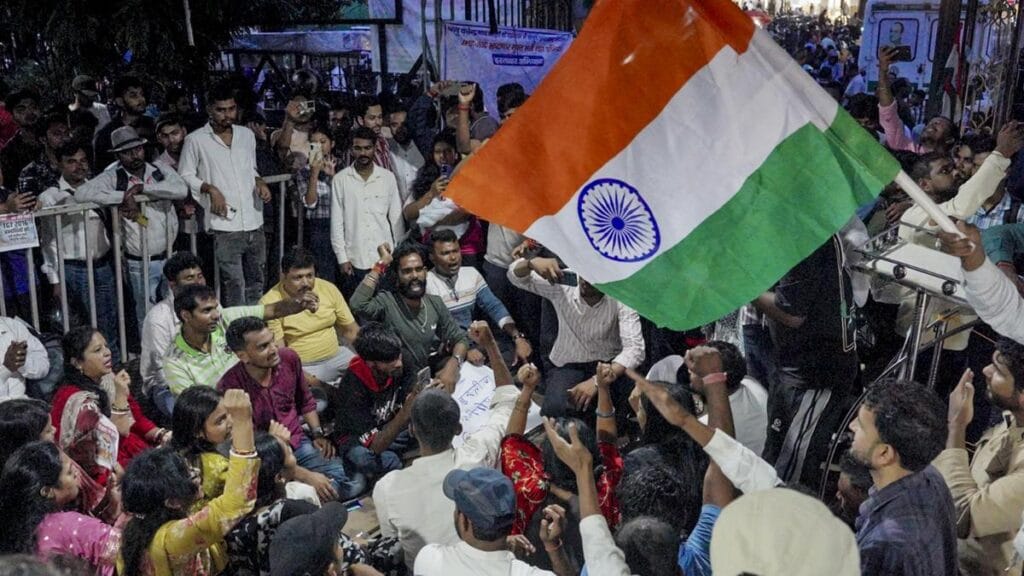
Students gather at Jaipal Singh Munda Stadium in Ranchi during the 13-day protest over alleged irregularities in JPSC and JSSC recruitment examinations. Image Credit: The Hindu
Hundreds of students and government job aspirants protesting in Ranchi have formed an 11-member delegation to hold talks with the Jharkhand government over alleged irregularities in competitive recruitment examinations. The move follows an invitation from the Hemant Soren government, which offered to discuss the students’ concerns after nearly two weeks of demonstrations at Jaipal Singh Munda Stadium.
The protest began on July 25 and entered its 13th day on Thursday. Students are demanding an independent inquiry into alleged malpractice in the Jharkhand Public Service Commission Combined Civil Services Examination, the Jharkhand Staff Selection Commission Combined Graduate Level examination and other recruitment tests conducted in the state.
The delegation was formed after the government sought discussions with a smaller group of student representatives. The student side decided to include wider representation, including legal and technical voices, to ensure that the allegations and demands were presented in detail. Reports said the proposed talks later faced a hurdle after officials objected to the presence of journalists and a legal representative in the delegation.
Who is in the delegation?
Reports differ slightly on the precise composition of the team, but the delegation was described as including student representatives, a legal expert and technical advisers. One reported arrangement consisted of eight student representatives, two journalists and one advocate, while another account described the group as involving students, a lawyer and technical experts.
Student leaders have argued that the wider group is necessary because the protest involves several complex issues:
Examination procedure and answer-sheet verification.
Legal questions relating to cancellation and re-conduct of examinations.
Technical aspects of question-paper distribution and digital systems.
Alleged irregularities in the appointment of examination agencies.
The need for long-term reforms in JPSC and JSSC.
The students have said that the journalists and legal representative would act as advisers or observers, while the student representatives would present the formal demands. The government, according to reports, preferred to hold talks only with student representatives. This story was also covered by The Hindu.
That disagreement has temporarily delayed the proposed dialogue. The student side has insisted that the delegation already finalised at the protest site should represent the movement.
What are the students demanding?
The principal demand is a CBI investigation into alleged irregularities in competitive examinations conducted by JPSC, JSSC and associated agencies. Students say they do not trust the state-level CID investigation and want a central agency or a panel of retired High Court judges from outside Jharkhand to examine the allegations.
The protesters have also demanded:
Cancellation of the 14th JPSC Combined Civil Services preliminary examination.
Re-conduct of the examination under secure and transparent conditions.
A probe into the JSSC Combined Graduate Level examination.
Investigation into the role of agencies involved in conducting the tests.
A fast-track court for recruitment-related cases.
A fixed calendar for examinations and appointments.
Structural reforms in JPSC and JSSC.
Greater transparency in question-paper setting, distribution and evaluation.
The protest movement says the controversy is not limited to one examination. Aspirants have alleged repeated delays, inconsistent schedules, unclear results and irregularities in recruitment processes over several years.
Yeh issue kaafi important hai because government exams decide the careers of thousands of young people who often prepare for several years before getting one opportunity.
How the talks began
The Jharkhand government began reaching out to the protesters after the agitation continued despite rain and hunger strikes. Senior district officials visited the protest site and conveyed an invitation for a delegation to meet Chief Minister Hemant Soren at his residence.
The government initially proposed a five-member group. Student leaders sought time to consult other protesters and decide who should attend. They later formed an 11-member team, saying the talks needed to be transparent and inclusive.
The protesters also insisted that the discussions should take place in the presence of the media or with a publicly recorded account of the proceedings. Their concern is that closed-door negotiations could lead to misunderstandings or different versions of what was promised.
For the government, a smaller delegation may make negotiations easier and faster. For the students, a larger team offers legitimacy and ensures that the concerns of different sections of the movement are represented.
This disagreement reflects a larger trust gap. Students are not simply requesting a meeting; they want guarantees that the dialogue will produce a written decision rather than another verbal assurance.
Background to the JPSC-JSSC controversy
The current agitation intensified after the results of the 14th JPSC Combined Civil Services preliminary examination were announced. Candidates questioned the results and circulated claims about possible discrepancies in answer sheets and evaluation.
The allegations have not been conclusively proved in court or through a completed independent investigation. However, they were serious enough for the state government to order a Criminal Investigation Department inquiry.
More than a dozen people have reportedly been arrested in connection with the wider investigation. JPSC chairman L Khiangte resigned on July 22, and the Commission postponed the Main examination after the controversy grew.
The students say these steps are not enough. They argue that the chairman’s resignation does not establish accountability and that postponing the Main examination leaves candidates in uncertainty without resolving the status of the preliminary test.
The protest has also expanded to include the JSSC Combined Graduate Level examination and other state recruitment tests. Students want the government to examine the complete recruitment system rather than focus on one result.
Hunger strike and political support
The protest has included hunger strikes by several students and supporters. Political activist Devendra Nath Mahto has been among those fasting, and reports said six demonstrators were on hunger strike as the agitation entered its 13th day.
The movement has also received support from opposition leaders and the Cockroach Janta Party, a youth-led organisation that recently backed student protests in Delhi over alleged examination irregularities.
Opposition parties have used the Ranchi agitation to criticise the Hemant Soren government. At the same time, the issue has become part of a wider national debate over examination integrity, unemployment and the treatment of student protesters.
Political support can increase pressure on the government, but it can also make negotiations more complicated. The state will need to reassure students without allowing the issue to become a prolonged political confrontation.
Timeline
April 2026: The 14th JPSC Combined Civil Services preliminary examination is conducted.
July 2026: Results announced; candidates raise allegations about answer sheets and the selection process.
July 22: JPSC chairman L Khiangte resigns.
July 25: Students begin protesting in Ranchi.
July 29: Demonstrators begin an indefinite sit-in at Jaipal Singh Munda Stadium.
August 5: State officials invite student representatives for talks with Chief Minister Hemant Soren.
August 6: Students form an 11-member delegation.
August 7: Proposed talks face a temporary hurdle over the government’s objection to the delegation’s composition.
Also Read: Why Are Jharkhand Students Protesting? Inside the JPSC, JSSC Recruitment Row and CBI Demand
Why This Matters
This matters because the protest is about more than a delayed examination. It is about whether young people can trust public recruitment institutions to select candidates fairly.
Government jobs are highly sought after in Jharkhand because they provide stable employment, regular income and social security. Candidates often spend years preparing for competitive examinations while their families support coaching, accommodation and study expenses.
If a paper leak or answer-sheet manipulation is established, candidates who prepared honestly could lose their opportunity. If allegations remain unresolved for months, even successful candidates may face doubts about the legitimacy of their selection.
The dispute also affects state administration. Delayed recruitment leaves vacancies in government departments and can weaken the delivery of public services. Teachers, police personnel, clerks and administrative officers are needed to keep government systems functioning.
For the students, the message is clear: talks alone will not end the agitation. They want a written commitment and a time-bound action plan. In simple Hinglish, students ko meeting nahi, meaningful decision chahiye.
India angle
For Indian readers, the Jharkhand movement reflects a broader national concern about competitive examinations. From civil services to medical entrance tests and staff-selection exams, paper leaks and delays have created insecurity among young aspirants.
The issue is particularly serious in states where private-sector jobs are limited. Government employment is seen as a secure path for middle-class and lower-income families, so exam uncertainty can create financial and emotional stress.
The demand for a CBI inquiry also highlights a recurring problem in Indian governance. Citizens often turn to central agencies when they believe that state-level institutions may not be independent enough. Whether a CBI probe is appropriate in this case will depend on legal and administrative decisions, but the demand itself shows how far public trust has fallen.
The protest could also influence recruitment reforms in other states. If Jharkhand creates a transparent system with independent monitoring, secure digital paper delivery and fixed examination calendars, it could offer a model for other recruitment bodies.
Analysis
The government’s decision to initiate dialogue is positive, but it must go beyond managing the protest. Officials should place concrete options before the students, including the legal basis for a re-examination, the status of the CID probe and a timeline for publishing findings.
The dispute over who attends the talks may appear procedural, but it represents a deeper issue of trust. If students believe the government is trying to control the format, negotiations may fail before the substantive discussion begins.
A practical solution could involve a formal meeting with student representatives, while allowing a lawyer and technical experts to attend as advisers or observers. The proceedings could be minuted and a written summary released to the public.
What Next
The immediate next step will be deciding the composition and format of the government-student dialogue. If both sides compromise, the delegation could meet state officials and present a written list of demands.
The government may also create a committee to examine the 14th JPSC preliminary examination, the JSSC-CGL test and the role of examination agencies. The committee’s credibility will depend on its independence, expertise and willingness to publish findings.
Students have indicated that the protest will continue until the government takes a concrete decision. If talks produce no commitment, the agitation could intensify through further hunger strikes, an Assembly march or support from opposition parties.
The state will also need to decide whether the 14th JPSC preliminary exam should be cancelled and conducted again. A decision without a transparent investigation could lead to further litigation and renewed protests.
Long term, JPSC and JSSC will need to improve their systems through secure question-paper storage, third-party audits, biometric candidate verification, independent evaluation and a fixed annual recruitment calendar.
Conclusion
The formation of an 11-member student delegation marks a crucial moment in Jharkhand’s prolonged JPSC-JSSC recruitment protest. After 13 days of demonstrations, hunger strikes and political pressure, students have agreed to enter talks with the government, but they have made clear that the agitation will continue until concrete action follows.
The immediate challenge is to resolve the disagreement over the delegation and begin transparent negotiations. The larger challenge is to restore trust in Jharkhand’s recruitment system.
For students, the issue is about fairness, careers and the right to compete on equal terms. For the government, it is a test of accountability and crisis management. A written, time-bound response could begin resolving the dispute; another round of vague assurances could deepen it.
Written By A. Jack