The protest entered its 15th day in Ranchi as student groups rejected broad assurances and demanded concrete action on alleged irregularities in JPSC and JSSC examinations.
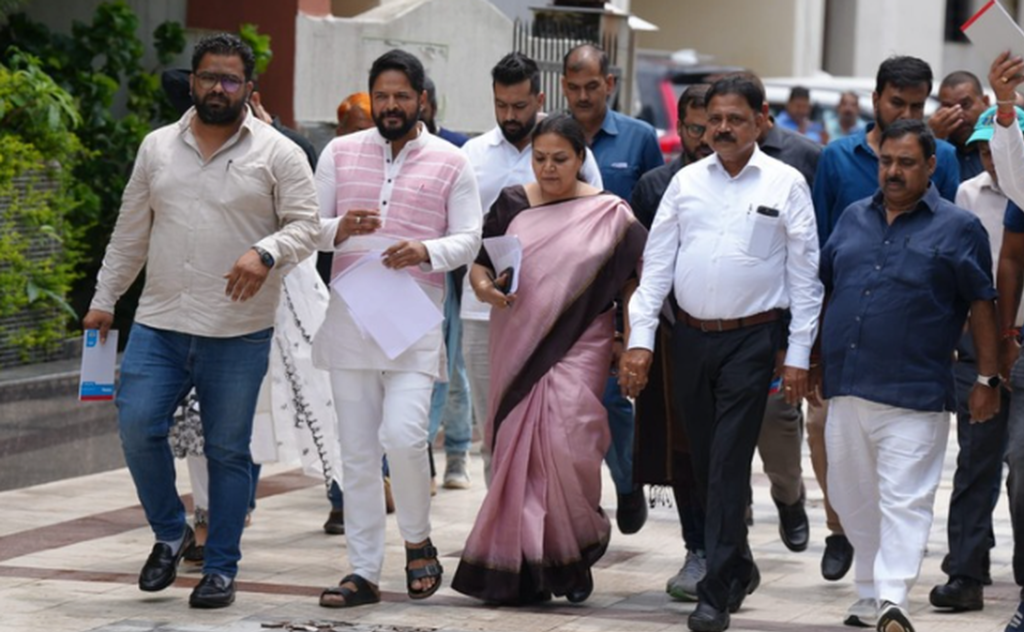
The Jharkhand government talks with a delegation of protesting job aspirants of the Devendra Nath Mahto faction over an alleged paper leak. Image Credit: The Hindu
The prolonged protest by Jharkhand government job aspirants entered its 15th day on Saturday, with no breakthrough in talks between the state government and another group of student protesters. The agitation is being led under the banner of the JPSS-JSCC Reform Manch and related candidates’ forums, which have accused the Jharkhand Public Service Commission and Jharkhand Staff Selection Commission of irregularities in competitive recruitment examinations.
The government held discussions with a second student faction after an earlier meeting also failed to end the protest. Minister Sudivya Kumar Sonu said the government was committed to speaking with all student groups and stakeholders. He also announced a dedicated email address for suggestions on reforms to the state’s examination system.
The students, however, maintained that the protest would continue until the government takes concrete action. Their principal demands include cancellation of the 14th JPSC preliminary examination, an independent inquiry by the Central Bureau of Investigation or retired High Court judges from outside Jharkhand, and action against those responsible for alleged malpractice.
What happened in the second round of talks?
An eight-member delegation from the JPSC-JSSC Candidates’ Forum or related aspirants’ group travelled from the protest site at Jaipal Singh Munda Stadium to the State Guest House in Morabadi for discussions with the government.
The meeting began after the government invited a second faction of the protest movement for talks. The move came amid disagreements over the composition of the student delegation and the scope of the earlier discussions.
The students told the government that the 14th JPSC examination must be cancelled and that the alleged irregularities in recruitment tests must be investigated independently. They also demanded a clear timeline for decisions.
After the meeting, the student delegation said the government had assured them that their concerns would be examined quickly. However, the assurance did not lead to a suspension of the protest.
The protesters said a decision to merely consider their demands was not enough. They want a written commitment, clarity on the investigation and a final decision on the disputed examination. This story was also covered by TheHindu.
The government, meanwhile, said it wanted to consult all sections of the student movement before formulating a policy. This approach has created a further gap between the two sides: the government is seeking a broad consultation process, while students are demanding action on an immediate examination dispute.
The government announces an email for suggestions.
Minister Sudivya Kumar Sonu said the state government had released a dedicated email address to collect suggestions from students, candidates and other stakeholders.
The government has invited recommendations for reforms in the JPSC and JSSC examination systems. It said the suggestions would be reviewed before a policy framework is prepared.
“We will continue to meet with various student groups and stakeholders,” the minister said. “We will meet with all of them. Additionally, we are releasing an email ID. Any student, individual or stakeholder can send suggestions to this address, and we intend to formulate a reform policy and reach a collective decision based on everyone’s input.
The initiative is intended to show that the government is willing to hear candidates beyond the main protest group. It could also help the administration gather complaints and recommendations from students across the state.
However, the protest leaders see the email process as a long-term reform mechanism rather than an answer to the immediate controversy. They argue that the government must first decide what will happen to the 14th JPSC preliminary examination.
Students’ main demands
The students are demanding a comprehensive response to alleged irregularities in several recruitment examinations.
The students say the issue is not limited to one result. They have raised concerns about delays, postponed examinations, disputed answer sheets, recruitment agencies and the wider functioning of JPSC and JSSC.
The allegations have not been conclusively established through a completed independent investigation. The purpose of the probe will be to determine whether the examination process was compromised and whether candidates were unfairly benefited or excluded.
Why the protest has continued for 15 days
The protest began on July 25 and has continued at Jaipal Singh Munda Stadium despite rain, fatigue and health concerns. Several students have been participating in hunger strikes, increasing pressure on the government to respond quickly.
The agitation intensified after the government’s earlier measures failed to satisfy candidates. The resignation of JPSC chairman L Khiangte, the Criminal Investigation Department investigation and the postponement of the Main examination were seen as important developments, but the students said they did not resolve the central dispute.
The protesters want the government to state clearly whether the preliminary examination will be cancelled or allowed to stand.
If the exam is cancelled, thousands of candidates will need to prepare again. If it is not cancelled, candidates who suspect irregularities may continue challenging the result. Either decision will have legal and administrative consequences.
Yeh issue kaafi important hai because every additional day of uncertainty affects the career plans of thousands of aspirants.
Also Read: No Breakthrough in First Talks; Jharkhand Students Continue JPSC Protest
Background to the JPSC-JSSC row
The controversy began after the results of the 14th JPSC Combined Civil Services preliminary examination were announced. Candidates raised questions about the results and circulated claims relating to answer sheets and the performance of selected applicants.
The state government ordered a CID investigation, and several people were reportedly arrested in connection with the wider allegations. JPSC chairman L Khiangte resigned on July 22, and the Commission postponed the Main examination.
The controversy later expanded to include other examinations conducted by JSSC, including the Combined Graduate Level examination.
Students say the current crisis reflects a longer pattern of recruitment problems in Jharkhand. They allege that examinations are repeatedly delayed, schedules are changed without sufficient notice and grievances are not resolved through a transparent system.
The government has said that the concerns are genuine and that it is willing to consider reforms. But students want the immediate examination dispute addressed before discussing long-term policy changes.
Timeline
April 2026: The 14th JPSC Combined Civil Services preliminary examination is held.
July 2026: Results are announced; candidates raise allegations about the evaluation and selection process.
July 22: JPSC chairman L Khiangte resigns.
July 25: Students begin an indefinite protest in Ranchi.
July 29: Demonstrators gather at Jaipal Singh Munda Stadium.
August 7: The First round of government-student talks ends without a final decision.
August 8: Talks with another student faction also fail to break the deadlock.
August 8: The Government announces a dedicated email address for suggestions on recruitment reforms.
August 10: Protesters have threatened a march to the Jharkhand Assembly if concrete action is not taken.
Also Read: Piyush Mishra Joins Jharkhand Students’ Protest, Sings ‘Aarambh Hai Prachand’ in Ranchi
Political and public impact
The protest has become a political issue in Jharkhand. Opposition parties have demanded a court-monitored CBI investigation and criticised the government for failing to resolve the dispute.
Student organisations, youth groups and political activists have also joined the movement. Actor and singer Piyush Mishra recently visited the protest site, spoke about the students’ suffering and sang “Aarambh Hai Prachand” for the protesters.
The involvement of public figures has brought national attention to the agitation. But it has also increased the risk that the original examination issue may become part of a wider political confrontation.
The government needs to ensure that talks remain focused on recruitment reforms and evidence. Students, meanwhile, must maintain a peaceful protest while continuing to present documented complaints.
Why This Matters
This matters because government recruitment examinations are among the most important opportunities for social mobility in Jharkhand. A government job can provide stable income and security for an entire family.
If the process is viewed as unfair, candidates lose faith not only in JPSC and JSSC but also in the broader public administration system.
The issue also affects government functioning. Delayed recruitment leaves vacancies in departments such as education, policing, health and administration. Those vacancies can affect public service delivery.
The protest is also important because it shows the growing confidence of student movements in India. Young aspirants are increasingly using demonstrations, social media, hunger strikes and public campaigns to demand accountability.
In simple Hinglish, students apne future ke liye lad rahe hain, aur unki demand ko sirf political issue samajhna sahi nahi hoga.
India angle
For Indian readers, the Jharkhand protest reflects a national crisis involving competitive examinations and employment. Paper-leak allegations, disputed answer keys, delayed results and cancelled examinations have affected students in several states.
Government jobs remain highly competitive because private-sector opportunities are unevenly distributed. In many regions, a single recruitment examination may attract candidates from thousands of families.
The demand for a CBI investigation also highlights the role of public trust. When students believe a state agency may not be independent enough, they seek a central investigation or judicial oversight.
The government’s dedicated email initiative could become useful if it is properly monitored and followed by public action. But an email address alone cannot replace a formal inquiry into a disputed examination.
Analysis
The decision to speak with different factions is understandable because the movement includes several student groups. However, separate negotiations can also create confusion and weaken trust if different groups receive different assurances.
The government should establish a single formal consultation process with representatives from all major student organisations. The proceedings should be documented, and the administration should release a written summary of the decisions taken.
The email address for suggestions may help with long-term reforms, but the immediate question remains the validity of the 14th JPSC examination. The government cannot avoid that decision by shifting the discussion entirely toward future policy.
A credible independent committee could examine the examination data, answer sheets, question-paper process and role of the examination agency. Its findings should be published within a fixed deadline.
What Next
The immediate next step will be the government’s response to the students’ demands and the proposed Assembly march on August 10. Authorities may invite further talks with the main protest group and other student organisations.
The government will also need to decide whether to order a CBI inquiry or create a judicially supervised alternative. If it rejects the CBI demand, it must explain why and present a credible replacement.
The future of the 14th JPSC preliminary examination will remain the central issue. Possible options include allowing the result to stand after a review, cancelling the exam, conducting a retest or cancelling only affected centres if evidence supports that approach.
Students are likely to continue their sit-in and hunger strike until a decision is announced. Their health will need to be monitored, particularly because prolonged fasting can create serious medical risks.
Long term, the government will need to introduce reforms in question-paper security, recruitment calendars, evaluation systems, grievance redressal and independent audits.
Conclusion
Jharkhand’s JPSC-JSSC student protest entered its 15th day on August 8, with talks between the government and another faction of aspirants ending without a breakthrough. The government’s decision to create a dedicated email address for policy suggestions is a step toward wider consultation, but it has not addressed the students’ immediate demands.
The protesters continue to seek cancellation of the 14th JPSC examination, an independent probe and action against those responsible for alleged irregularities. Their planned Assembly march on August 10 could increase pressure on the Hemant Soren government.
The path forward requires more than sympathetic assurances. The state must provide a clear, written and time-bound response while ensuring that the investigation remains independent and evidence-based. Until then, the protest is likely to continue as a major movement for fair recruitment and youth accountability in Jharkhand.
Written By A. Jack