Jharkhand students continue indefinite protest in Ranchi demanding CBI probe into JPSC, JSSC recruitment irregularities; CID arrests officials, JPSC chief resigns, but aspirants say only central investigation will ensure fairness.
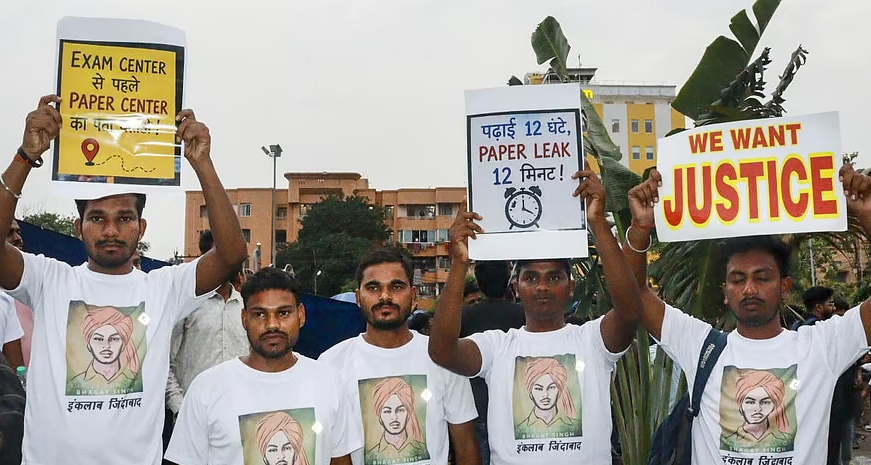
Hundreds of government job aspirants stage an indefinite sit-in protest in Ranchi amid heavy rain. Image Credit: Deccan Herald
Hundreds of government job aspirants in Jharkhand have been protesting indefinitely in Ranchi for over a week, braving heavy rain to demand a CBI probe into alleged irregularities in state recruitment examinations, particularly the 14th JPSC Combined Civil Services Examination. The protests intensified after the preliminary results were declared in early July, with aspirants alleging manipulation in the selection process, paper leaks and lack of transparency.
While the Jharkhand government has directed the CID to form a Special Investigation Team (SIT) and the JPSC Chairman L Khiangte resigned from his post on July 22, students say the action taken so far does not address their primary demand for a CBI investigation. Protesters argue that an independent central agency should investigate the alleged irregularities to ensure a fair and impartial probe, as they believe state agencies may not be fully autonomous given the political and administrative pressures.
Why and how the recruitment row erupted
The immediate trigger for the protests was the controversy surrounding the 14th JPSC Combined Civil Services Examination. As per media reports, the Commission had advertised 103 vacancies, and shortlisted 2,204 candidates for the Main examination after declaring the preliminary results in early July. However, soon after the results, aspirants began alleging irregularities, including questions being repeated, answer keys being manipulated and certain candidates being favoured.
Following the allegations, the Jharkhand government directed the Criminal Investigation Department (CID) to constitute a Special Investigation Team (SIT) to probe the matter. As part of the ongoing investigation, the CID has arrested several people, including JPSC Deputy Examination Controller Shweta Gupta and others allegedly linked to the recruitment process. The Commission has also postponed the 14th JPSC Civil Services Main Examination, along with several other recruitment examinations, saying fresh dates will be announced later. This story was also covered by The Deccan Herald.
Despite these developments, students have continued their indefinite sit-in protest, saying the action taken so far does not address their primary demand for a CBI investigation. They argue that while the CID probe is a step forward, it is not enough to restore confidence in the system.
Yeh issue kaafi important hai because it involves the future of thousands of young aspirants and the credibility of the state’s entire recruitment ecosystem.
Statements from protesters and officials
Student leaders have consistently said that the agitation is not limited to the 14th JPSC. They claim that similar allegations of delays, opacity and irregularities have plagued other recruitment drives conducted by the Jharkhand Staff Selection Commission (JSSC) and other state bodies over the years.
“Students say the protest reflects years of alleged delays, lack of transparency and irregularities across the state’s recruitment system,” one protester told local media. “We want a CBI probe because only an independent central agency can ensure a fair and impartial investigation.”
On the government side, officials have defended the CID probe as a serious and credible mechanism. However, they have not ruled out the possibility of a CBI investigation if the SIT’s findings warrant it. The resignation of JPSC Chairman L. Khiangte is seen as an acknowledgement of the gravity of the situation, though students say it does not substitute for a thorough, independent probe.
Background and context
Recruitment scams and examination controversies are not new in India, but they strike a particularly sensitive chord in states like Jharkhand, where government jobs are seen as a primary route to social mobility and economic security. The JPSC and JSSC are responsible for recruiting candidates to civil services, police, clerical and other government posts, and any perception of unfairness can trigger widespread unrest.
In recent years, several states have faced similar controversies, from paper leaks to answer key manipulations to allegations of favouritism. In some cases, courts have ordered re-examinations or CBI probes. In others, state agencies have conducted investigations that critics say lack independence.
The Jharkhand protests come against the backdrop of a broader national conversation about exam integrity, from NEET to SSC to state-level recruitments. Students across India are increasingly vocal about demanding transparency, timely results and accountability when things go wrong.
Timeline
Early July 2026: JPSC declares preliminary results for 14th Combined Civil Services Examination; 2,204 candidates shortlisted for Mains.
Mid-July 2026: Aspirants allege irregularities in results, answer keys and selection process; protests begin in Ranchi.
July 22, 2026: JPSC Chairman L Khiangte resigns amid pressure.
Late July 2026: Jharkhand government directs CID to form an SIT; several arrests, including JPSC Deputy Examination Controller Shweta Gupta.
Early August 2026: JPSC postpones 14th Civil Services Mains and other exams: students continue indefinite protest demanding a CBI probe.
Also Read: NEET Case: Delhi Court Seeks CBI Response on Accused’s Plea for Lie Detector Test
Why This Matters
This matters because it involves the future of thousands of young aspirants who have spent years preparing for government exams. When trust in the system erodes, it not only affects individual careers but also undermines the legitimacy of public recruitment itself.
It also matters for governance. If citizens believe that exams are rigged or that selections are based on connections rather than merit, it fuels cynicism and reduces faith in institutions. For a state like Jharkhand, which has faced multiple recruitment controversies, restoring credibility is essential for social stability.
For the political class, the protests are a reminder that job aspirants are a significant voting bloc. Ignoring their demands or offering half-measures can lead to sustained unrest and electoral consequences. In simple Hinglish, jab youth ko lagta hai ki system unke saath dhokha kar raha hai, toh wo sadak par aa jaate hain.
India angle
For Indian readers, this story is directly relevant because recruitment scams and exam controversies are a pan-India issue. From Bihar to Uttar Pradesh to Rajasthan, students have protested against paper leaks, answer key manipulations and delayed results.
The India angle also includes the legal and institutional dimension. The demand for a CBI probe reflects a broader trend where citizens seek central agencies to investigate state-level scandals, believing them to be more independent. Courts have often had to step in to order CBI probes or re-examinations when state mechanisms are perceived as compromised.
There is also the policy angle. The National Education Policy and various judicial pronouncements emphasise fair, transparent and timely recruitment. States that fail to deliver on these fronts risk not just protests but also long-term damage to their human capital development.
Analysis
My opinion is that the students’ demand for a CBI probe is rooted in a genuine lack of trust in state agencies, given past controversies. Even if the CID probe is thorough, the perception of bias may persist unless the findings are made public and subjected to judicial scrutiny.
I also think the resignation of the JPSC Chairman is significant but insufficient. It signals accountability at the top, but without a transparent investigation and concrete reforms, the underlying issues will remain.
What Next
The immediate next step will be the SIT’s investigation into the 14th JPSC exam and related recruitments. If the SIT finds evidence of widespread irregularities, the government may be forced to consider a CBI probe or reconduct certain exams.
The protests are likely to continue until the students see tangible action on their core demand. If the government ignores them, the unrest could spread to other districts and involve more groups, including teachers, parents and opposition parties.
Longer term, Jharkhand may need to overhaul its recruitment architecture, including digital exam systems, third-party monitoring and stricter penalties for fraud. Without systemic reforms, similar controversies are likely to recur.
Conclusion
The indefinite protest by Jharkhand students in Ranchi demanding a CBI probe into JPSC and JSSC recruitment irregularities is a stark reminder of the fragility of trust in public recruitment systems. While the CID probe, arrests and resignation of the JPSC Chairman are significant steps, aspirants say only an independent central investigation can restore confidence.
For Jharkhand, the challenge is to balance immediate crisis management with long-term reforms. For India, the episode is another data point in the ongoing battle for exam integrity and fair recruitment. As the SIT begins its work, the focus must remain on transparency, accountability and the future of thousands of young aspirants who see government jobs as their only hope.
Written By A. Jack