
FDA suspends FSSAI licence of iconic Tewari Bros. Mithaiwala after Mumbai father finds corroded stapler pin in kaju katli meant for his 3-year-old; inspection reveals hygiene lapses, samples sent for testing.
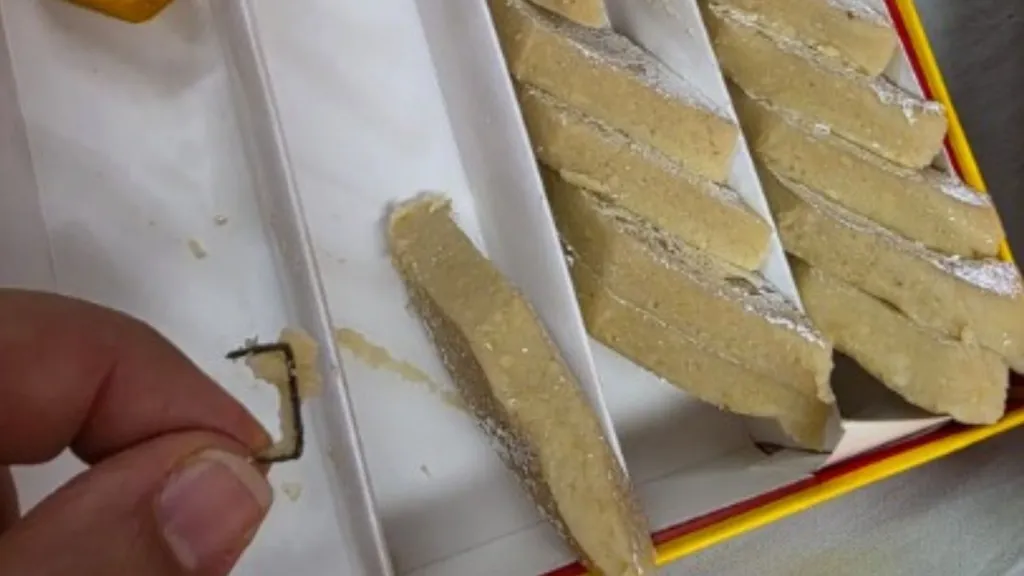
A father found a rusted stapler pin in kaju katli. Image Credit: The IndianExpress
A Mumbai father’s routine act of buying sweets for his three-year-old daughter turned into a nightmare when he discovered a corroded metal pin embedded inside a piece of kaju katli from the iconic Tewari Bros. Mithaiwala in Charni Road. The incident, which came to light on Saturday, August 1, after the complainant, Prannoy Palav, shared his experience on Instagram, has led the Maharashtra Food and Drug Administration (FDA) to suspend the shop’s FSSAI licence and launch an investigation into hygiene and safety practices at the outlet.
Palav said he had purchased a 500-gram box of kaju katli from Tewari Bros. Mithaiwala, opposite the Opera House in Mumbai, on July 29. “When I was about to feed one of the sweets to my 3-year-old daughter, I noticed something unusual. On closer inspection, I found a corroded metal pin embedded inside one of the sweets,” he said. “It was only by chance that I spotted it before she ate it. The consequences could have been extremely serious,” he added.
Why and how the incident happened
According to Palav’s account, the pin was found just as he was about to feed the sweet to his daughter, averting a potential choking hazard or internal injury. The pin, described as rusted and corroded, suggests it may have been in the production or packing area for some time before making its way into the sweet.
Following the complaint, a team of FDA officials inspected the Tewari Bros. Mithaiwala outlet on Monday. During the inspection, officials allegedly found hygiene-related lapses, though the exact nature of these lapses has not been detailed in initial reports. Officials also collected a sample of kaju katli for laboratory testing to check for contamination, foreign objects and compliance with food safety standards.
“We have taken a sample for testing and suspended the licence,” an official said. Another official said it was too early to conclude how the corroded stapler pin had ended up in the box of sweets. “Prima facie, we cannot be sure what the matter is. It could also be an attempt to blackmail them; we do not know yet. We are trying to determine how a rusty stapler pin made its way into the box of sweets,” the official said. This story was also covered by The IndianExpress.
The FDA’s cautious language reflects the need to balance consumer safety with the rights of the business, especially given the shop’s long-standing reputation. However, the suspension of the FSSAI licence signals that the regulator is treating the complaint seriously.
Yeh issue kaafi important hai because it involves child safety, food hygiene and the credibility of an old brand.
Statements from the complainant and FDA
Prannoy Palav’s Instagram post described the moment he discovered the pin and the shock of realising what could have happened if his daughter had consumed the sweet. “It was only by chance that I spotted it before she ate it. The consequences could have been extremely serious,” he said, emphasising the potential for choking, internal injury or infection from a rusted object.
The FDA, for its part, has not yet concluded whether the pin was introduced accidentally during production or packing or whether there is any other explanation. The official’s remark about the possibility of blackmail highlights that such complaints can sometimes be misused, but the regulator has chosen to act on the complaint first and investigate further.
Background and context
Tewari Bros. Mithaiwala is one of South Mumbai’s oldest and most well-known sweet shops, with a legacy spanning over a century. Located near Opera House, it has a loyal customer base and is often recommended for traditional Maharashtrian and Gujarati sweets, including kaju katli.
The Maharashtra FDA has been increasingly active in inspecting eateries and food businesses across the state to ensure compliance with food safety norms. In recent months, it has suspended licences of several establishments after finding hygiene lapses, foreign objects in food or adulteration.
The incident also comes against the backdrop of growing consumer awareness about food safety. Social media has amplified such complaints, allowing customers to share their experiences widely and forcing regulators to respond quickly.
Timeline
July 29, 2026: Prannoy Palav purchases 500g kaju katli from Tewari Bros. Mithaiwala, Charni Road.
Saturday, August 1, 2026: Palav posts on Instagram about finding a rusted stapler pin in the sweet; a complaint is filed with the FDA.
Monday, August 3, 2026: FDA inspects outlet, finds hygiene lapses, collects kaju katli sample for testing, suspends FSSAI licence.
Coming days: Laboratory results awaited; further action depending on findings and investigation into how the pin entered the sweet.
Also Read: Rs 6.4-Crore Salary, 10 Ghost Employees: Mumbai Police’s Payroll ‘Scam’ Exposed
Why This Matters
This matters because it involves the safety of children and the integrity of food production in a trusted brand. A metal pin in a sweet meant for a toddler could have led to choking, internal injury or infection, especially given its rusted condition.
It also matters for consumer confidence. When a century-old shop like Tewari Bros. faces such an allegation, it shakes trust not just in that outlet but in the broader sweet and confectionery industry. Customers expect that food meant for children is free from foreign objects and produced under strict hygiene controls.
For regulators, the case is a test of responsiveness. The FDA’s quick action—inspection, sample collection and licence suspension—sends a message that such complaints will be taken seriously, even if the final cause is yet to be determined. In simple Hinglish, jab bachchon ki safety ka sawal hota hai, toh koi risk nahi lena chahiye.
India angle
For Indian readers, this story is directly relevant because sweets are an integral part of Indian culture, festivals and daily life. From kaju katli to laddoos to barfis, these items are often shared with children and elders, making safety a top priority.
The India angle also includes the regulatory dimension. The FSSAI and state FDAs have been pushing for stricter compliance with food safety norms, especially after multiple incidents of foreign objects, adulteration and hygiene lapses were reported across the country. This case could become a reference point for how regulators handle similar complaints in the future.
There is also the social media angle. Palav’s decision to post on Instagram amplified the issue, forcing a swift response from the FDA and the business. This reflects a broader trend where consumers use digital platforms to hold brands accountable.
Analysis
My opinion is that the FDA’s decision to suspend the licence immediately is justified, given the potential risk to children. Even if the pin was introduced accidentally, the presence of a foreign object in food meant for toddlers is unacceptable.
I also think the shop’s response will be critical. If they cooperate fully, demonstrate corrective actions and communicate transparently, they can rebuild trust. If they become defensive or dismissive, the reputational damage could be long-lasting.
What Next
The immediate next step will be the laboratory testing of the kaju katli sample collected by the FDA. The results will determine whether there are other contaminants or hygiene issues beyond the single-pin incident.
The FDA will also investigate how the pin entered the sweet—whether during production, packing or storage. This could lead to recommendations or penalties related to equipment maintenance, staff training and quality checks.
Longer term, Tewari Bros. may need to undergo a comprehensive audit of its production and packing processes, possibly with third-party certification, to regain customer confidence. The FDA may also use this case to issue broader advisories to sweet shops and confectioneries across Mumbai and Maharashtra.
Conclusion
The discovery of a rusted stapler pin in kaju katli from Mumbai’s iconic Tewari Bros. Mithaiwala has triggered a swift regulatory response, with the FDA suspending the shop’s FSSAI licence and launching an investigation into hygiene and safety practices. While the exact cause of the contamination is yet to be determined, the incident underscores the critical importance of food safety, especially when children are involved.
For consumers, the lesson is to remain vigilant and report any issues promptly. For businesses, the reminder is that legacy and reputation mean little if basic safety standards are compromised. As the investigation unfolds, the focus must remain on preventing such incidents and restoring trust in one of Mumbai’s most beloved sweet shops.
Written By A. Jack