A surprise undercover inspection by Karnataka Transport Minister Byrathi Suresh exposed the everyday challenges faced by Bengaluru commuters after a BMTC conductor reportedly asked him to get off the bus for not having exact change.
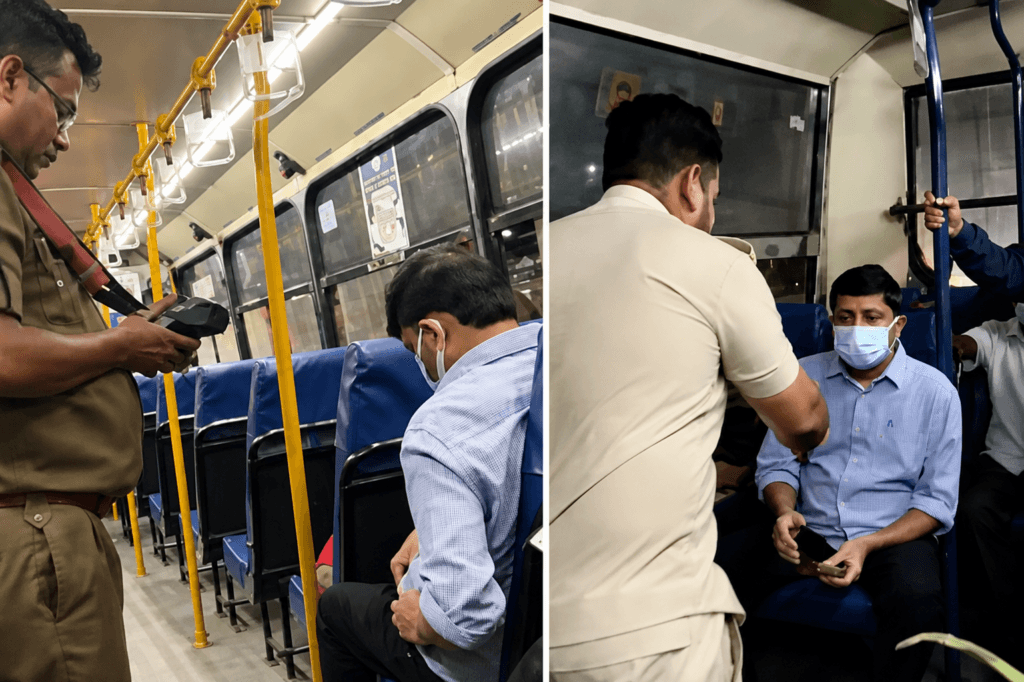
Karnataka Transport Minister Byrathi Suresh boards a BMTC bus in disguise during a surprise inspection to assess commuter experiences in Bengaluru. |Credit to PTI
Transport Minister Byrathi Suresh was taken by surprise when he inspected Bengaluru’s public transport system, exposing the plight of ordinary commuters, an episode that has become the talk of Karnataka. The minister was reportedly traveling incognito in a Bangalore Metropolitan Transport Corporation (BMTC) bus when a conductor asked him to get off the bus for not having the exact fare.
The incident occurred during a late-night inspection in Bengaluru, where the Minister got into a BMTC bus with a face mask to avoid being identified. It is said that he asked the conductor for two tickets and handed him a ₹100 note. “And the conductor asked for exact change and he didn’t have any and the conductor told him to get off the bus,” the minister said. The staff were not aware that the passenger was the state’s Transport Minister, on an undercover review of public transport services.
The incident has sparked fresh debate on commuter convenience, cashless ticketing, passenger behaviour and quality of public transport services in Bengaluru.
Surprise Inspection Reveals Ground Reality
Byrathi Suresh decided to travel like a common passenger to know the actual experience of the daily commuters instead of relying on reports from the department alone, the officials said.
Wearing a mask, he took a BMTC bus from Hebbal to Nagashettyhalli and mingled with the transport staff without revealing his identity. In the course of his journey, he attempted to buy tickets with a ₹100 note.
The conductor was said to want exact change. The minister said he did not have smaller denominations and the conductor allegedly told him to get off the bus instead of issuing the ticket or providing an alternative solution. The minister slipped off the bus quietly without disclosing his identity.
The incident was a reminder of a common complaint raised by passengers using BMTC buses, particularly regarding the availability of change during cash transactions.
More Issues Found During the Inspection
Bengaluru’s public transport services appear to have discovered more problems during the minister’s inspection.
Officials said a BMTC bus did not stop at a designated bus stop even as a passenger signaled to get down. After the inspection, the driver and the conductor of the offending train were suspended and further disciplinary action is being taken.
The minister also went for a ride in an autorickshaw during his inspection. The fare meter showed ₹30 but the driver insisted on ₹36 saying that the revised fares have not been updated on the meter yet, reports said. The minister finally paid ₹40 and the journey ended.
These observations were part of a larger exercise to get a direct feel of commuter grievances from the ground.
Why the Exact Change Issue Persists
One of the most frequent complaints among BMTC passengers is the conductors asking commuters for exact change.
Conductors often begin their shifts with insufficient small-denomination currency, which can make it challenging to return change immediately during busy rush hour operations. According to BMTC guidelines, conductors can write the balance amount on the back of the ticket and the passenger can collect the money later. However, many commuters say this is not always implemented. Community conversations have also revealed a growing desire for greater acceptance of digital ticket payments.
The incident involving the transport minister has again brought this long-standing operational challenge into the public eye.
Official Response
During the inspection, other service lapses were found for which disciplinary proceedings were initiated against the bus crew concerned.
The minister is said to have stressed that the visit was not to find out individual errors but to understand the systemic problems of daily commuters.
Officials from the Transport department are likely to examine the working procedures of the department related to fare collection, passenger behaviour, compliance at bus stops and digital ticketing systems.
Background
BMTC runs one of India’s largest networks of urban buses, ferrying millions of passengers across Bengaluru every month.
In recent years, Karnataka has launched a number of initiatives to boost public transport, including the Shakti Scheme, which provides free bus travel for women on state-run buses, leading to a significant increase in passenger volumes.
Commuters, in contrast, have been complaining about overcrowded buses, delayed services, shortage of conductors, cash handling, refusal to accept digital payments in some cases and inconsistent customer service.
A surprise inspection by the minister shows that public officials are increasingly choosing to see for themselves how government services function at the grassroots level, instead of just relying on administrative reports.
Timeline
Karnataka Transport Minister Byrathi Suresh on Saturday evening did an incognito check of the public transport system in Bengaluru wearing a face mask to conceal his identity. He boarded a BMTC bus at Hebbal during the inspection and tried to buy two tickets using a ₹100 note. Allegedly the conductor wanted him to get off because he could not give exact change. The minister, during the inspection, also saw another BMTC bus, which did not stop for passengers and had a fare dispute with an autorickshaw. Departmental action was taken against the driver and conductor in the service violations identified following the inspection.
Why it’s important
This is more than just one interaction between a minister and a conductor.
It throws light on the day-to-day operational problems of thousands of Bengaluru commuters on a daily basis. Public transport is an essential service and even minor inconveniences such as the inability to pay using larger currency notes can have a great impact on the daily travel experience of passengers.
This is a very important issue, as improving commuter satisfaction is not simply about adding more buses but also having courteous behaviour, efficient ticketing and consistent service standards.
The incident also underlines the importance of surprise inspections in uncovering practical difficulties that are not always reflected in official reports.
India Angle
Infrastructure in India, a top priority for the country, includes Indian urban public transport.
Government buses are widely used in cities like Bengaluru, Delhi, Mumbai, Chennai, Hyderabad and Pune to reduce traffic congestion and to provide affordable transportation.
The Bengaluru incident could prompt other state transport departments to upgrade digital fare collection systems, improve staff training, and increase the number of cashless payment options.
With India leading the way in Digital India initiatives, wider usage of UPI-based ticketing and smart transport cards could lead to fewer disputes over exact change and a smoother travel experience for passengers.
Analysis
Editorially, the minister’s secret inspection was successful in highlighting the day-to-day issues faced by the average commuter.
But the incident is also symptomatic of a wider, systemic problem, not just individual misconduct. Conductor operations are often constrained by limited access to change during busy shifts, and passengers increasingly want seamless digital payment options.
This episode should lead to a full review of ticketing systems, staff training and passenger communication, rather than being treated as a disciplinary matter.
As a news writer, you shouldn’t get caught up in the dramatic headline and miss the bigger governance lesson: public service works better when policymakers get a direct taste of citizens’ concerns.
What Happens Next?
The Karnataka Transport Department is expected to take note of the surprise inspection findings and initiate corrective action where needed.
BMTC could look at strengthening the digital payment infrastructure, better training of conductors, strengthening of guidelines on service to passengers and ensuring that buses stop at designated places at all times.
Officials are also expected to conduct surprise inspections in Bengaluru to check on the quality of service and find more operational problems.
If the reforms are implemented after these inspections, commuters may experience more reliable, transparent and passenger-friendly public transport services in the coming months. the story also covered by The times of India
Conclusion
The viral incident of Karnataka Transport Minister Byrathi Suresh unexpectedly coming face-to-face with a BMTC conductor has become more than just a viral incident and has shed light on the everyday issues faced by many Bengaluru commuters on a daily basis. Traveling incognito, the minister experienced firsthand the frustrations of disputes over exact change, lapses in service and inconveniences caused by the fare that often frustrate passengers.
Some of these cases noticed during the inspection have already been taken up for disciplinary action, but the broader takeaway is to address the systemic issues by way of better technology, better training of staff and commuter-centric reforms. Better digital payments, better operational guidelines for the buses and better customer service can make a huge difference to the public transport experience in Bengaluru.
The incident is ultimately a reminder that good governance begins with an in-depth knowledge of the realities of everyday life of citizens and that, sometimes, the best lessons in policy are learned from traveling as an ordinary passenger.