
A prohibitory order issued under Section 37(3) read with Section 10(2) cites breach of peace concerns; marriages, funerals, educational and commercial activities exempted
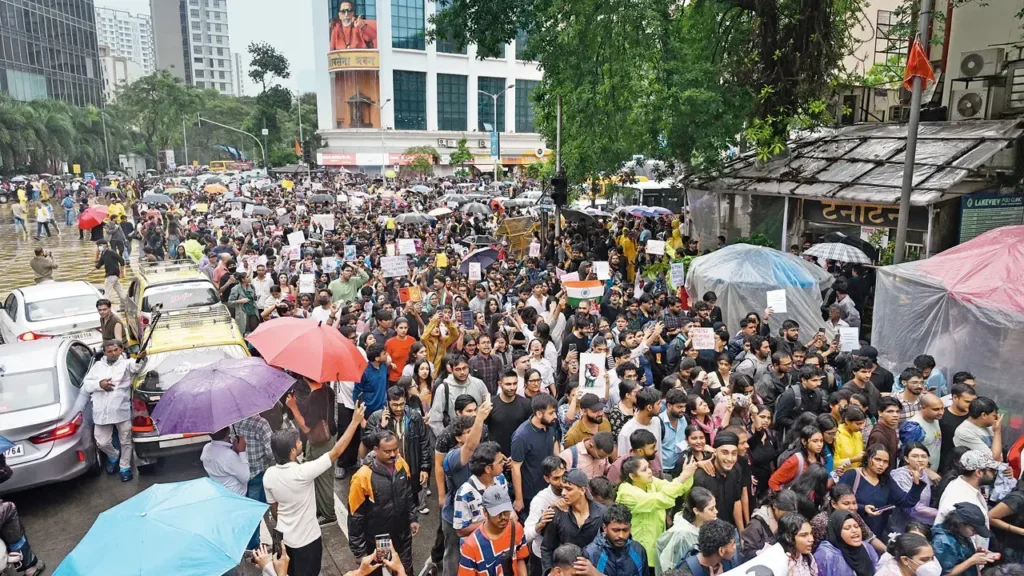
This Image is only for illustrations. Image Credit: Mid-Day
In a significant preventive measure aimed at maintaining law and order during a potentially sensitive period, Mumbai Police have imposed prohibitory restrictions across Greater Mumbai, banning the assembly of five or more people, processions, and the use of loudspeakers, amplifiers, musical bands, and firecrackers during processions from midnight on September 9 to 11:59 PM on September 23, 2026.
The order, issued under Section 37(3) read with Section 10(2) of the Maharashtra Police Act, 1951, was signed on Friday, September 4, by Akbar Pathan, Deputy Commissioner of Police (Operations), Brihanmumbai, and Executive Magistrate, Greater Mumbai. Citing inputs from various sources indicating the possibility of a breach of peace, disturbance to public tranquillity, and danger to human life and property, the 15-day prohibitory order applies across Mumbai and specifically restricts assemblies, processions, and noise-generating activities during the enforcement period.
DCP Pathan has directed that the order be given wide publicity across Greater Mumbai, with copies to be displayed at prominent public places, courts, and government offices, and publicized through announcements using loudspeakers or megaphones and other available media. The order states that its expiry will not affect any investigation, legal proceeding, or enforcement action already initiated during the period it was in force, and any penalty, forfeiture, or punishment incurred for violating the order can continue to be imposed even after the order expires.
Why and How?
The imposition of prohibitory orders under Section 37(3) of the Maharashtra Police Act is a standard preventive policing tool used when intelligence inputs suggest a heightened risk of public disorder, communal tension, or unlawful assemblies. While the police order does not explicitly mention any specific incident or festival, the timing coincides with the Ganesh Chaturthi festival period, which typically sees large-scale processions, religious gatherings, and heightened emotions across Mumbai.
According to the order, the restrictions have been introduced as a preventive measure to curb any potential breach of peace, disturbance to public order, unlawful assembly, riots, or affrays within the jurisdiction of the Commissioner of Police, Greater Mumbai. The language used—”inputs from various sources indicating the possibility of a breach of peace”—suggests that police have received specific intelligence about potential flashpoints, though these have not been made public to avoid escalating tensions. This story was also covered by The Mid-Day.
The timing is also significant in the broader context of Maharashtra’s ongoing debates over noise pollution during festivals. In Pune, for instance, police have recently cracked down on high-decibel DJ systems, plasma displays, and laser lights during Ganesh festival processions, citing Supreme Court and National Green Tribunal guidelines on noise limits. Similar tensions have emerged in Mumbai, with citizen groups demanding stricter enforcement of noise norms and police facing pressure to balance religious sentiments with public order and environmental concerns.
Key Restrictions and Exemptions
The 15-day prohibitory order specifically restricts the following activities across Greater Mumbai:
Prohibited Activities:
Assembly of five or more persons in public spaces
Processions by any person or group
Use of loudspeakers and amplifying instruments during processions
Musical bands during processions
Bursting of firecrackers during processions
The exemptions are designed to minimize disruption to daily life while maintaining strict control over activities that could potentially lead to public disorder or noise pollution.
Official Statements and Legal Framework
The order was issued by Akbar Pathan, DCP (Operations) and Executive Magistrate, Greater Mumbai, who has the authority under Section 37(3) of the Maharashtra Police Act, 1951, to impose prohibitory orders when there is a threat to public order. Section 10(2) of the same Act empowers police officers to take preventive measures to avoid breaches of peace.
“According to the order, the restrictions have been introduced as a preventive measure to curb any potential breach of peace, disturbance to public order, unlawful assembly, riots, or affrays within the jurisdiction of the Commissioner of Police, Greater Mumbai,” the order states.
The legal consequences for violating the order are significant. The order explicitly states that its expiry will not affect any investigation, legal proceeding, or enforcement action already initiated during the enforcement period. Any penalty, forfeiture, or punishment incurred for violating the order during its enforcement period can continue to be imposed even after the order expires, “as if the prohibitory order were still in force.”
Background
The timing of this prohibitory order is particularly noteworthy given the ongoing Ganesh Chaturthi festival period, which typically runs from late August to mid-September. Mumbai, being the financial capital and a city with deep cultural ties to the Ganesh festival, witnesses massive celebrations, including processions (visarjan), public pandals, and religious gatherings.
In recent years, there has been growing debate in Maharashtra over noise pollution during festivals, particularly the use of high-decibel DJ systems, loudspeakers, and firecrackers. In Pune, police have recently taken a hard line, restricting sound systems to four bass and four top speakers, banning plasma speakers and laser lights, and recording violations during Dahi Handi and Eid-e-Milad celebrations.
The political dimension is also significant. Maharashtra ministers have been divided over the use of high-decibel DJ systems during Hindu festivals, with some asserting that festival sound will not be stopped while others warning of strict action against violators. MNS chief Raj Thackeray has warned that social media could inflame tensions ahead of the Ganesh festival, highlighting the potential for communal discord.
In Mumbai, police have previously invoked prohibitory orders during sensitive periods. In July 2026, similar restrictions were imposed from July 23 onwards, citing law and order concerns. The pattern suggests that Mumbai Police use such orders as a standard preventive measure during periods when intelligence inputs indicate potential risks to public order.
From Order Issuance to Enforcement
September 4, 2026 (Friday): DCP Akbar Pathan, Executive Magistrate, Greater Mumbai, signs a prohibitory order under Section 37(3) read with Section 10(2) of the Maharashtra Police Act, 1951.
September 5–8: Order given wide publicity; copies displayed at prominent public places, courts, and government offices; announcements made through loudspeakers, megaphones, and media.
September 9, 2026, 12:00 AM (midnight): A Prohibitory order comes into force across Greater Mumbai.
September 9–23: Restrictions on assemblies of 5+ people, processions, loudspeakers, musical bands, and firecrackers during processions enforced across Mumbai. midday+1
September 23, 2026, 11:59 PM: The Prohibitory order expires, unless modified or withdrawn through a subsequent order.
Post-September 23: Investigations, legal proceedings, and enforcement actions initiated during the order’s enforcement period continue; penalties and punishments for violations remain applicable.
Why This Matters
Yeh issue kaafi important hai for multiple reasons. First, it strikes at the balance between public order and civil liberties. The right to assemble peacefully is a fundamental right under Article 19 of the Indian Constitution, but it is subject to reasonable restrictions in the interest of public order. The question is, are these restrictions reasonable, or are they overly broad?
Second, the timing during Ganesh Chaturthi is significant. For millions of Mumbaikars, this is a period of religious celebration, community bonding, and cultural expression. Restrictions on processions and loudspeakers could impact traditional practices, leading to potential resentment. However, exemptions for marriages, funerals, and religious processions (with prior permission) suggest that police are trying to balance security with religious sentiments.
Third, the noise pollution angle cannot be ignored. Mumbai is one of the noisiest cities in the world, and festival-related noise contributes significantly to the problem. Restrictions on loudspeakers and Amplifiers: Mumbai Police Impose 15-Day Ban on Gatherings of People, Processions and Loudspeakers.
India Angle
For readers across India, yeh sirf Mumbai ki problem nahi hai—yeh ek national practice ban chuka hai. From Delhi’s restrictions during Republic Day to Kolkata’s prohibitory orders during Durga Puja, from Chennai’s bans during political rallies to Bengaluru’s curbs during communal tensions, preventive policing through prohibitory orders is common across Indian cities.
Agar aapko lagta hai ki yeh issue sirf Maharashtra tak limited hai, toh sochiye dobara. The debate over loudspeakers, processions, and public order is playing out in Pune, Belagavi, Parbhani, and other Maharashtra cities. BJP leaders have sought statewide bans on DJ speakers, while ministers clash over enforcement.
The constitutional framework is uniform across India. Section 144 of the CrPC (now Section 163 of the Bharatiya Nagarik Suraksha Sanhita, BNSS) empowers magistrates to issue prohibitory orders in urgent cases of nuisance or apprehended danger. State police acts, like Maharashtra’s, provide additional powers.
The challenge is balancing security with liberty. Too many restrictions stifle democratic expression; too few invite chaos. Mumbai’s 15-day order is an attempt to find that balance—but whether it succeeds remains to be seen.
Analysis
The legal basis is solid. Section 37(3) of the Maharashtra Police Act explicitly empowers police to issue prohibitory orders when there is apprehension of disturbance to public tranquillity. The order cites “inputs from various sources,” suggesting intelligence-based decision-making rather than arbitrary action.
The exemptions are comprehensive. Unlike blanket bans that paralyze cities, this order allows routine civic, religious, educational, and commercial activities to continue. Marriages, funerals, court proceedings, and business operations are all exempt.
The timing is strategic. By imposing the order from September 9 to 23, police cover the peak Ganesh Chaturthi period without explicitly naming the festival. This avoids accusations of targeting specific communities while maintaining flexibility to manage any situation.
The enforcement challenge is real. Mumbai is a city of 20 million people. Policing every assembly of five or more people is impractical. The order will likely be enforced selectively, focusing on potential flashpoints rather than routine gatherings.
The political optics matter. With Maharashtra ministers divided over loudspeaker bans and festival regulations, the order could be seen as either prudent policing or unnecessary restriction. Opposition parties may cry overreach; ruling parties may praise proactive governance.
What Next
In the immediate term (September 9–23):
Police enforcement: Mumbai Police will deploy additional personnel to monitor assemblies, processions, and loudspeaker use; violations may result in FIRs, fines, or arrests.
Permission requests: Organizers of large events may approach Zonal DCPs for specific exemptions; approvals will be granted on a case-by-case basis.
Public awareness: Media campaigns, social media posts, and public announcements will educate citizens about restrictions and exemptions.
Complaint mechanism: Citizens can report violations to local police stations or through Mumbai Police’s social media channels.
Longer-term (weeks to months):
Legal scrutiny: Civil liberties groups may challenge the order’s duration or scope if they deem it excessive; courts will assess proportionality.
Policy review: Mumbai Police may review the order’s effectiveness and adjust future prohibitory orders based on enforcement experience.
Festival guidelines: The Maharashtra government may issue comprehensive guidelines on loudspeaker use, processions, and noise pollution during festivals.
Public discourse: Debate over balancing public order with civil liberties and religious sentiment will continue in media and civil society.
Final Thoughts
The 15-day prohibitory order in Mumbai is a calculated move to maintain public order during a sensitive period. It reflects the police’s assessment of potential risks and their determination to prevent breaches of peace.
But the order also raises questions. What specific intelligence prompted this action? Were there credible threats of violence or unrest? Or is this routine preventive policing during festival season?
The exemptions show that police recognize the need to balance security with normalcy. Marriages, funerals, businesses, and educational institutions can function without disruption. But the ban on processions and loudspeakers will undoubtedly affect festival celebrations.
For citizens, the order is a reminder that public order comes with responsibilities. The right to assemble is not absolute; it must be exercised within the bounds of law.
For police, the order is a test of enforcement capability and public trust. Will they enforce it fairly and proportionately? Or will it become another example of overreach?
Written By A. Jack