11 rescued from debris of 50-year-old PG hostel ‘Hostel Daze’; FIR under Sections 105, 290, 125(a) BNS as CM Rekha Gupta orders magisterial probe into illegal construction
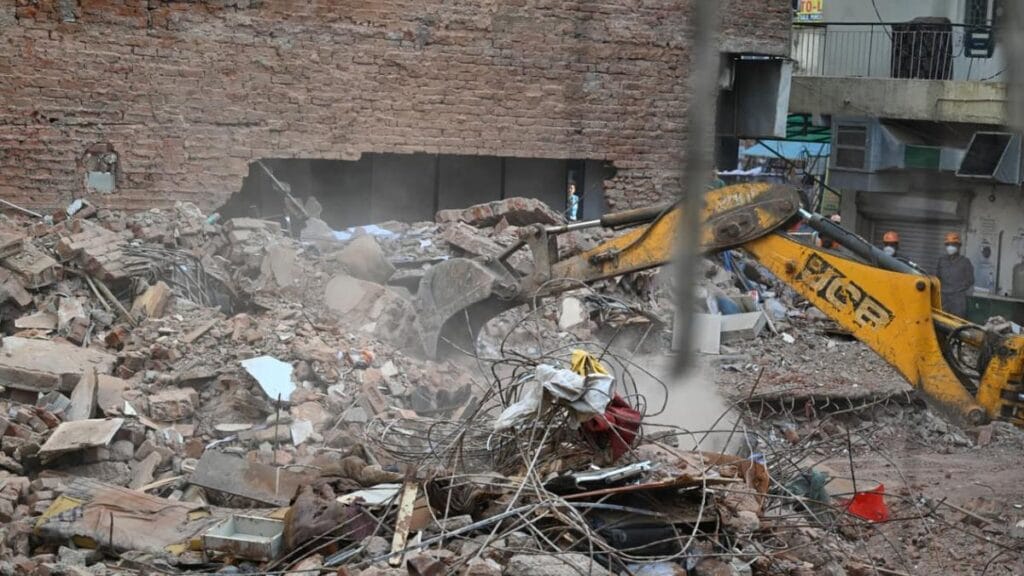
Rescue workers from NDRF, Delhi Fire Service, and Delhi Police work through the night amidst the rubble of a collapsed five-story PG building in Satya Niketan. Image Credit: The Hindu
Delhi Building Collapse: The death toll from a catastrophic five-story building collapse in South West Delhi’s Satya Niketan area rose to six on Monday morning as rescue teams worked through the night to extract survivors from the debris, while Delhi Police registered an FIR under stringent Bharatiya Nyaya Sanhita (BNS) sections against the building owner Hariram Bansal and others connected to the illegal PG accommodation named Hostel Daze.
A total of 11 people have been rescued so far from the rubble, with one more person recovered during overnight operations but declared brought dead at AIIMS Trauma Centre, taking the fatalities to six, Delhi Police said in its latest update on Monday. Multiple agencies, including the Delhi Police, Delhi Fire Service, National Disaster Response Force (NDRF), and Delhi Disaster Management Authority (DDMA), have been carrying out continuous rescue operations since the building collapsed around 1:30 PM on Sunday, September 6.
The building, which locals say is at least 50 years old and comprises a basement plus five floors, housed a paying guest accommodation primarily for college students studying at Delhi University’s South Campus and nearby institutions. An FIR under Sections 105 (culpable homicide not amounting to murder), 290 (negligent conduct with respect to pulling down, repairing or constructing buildings), and 125(a) (act endangering life or personal safety of others) of the BNS has been registered against Hariram Bansal and others, with police efforts ongoing to trace additional persons allegedly connected to the incident.
Why and How?
The collapse of the Satya Niketan building appears to be the result of multiple compounding factors: the structure’s advanced age, alleged illegal modifications including basement construction, water accumulation weakening the foundation, and possible violations of building safety norms.
According to preliminary investigations and local accounts, the building was originally constructed around the 1970s and had been converted into a PG hostel catering to students, with reports suggesting it exceeded the area’s permissible height limit of three stories. The structure reportedly had a basement plus five upper floors, making it significantly taller than what zoning regulations allow in Satya Niketan, a densely populated residential area near Delhi University. This story was also covered by TheHindu.
Eyewitnesses described a “sudden tremor” that sent residents of nearby buildings rushing out of their homes on Sunday afternoon, only to find a pile of rubble where the five-story structure once stood. The collapse appears to have been a “pancake collapse”—where floors fall directly onto each other in rapid succession—leaving little time for occupants to escape.
Technical experts point to several likely contributing factors:
Basement excavation: Reports suggest unauthorized basement work may have compromised the building’s foundation, especially in an area with high water tables during monsoon season.
Water accumulation: Heavy rains in preceding days may have led to water seepage and accumulation around the foundation, weakening the soil and structural integrity.
Overloading: The building housed 40-50 students, according to initial estimates, potentially exceeding safe occupancy limits for a 50-year-old structure.
Illegal construction: The building allegedly exceeded the three-story limit permitted in Satya Niketan, raising questions about enforcement by the Municipal Corporation of Delhi (MCD).
Official Statements and Political Reactions
Delhi Chief Minister Rekha Gupta visited the site on Sunday evening and ordered a magisterial probe into the collapse, vowing that “no one will be spared” if negligence or illegal construction is found. “We will ensure strict action against all those responsible for this tragedy. Safety of citizens, especially students, is our top priority,” Gupta said, announcing that the civic body would seal illegal structures above four floors across Delhi.
Union Health Minister Mansukh Mandaviya assured Delhi CM of full support, while Delhi Police Commissioner Anurag Kumar reviewed rescue operations and directed that all possible resources be deployed.
DCP (South West) Amit Goel confirmed the FIR registration: “An FIR under Sections 105, 290, and 125(a) of the Bharatiya Nyaya Sanhita, 2023 (BNS), relating to culpable homicide, negligence during construction or repair of buildings, and rash and risky act that endangers life, respectively, has been registered against Hariram Bansal and others. Efforts are ongoing to trace additional persons allegedly connected to the incident.
Delhi University expressed concern over the incident and said it is ready to support affected students. However, the university has yet to confirm the exact number of DU students among the deceased or trapped, as many PG accommodations in Satya Niketan operate independently without formal university affiliation.
Satya Niketan’s Student Housing Crisis and Illegal Construction
Satya Niketan, located near Delhi University’s South Campus, has long been a hub for student accommodations, with hundreds of PG hostels and rented apartments catering to the university’s large student population. However, the area has also been notorious for illegal construction, with building owners routinely exceeding height limits, adding basements, and converting residential properties into high-density hostels without proper approvals.
The MCD has issued demolition notices for numerous illegal structures in Satya Niketan over the years, but enforcement has been patchy. In a startling coincidence, a demolition notice for a building adjacent to Hostel Daze surfaced on the day of the collapse, raising questions about timing and whether authorities were aware of imminent risks.
This is not the first building collapse in Delhi. In recent years, multiple incidents have occurred in Old Delhi, Karol Bagh, and other congested areas, often linked to illegal construction, aging structures, and monsoon-related stress. Yet, systemic reforms remain elusive, and enforcement continues to lag behind violations.
From Collapse to FIR
September 6, 2026, 1:30 PM (approx.): A five-story building collapses in Satya Niketan; locals report “sudden tremor”; immediate rescue efforts begin.
2:00–4:00 PM: Teams from Delhi Police, NDRF, Delhi Fire Service, and DDMA arrive; six people were rescued initially, and one was brought dead to AIIMS.
4:00–6:00 PM: Death toll rises to three; five critically injured; 40-50 feared trapped.
6:00–8:00 PM: CM Rekha Gupta visits site; orders magisterial probe; announces sealing of illegal structures above four floors.
8:00 PM–Midnight: Rescue operations continue through the night; death toll reaches five; 11 rescued total.
September 7, 12:00–6:00 AM (overnight): One more person rescued but declared dead; death toll rises to six.
September 7, Morning: Delhi Police confirms FIR under BNS Sections 105, 290, and 125(a) against Hariram Bansal and others; rescue operations ongoing.
Why This Matters
Yeh issue kaafi important hai for multiple reasons. First, it exposes the vulnerability of student housing in Delhi. Thousands of students rely on private PG accommodations in areas like Satya Niketan, often with little oversight on safety, fire norms, or structural integrity. When buildings collapse, it’s not just property damage—it’s young lives lost, families shattered, and futures ended.
Second, the incident highlights systemic failures in urban governance. How did a 50-year-old building exceed height limits by two stories? Why was basement construction allowed without proper approvals? Where was the MCD’s enforcement machinery when violations were so visible? These are not rhetorical questions—they demand answers.
Third, the human cost is staggering. Six dead, 11 rescued, and potentially dozens more still feared trapped. Each number represents a student, a son or daughter, a dreamer who came to Delhi for education and instead met tragedy.
For Delhi—a city aspiring to be a global capital—such incidents are a black mark. If the city cannot ensure safe housing for its students, what does that say about its priorities?
India Angle
For readers across India, yeh sirf Delhi ki problem nahi hai—yeh ek national epidemic ban chuka hai. From Mumbai’s building collapses to Bengaluru’s illegal layouts, from Chennai’s encroached structures to Kolkata’s aging tenements, Indian cities are riddled with unsafe buildings that violate norms with impunity.
Agar aapko lagta hai ki yeh issue sirf monsoon season tak limited hai, toh sochiye dobara. Climate change is making extreme weather more frequent, and aging infrastructure cannot withstand the stress. What happened in Satya Niketan could happen anywhere—unless systemic reforms are implemented.
The student housing angle is particularly concerning. India has over 40 million higher education students, millions of whom live in private accommodations with minimal safety oversight. Universities often disclaim responsibility, municipalities lack capacity, and parents assume the system works. It doesn’t.
Analysis
The violations were visible. A five-story building in a three-story zone. A basement in an area with high water tables. Dozens of students packed into a 50-year-old structure. These were not hidden secrets—they were open violations.
The enforcement was absent. MCD has bylaws, demolition powers, and inspection teams. Yet, the building stood for years, collecting rent while violating every norm. Why? Corruption? Apathy? Both?
The response is reactive, not proactive. CM orders a probe after six dies. MCD announces sealing of illegal structures after tragedy strikes. Where was this urgency before?
The legal framework exists—but conviction is rare. FIRs under BNS Sections 105, 290, and 125(a) are serious. But how many building owners actually go to jail? How many illegal structures are actually demolished?
What Next
In the immediate term (next 24–72 hours):
Rescue operations: NDRF and the Delhi Fire Service will continue searching the rubble for any remaining survivors; the death toll may rise further.
Victim identification: Police and hospitals will work to identify all deceased and inform families; DU may assist in identifying students.
Accused apprehension: Efforts ongoing to trace and arrest Hariram Bansal and others named in the FIR; police may seek custody for interrogation.
Magisterial probe: The Court-appointed magistrate will investigate circumstances of collapse, including building approvals, violations, and enforcement lapses.
Longer-term (weeks to months):
Criminal prosecution: The Case will move to court; charges under BNS Sections 105, 290, and 125(a) carry significant prison terms if convicted.
Demolition drive: MCD may launch widespread sealing and demolition of illegal structures above four floors across Delhi, starting with Satya Niketan.
Policy reforms: The Delhi government may propose stricter building safety norms, mandatory structural audits for old buildings, and enhanced penalties for violations.
Student housing oversight: Universities and MCD may collaborate to regulate PG accommodations, including safety certifications, occupancy limits, and regular inspections.
For students and parents, the advice is clear:
Verify building safety: Before renting PG accommodation, check for structural integrity, fire exits, and occupancy limits.
Report violations: If you notice illegal construction or safety hazards, report to MCD or Delhi Police.
Demand accountability: Universities and municipalities must be held responsible for ensuring safe student housing.
Final Thoughts
The collapse of Hostel Daze in Satya Niketan is not just a tragedy—it’s a failure. A failure of governance, of enforcement, of priorities. Six young lives were lost because a 50-year-old building was allowed to become a death trap.
The FIR against Hariram Bansal is a start. The magisterial probe is necessary. But justice for the deceased requires more than arrests and inquiries. It requires systemic change.
Will Delhi learn from this? Will MCD finally enforce building norms? Will universities take responsibility for student housing? Will parents demand safer accommodations?
The answers to these questions will determine whether Satya Niketan becomes a turning point—or just another footnote in Delhi’s long history of preventable tragedies. For now, rescue teams continue to sift through the rubble. Families wait for news. And six students will never return home.
Written By A. Jack