
The pirates, arrested in 2024 and jailed since April that year, pleaded guilty hoping to strengthen their transfer applications. Barring one, none speak English and none have had visitors in two years.
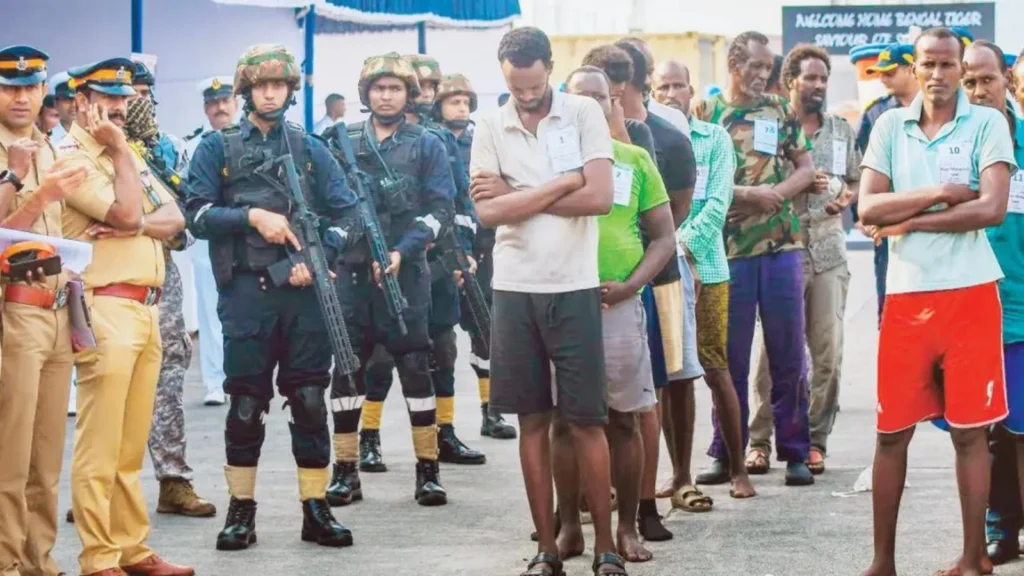
The 44 Somali pirates, sentenced to life imprisonment in Mumbai, are requesting transfer to Somalia to serve their sentences. Image Credit: The IndianExpress
In a significant post-sentencing development, 44 Somali pirates convicted under India’s Maritime Anti-Piracy Act, 2022, have formally requested transfer to prisons in Somalia to serve their life sentences. The request came a day after a special court in Mumbai handed them life imprisonment for hijacking vessels and holding crew members hostage in 2024.
The men, ranging in age from their early 20s to 50s, raised their hands during Monday’s sentencing as one among them, Li Banm Abdi Jama, the only English speaker, asked the court about the procedure and timeline for returning to Somalia. Jama told the court that the men had pleaded guilty in the hope that this would strengthen their applications to serve their sentences in Somalia. He said they were facing severe hardship in prison because of differences in language, culture, food and lifestyle, and because they had no family or friends in India.
What Happened in Court
The special court in Mumbai convicted all 44 Somali nationals in two separate hijacking cases under the Maritime Anti-Piracy Act, 2022, along with other laws, including the Unlawful Activities (Prevention) Act and sections of the Bharatiya Nyaya Sanhita (BNS) related to attempted murder and kidnapping. The conviction marks the first under the 2022 anti-piracy law, which was enacted to strengthen India’s legal framework against maritime crimes.
During the sentencing, the men admitted guilt and requested leniency, citing the hardships they had been facing in Indian prisons. Special judge Sanjay Dige accepted their guilty pleas after giving them time to reconsider and ruled that the admissions were voluntary. The court held that the acts of piracy, including hijacking vessels, taking crew hostage, attempting to kill them and using them as human shields, amounted to terrorism. This story was also covered by the Indian Express.
The court also praised the Indian Navy for its prompt action in rescuing the vessels and apprehending the pirates, noting that the Navy fulfilled its legal and international obligations with dedication despite the inherent risks. However, the court did not grant leniency in sentencing, imposing life imprisonment on all 44 convicts.
Why the Pirates Are Seeking Transfer
The pirates’ request for transfer is rooted in the severe difficulties they face in Indian prisons. Jama told the court that the men had been isolated from their families, with no visitors in the two years since their arrest. They also struggle with language barriers, as barring Jama, none of them can speak English. This makes communication with prison staff and other inmates extremely difficult.
Cultural and dietary differences have also been a major issue. The men are accustomed to Somali food and lifestyle, which is vastly different from what is available in Indian jails. The isolation, combined with the inability to communicate effectively, has made their imprisonment particularly harsh. Jama said they hoped that pleading guilty would help their transfer applications, but the court has not yet ruled on the request.
The bilateral prisoner transfer agreement between India and Somalia allows convicted nationals to serve their sentences in their home country, subject to certain conditions. This includes the consent of both countries and the agreement of the prisoner. The process is designed to help prisoners reintegrate into society after serving their sentences by allowing them to be closer to family and familiar surroundings.
Background and Context
The Maritime Anti-Piracy Act, 2022, was enacted to address the growing threat of piracy in international waters, particularly in regions like the Gulf of Aden and the Indian Ocean. The law gives Indian authorities the power to prosecute piracy cases, even if the crimes occur outside India’s territorial waters, as long as Indian ships or citizens are involved.
The 44 pirates were arrested in two separate rescue operations carried out by the Indian Navy in 2024. In one incident, 35 pirates hijacked a bulk carrier and held the crew hostage for more than three months. In another, nine pirates took over an Iranian fishing vessel. Both groups were armed with assault rifles, hand grenades and other deadly weapons. The Navy rescued the vessels and apprehended the attackers, leading to their trial in Mumbai.
The conviction is considered a landmark judgement because it is the first under the 2022 anti-piracy law. Special Public Prosecutor Ranjeet Sangle called it a significant step in India’s fight against maritime terrorism. The court’s decision to impose life sentences sends a strong message that piracy will be treated as a serious offence with severe consequences.
Timeline
2022: India enacts the Maritime Anti-Piracy Act to strengthen the legal framework against maritime crimes.
2024: Indian Navy rescues two vessels hijacked by Somali pirates and apprehends 44 suspects.
April 2024: The pirates are arrested and jailed in Navi Mumbai’s Taloja jail.
July 2026: The pirates plead guilty in Mumbai court, hoping for leniency and transfer to Somalia.
July 20, 2026: Special court sentences all 44 pirates to life imprisonment under the Maritime Anti-Piracy Act.
July 21, 2026: The pirates request transfer to Somalia under the bilateral prisoner transfer agreement.
Also Read: India’s Cockroach Movement Protesters Show No Sign of Backing Down After Police Crackdown
Why This Matters
This matters because it highlights the human side of international piracy convictions. While the court’s decision to impose life sentences sends a strong message against maritime crimes, the pirates’ request for transfer raises questions about prisoner welfare and rehabilitation. Yeh issue kaafi important hai because it touches on how countries handle foreign convicts and whether bilateral agreements can help in their reintegration.
It also matters because the Maritime Anti-Piracy Act, 2022, is a relatively new law, and this is the first major conviction under it. The case sets a precedent for how future piracy cases will be handled in India. The court’s decision to impose life sentences without leniency, despite the guilty pleas, shows that the law will be applied strictly.
For the Indian Navy, the case is a validation of its role in combating piracy in international waters. The court’s praise for the Navy’s prompt action underscores the importance of maritime security and the risks involved in such operations. Seedhi baat yeh hai: jab international waters mein crime hota hai, toh India ka response bhi strong hona chahiye.
India Angle
For Indian readers, this story matters because it shows India’s commitment to fighting maritime piracy and protecting international shipping lanes. In Hinglish, seedhi baat yeh hai: jab samudri Dakaiti hoti hai, toh India ka kanoon ab usse serious le raha hai.
The case also highlights the challenges of prosecuting foreign nationals in India. The language barriers, cultural differences and isolation faced by the pirates are issues that Indian authorities will need to consider in future cases. The bilateral prisoner transfer agreement offers a potential solution, but it requires coordination between countries and adherence to legal procedures.
For families of the crew members who were held hostage, the life sentences bring a sense of justice. However, the pirates’ request for transfer may raise questions about whether they will serve their full sentences. That is a concern for victims and their families, who want to see the convicts face the full consequences of their actions.
Analysis
My opinion is that the court’s decision to impose life sentences without leniency, despite the guilty pleas, sends a strong message that piracy will not be tolerated. However, the pirates’ request for transfer is a reasonable plea given the hardships they face. The bilateral agreement exists precisely for such situations, and it should be considered if all conditions are met.
I also think the case highlights the importance of the Indian Navy’s role in maritime security. The Navy’s prompt action not only saved lives but also ensured that the pirates were brought to justice. That is a point of pride for India and a reminder of the risks involved in such operations.
From an editorial perspective, this is a strong story because it has a clear central event, legal significance and human interest angle. It is not just about a conviction; it is about what happens after the sentence and how countries handle foreign convicts. The challenge is to explain the story in a way that is both factual and accessible to readers who want to understand the big picture.
What Next
The next step will depend on whether the Indian government approves the transfer request and whether Somalia agrees to take the convicts. The process requires coordination between both countries and adherence to the terms of the bilateral prisoner transfer agreement. If approved, the pirates could be transferred to Somalia to serve the remainder of their sentences.
There may also be appeals or legal challenges to the conviction or sentencing, although the pirates have already pleaded guilty. The case could also influence future piracy prosecutions under the 2022 law, setting a precedent for how similar cases are handled.
For now, the situation remains fluid. The pirates’ request for transfer adds a new dimension to the case, and the government’s response will be closely watched. Whether they are transferred or not, the conviction stands as a landmark in India’s fight against maritime piracy.
Conclusion
The 44 Somali pirates sentenced to life imprisonment in Mumbai have requested transfer to Somalia to serve their sentences, citing severe hardship in Indian prisons due to language, cultural and family isolation. The conviction marks the first under India’s Maritime Anti-Piracy Act, 2022, and sends a strong message against maritime crimes.
While the court praised the Indian Navy for its prompt action, it did not grant leniency in sentencing. The pirates’ request for transfer now adds a new dimension to the case, raising questions about prisoner welfare and bilateral agreements. Whether they are transferred or not, the conviction stands as a significant step in India’s fight against piracy.
Written By A. Jack