A routine cleaning operation inside an underground water tank in Haldwani Gaulapar area turned into a devastating tragedy after toxic gas trapped inside the tank claimed the lives of a mother and her two sons.
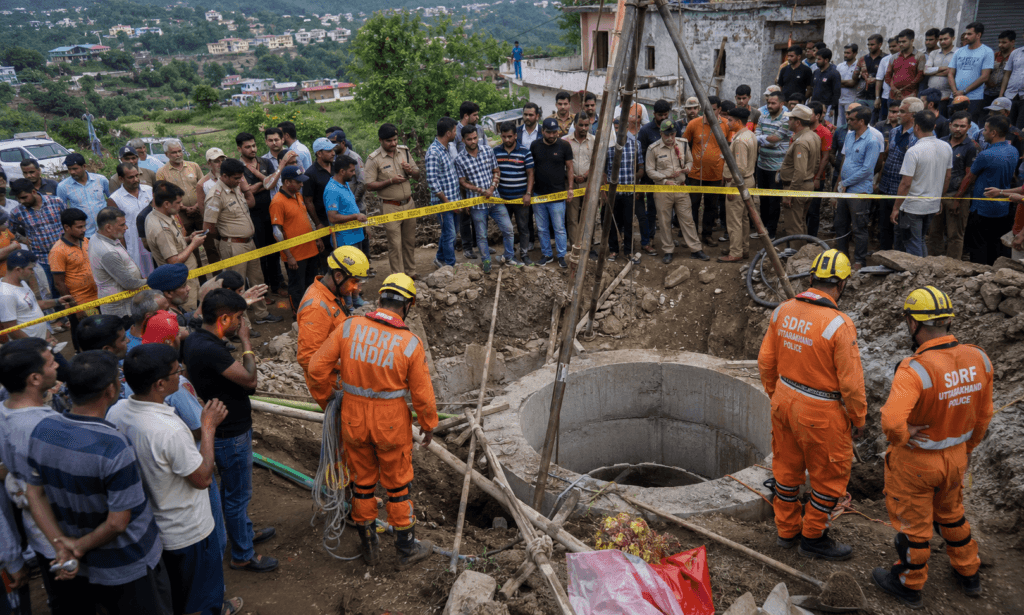
The image is illustration only | Made By AI
In Uttarakhand’s Haldwani on Tuesday evening, a routine construction task turned into a heart-wrenching tragedy when three members of the same family lost their lives after entering an underground water tank filled with poisonous gas. The incident took place in Manpur village under Kunwarpur Nyaya Panchayat of Gaulapar area.
Officials said 46-year-old Dharmendra Bisht had entered the newly constructed underground water tank while its shuttering was being removed. When he did not come back, his younger brother Khushal Singh went into the tank to rescue him. Within minutes both men were unconscious from the toxic gases trapped inside. In a desperate attempt to save her sons, their mother also climbed into the tank but met the same end. The three of them were rushed to Sushila Tiwari Hospital, where doctors declared them dead.
The incident has come as a shock to the residents of Haldwani and brought to the fore the lurking dangers of confined spaces such as underground water tanks.
Why and How Did the Accident Happen?
Initial reports suggest the underground water tank was newly built and had been closed for several days. These enclosed spaces are usually very poorly ventilated, and harmful gases tend to accumulate naturally.
Experts believe the victims were exposed to air with insufficient oxygen or poisonous gases such as hydrogen sulfide, methane or carbon dioxide. They are colorless; many are odorless and can render a person unconscious within seconds.
And then the tragedy began, a chain reaction. Dharmendra Bisht had entered the tank first and probably died from lack of oxygen. His younger brother Khushal Singh, unaware of the danger, climbed down to the rescue of his elder brother and also fainted. Their mother, in an emotional effort to save both sons, followed but was also lost in the toxic atmosphere.
Often, confined-space accidents become multiple-fatality incidents when family members or co-workers, attempting to rescue the victim, do so without protective equipment. Such rescue attempts are brave but too often result in more loss of life, say safety experts.
Police officials are investigating to determine the exact makeup of the gas and if any construction-related elements played a role in the fatal environment inside the tank.
Also read: India’s Cockroach Movement Protesters Show No Sign of Backing Down After Police Crackdown
Official Statements and Expert Views
All three victims were rushed unconscious to Sushila Tiwari Hospital, where they were declared dead by doctors, local authorities confirmed.
Post-mortem examinations have been ordered and forensic teams are examining the underground tank to ascertain the exact cause of death, officials said.
A disaster management expert said confined spaces should never be entered without proper ventilation and gas detection equipment. Safety professionals say you should always test the oxygen levels before entering underground tanks, wells, septic tanks or other enclosed spaces.
Medical experts also warn that toxic gases can cause unconsciousness within seconds, making it nearly impossible to rescue oneself.
Background and Context
In the last decade, India has seen a number of deadly incidents with toxic gases inside confined spaces. Most incidents happen during the cleaning of septic tanks, sewer lines, underground water tanks and wells.
Safety campaigns and regulations have been plentiful, yet many workers and homeowners still enter enclosed spaces without protective gear or proper ventilation.
Experts have always advised that anyone entering underground structures should be preceded by mandatory gas testing, ventilation systems, protective breathing apparatus and trained rescue teams.
The Haldwani tragedy is yet another painful reminder of such invisible dangers that continue to take lives across the country.
Timeline of Events
Tuesday, approx. 5:30 PM: start work of shuttering removal in the newly constructed underground water tank.
Dharmendra Bisht Walks Into the Tank. He climbs down the ladder but never comes back.
Khushal Singh tries to rescue his younger brother, who enters the tank and also loses consciousness.
Mother enters the tank. She tries to save both sons but inhales toxic gas and faints.
Local people rush the victims to Sushila Tiwari Hospital after rescuing them Emergency response
Hospital Confirmation: Doctors confirm all three members of the family are dead.
The inquiry has begun. Police and administration officials are investigating the incident.
Why This Matters
This tragedy is far more than a single accident. It also highlights a major public safety issue that impacts thousands of households and construction sites across India.
They may appear harmless enough from the outside, but underground water tanks, septic tanks, wells and sewer chambers often contain dangerously low levels of oxygen and poisonous gases that can kill within minutes.
Many people don’t know about these risks and try to do rescue operations without knowing the invisible danger. Such rescue efforts often result in multiple deaths in the same family, as has been seen in Haldwani.
This issue is quite critical since such tragedies can be prevented in the future through increased public awareness, proper training, and following safety protocols.
India Angle
This case becomes more relevant when we take into account the case of India, where the underground water tank storage system is common in Indian cities and villages.
In places like Uttarakhand, Uttar Pradesh, Rajasthan, Punjab, and Maharashtra, homeowners as well as constructors go inside the tanks without any safety equipment for cleaning, repairing, and inspection purposes.
It is believed that there is an immediate need to raise awareness among people regarding the risks involved in working inside the confined spaces. The state government, local government authorities, and builders can play an important role here.
By making the people aware of the risks, they can avoid deaths caused due to toxic gases.
Analysis
In terms of an editorial, the tragedy at Haldwani highlights the huge void in the area of safety consciousness. The country has seen fast development when it comes to infrastructure; however, education about the perils of confined space is lagging behind.
Almost all fatal cases that occur due to underground tanks are completely avoidable. Inadequate gas testing, insufficient ventilation, and impulse-based rescue operations result in deaths every single year.
The government could think about making confined-space safety regulations obligatory in residential buildings, especially when the presence of underground water reservoirs is concerned.
The number of lives that can be saved in the future cannot be determined. this story also covered by Amar Ujala in Hindi.
What Next?
In this regard, the case of Haldwani is relevant for India, since underground water tanks are widespread among both urban and rural populations in their houses.
People enter underground tanks for cleaning, repair and inspection in the states of Uttarakhand, Uttar Pradesh, Rajasthan, Punjab, and Maharashtra without any safety devices.
Experts say that there is an acute need to conduct awareness campaigns on confined spaces in all the regions. Authorities, municipalities and even builders should inform people about the threat of toxic gas exposure and encourage them to use gas detectors, ventilation system and protective equipment.
Grassroots-level awareness will significantly decrease the number of fatalities in the country.
Analysis
From the point of view of an editorial, the tragedy in Haldwani reveals the serious gap in public awareness of the issue of safety. India has built the modern infrastructure quickly but education in confined spaces has not kept up with it.
Fatal accidents in underground tanks are usually preventable by gas testing, ventilation and instinctive rescue attempts. Authorities have to think about imposing the requirements on safety in confined spaces in residential buildings, especially in the case of underground water tanks.
Awareness campaigns, stricter regulation of safety standards and trainings
Conclusion
The accident involving the death of a woman and her two sons at Haldwani stands out among the saddest accidents that have occurred in Uttarakhand lately. The normal activity of constructing soon turned into a heart-wrenching family tragedy because of the poisonous gases that had collected in the underground water tank.
As investigations on the incident proceed, it becomes clear that there was a need for caution before entering any kind of confined space. It is hoped that the incident will serve as an eye-opener to help prevent further such accidents in the future through increased knowledge and safety practices.
This tragic incident must mark the beginning of a new era for safety in confined spaces in India.