
A school vehicle had a narrow escape near Metro Line 9’s Medetiya Nagar station in Mira Bhayandar after granite material fell during crane work; MMRDA says no students were aboard and no injuries were reported.
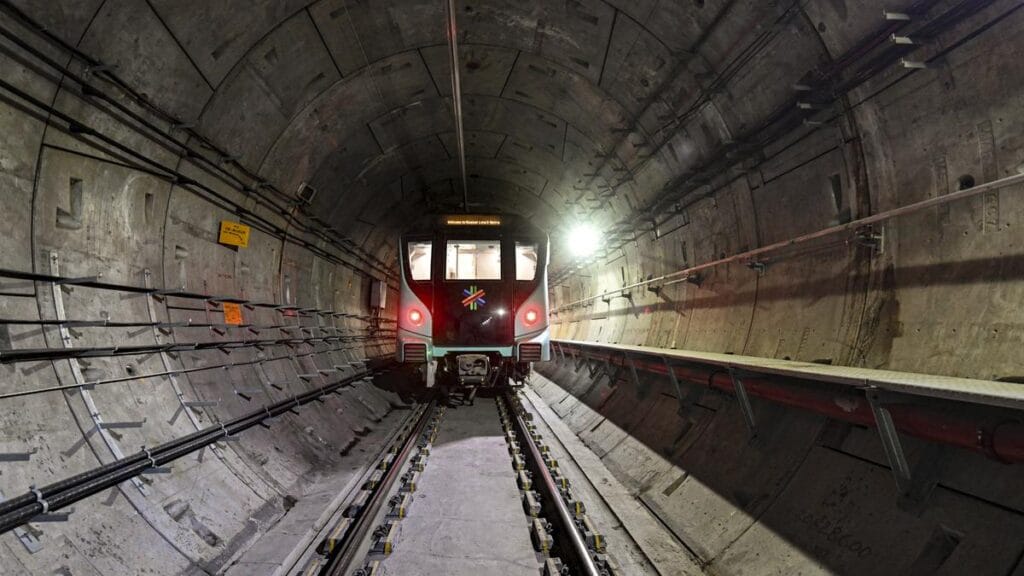
This image is only for illustrations. Image credit: The Hindu
A school vehicle had a narrow escape in Maharashtra’s Thane district on Monday, August 17, 2026, after granite stones kept for Mumbai Metro Line 9 construction fell from a foot overbridge-level work area near the Medetiya Nagar Metro station in Mira Bhayandar.
No one was injured, and the Mumbai Metropolitan Region Development Authority (MMRDA) clarified that no granite stone fell on or directly struck the school vehicle. It also said no students were inside at the time of the incident.
Taking serious note of the safety lapse, the MMRDA imposed penalties totalling ₹12.5 crore: ₹10 crore on main contractor J. Kumar Infraprojects Ltd. (JKIL), ₹1.5 crore on architectural finishing contractor N.A. Gajanan, and ₹1 crore on general consultant Systra-CEG.
What Happened at the Site
The incident occurred at around 11.50 am during debris-removal and material-shifting work at the Medetiya Nagar station site on Metro Line 9, part of the Dahisar–Mira Bhayandar Metro corridor.
According to the MMRDA, a material basket being handled by a crane accidentally came into contact with granite stones stacked near a foot overbridge (FOB) area. The impact caused some stones to fall from the elevated level into the barricaded construction zone below. This story was also covered by The Hindu.
The authority stressed that the stones fell within the barricaded work area and did not directly hit any school van or bus. However, scattered granite pieces later ended up on or near the road surface, and a passing school vehicle reportedly ran over them, causing tyre damage.
“Some scattered pieces were subsequently run over by a vehicle passing through the area, puncturing its tyres,” the MMRDA said. It added that no students were present in the vehicle and there were no injuries.
This clarification is important because early reports and social media videos suggested that a Metro slab or construction debris had fallen directly on a school van. The MMRDA has disputed that description, saying the incident involved granite material, not a structural collapse of the under-construction Metro station.
MMRDA’s ₹12.5 Crore Penalty Breakdown
The unusually steep financial penalty shows the MMRDA’s attempt to send a strong message on construction-site safety.
| Agency or contractor | Role in Metro 9 work | Penalty imposed |
|---|---|---|
| J. Kumar Infraprojects Ltd. (JKIL) | Main project contractor | ₹10 crore |
| N.A. Gajanan | Architectural finishing contractor | ₹1.5 crore |
| Systra-CEG | General consultant | ₹1 crore |
| Total | ₹12.5 crore |
The MMRDA said the penalties were imposed after taking serious note of the safety lapse at the construction site.
The fine against JKIL is the largest portion, reflecting its responsibility as the primary contractor for site management and work execution. The penalties against N.A. Gajanan and Systra-CEG underline that the authority is also holding finishing-work and supervisory entities accountable.
Statements and Clarifications
The MMRDA issued a detailed clarification to address confusion around the incident.
The authority said, “No granite stones fell on or directly struck any school vehicle during the incident.” It added, “No students were present in the vehicle at the time of the incident, and no injuries were reported.”
Explaining the chain of events, MMRDA said the crane-operated material basket accidentally contacted granite stones stored in the nearby FOB area. This caused the stones to fall into the barricaded construction area, after which scattered fragments were run over by a vehicle outside the immediate work zone.
The distinction matters. A slab collapse or direct impact on a school vehicle would point to a far more severe structural failure. MMRDA’s version describes a material-handling lapse involving improperly protected granite stones during construction operations.
Still, the size of the penalty makes clear that the authority considers the incident serious. Even without injuries, falling material near a public road and a school vehicle is a major red flag in a densely populated urban corridor.
Mumbai Metro Line 9 and Mira Bhayandar Construction
Mumbai Metro Line 9 is part of the broader Dahisar–Mira Bhayandar–Bhayandar corridor being developed by the MMRDA to improve connectivity between Mumbai’s northern suburbs and the fast-growing Mira Bhayandar region.
The Medetiya Nagar station is one of the active construction points on the corridor. Like many urban Metro projects, the work is taking place close to busy roads, residential areas, markets, hospitals, and schools. This makes construction safety especially critical.
Metro construction typically involves cranes, elevated viaducts, station structures, precast material, steel, granite or stone finishes, temporary barricades, and heavy equipment. When work is carried out near live traffic, even a small lapse in storage, lifting, barricading, or road cleaning can put commuters at risk.
The Mira Bhayandar region has seen intense infrastructure activity in recent years, with Metro construction expected to ease road congestion and strengthen last-mile connectivity. However, yeh development tabhi meaningful hoga jab public safety ko speed aur deadlines se upar rakha jaaye.
Timeline
August 17, 2026, around 11.50 am: Material-shifting and debris-removal work is underway at the Medetiya Nagar station site on Metro Line 9.
During crane operation: A material basket handled by a crane accidentally contacts granite stones stacked near the foot overbridge-level work area.
Granite stones fall: Some stones fall into the barricaded work area below; MMRDA says there is no structural collapse of the Metro station.
Vehicle tyre damaged: A passing school vehicle reportedly runs over scattered granite pieces, leading to tyre puncture or damage.
No casualties: MMRDA says no students were inside the vehicle, no stone directly struck it, and no injuries were reported.
MMRDA action: The authority fines JKIL ₹10 crore, N.A. Gajanan ₹1.5 crore and Systra-CEG ₹1 crore, totalling ₹12.5 crore.
Post-incident review: Safety processes around crane operations, material storage, barricading and road clearance are expected to come under scrutiny.
Also Read: 238 Vande Metro Locals Cleared for Mumbai: First AC Train Expected in 2027, Full Fleet by 2030
Why This Matters
Yeh incident kaafi important hai because it raises concerns about public safety around one of Mumbai Metropolitan Region’s biggest infrastructure projects.
A narrow escape: No child was on board and nobody was injured, but the event could have been far more serious had the vehicle been carrying students or pedestrians been nearby.
Construction-site safety: The incident points to possible gaps in how materials were stored, secured and handled during crane operations near a public road.
Accountability: The ₹12.5 crore penalty is a significant example of a project authority financially penalising not only the main contractor but also consultants and finishing contractors.
Public confidence: Metro projects need public support, but falling debris, even without injuries, can quickly damage trust among commuters and residents.
Urban risk: In Mumbai and Thane’s densely populated areas, construction zones are often just metres away from schools, buses, cars and pedestrians. One error can become a major tragedy.
India Angle
India is building Metro corridors at an unprecedented pace. Cities such as Mumbai, Delhi, Bengaluru, Chennai, Pune, Nagpur, Ahmedabad, Lucknow and Patna are expanding urban rail networks to reduce road congestion and improve mobility.
But as projects move through crowded neighbourhoods, safety management becomes as important as engineering speed. The Mira Bhayandar incident is a reminder that rapid infrastructure growth cannot mean relaxed oversight.
There are several practical lessons for urban project agencies across India:
Heavy construction materials must be stored away from public movement zones.
Crane operations need exclusion areas with strict supervision.
Temporary barricades must be tested for falling-object protection, not just access control.
Roads surrounding construction sites should be checked immediately after any material movement.
Contractors and consultants should face clear financial and operational consequences for safety breaches.
For parents and school operators, yeh concern bilkul genuine hai. School vehicles travel through congested roads every day, and construction sites must create safe corridors rather than additional risk.
Analysis
The MMRDA’s response deserves attention. A ₹12.5 crore penalty is not symbolic. It signals that the authority is willing to hold multiple parties accountable, including the contractor, the finishing agency and the general consultant.
However, a penalty after an incident is only one part of safety management. The bigger question is whether the MMRDA will now conduct preventive audits across all active Metro 9 sites and other Metro projects under its control. A site-specific response may calm immediate concerns, but a system-wide audit is what can prevent the next incident.
The MMRDA’s clarification that no stone struck the school vehicle and no child was inside should not dilute the seriousness of the lapse. It is fortunate news, not proof that the risk was minor. Infrastructure safety cannot be judged only by whether a disaster happened; it must be judged by whether systems were strong enough to prevent one.
What Next
The incident is likely to lead to several immediate and longer-term steps:
Safety audit: MMRDA may direct detailed inspections of material storage, crane operations, overhead work and barricading at Metro Line 9 sites.
Contractor compliance review: JKIL, N.A. Gajanan and Systra-CEG could be required to submit corrective action plans and safety compliance reports.
Traffic-side safeguards: Authorities may examine whether more protective netting, covered walkways, stronger barricades and road-cleaning teams are needed near active construction locations.
Independent verification: A third-party safety review could be considered to verify whether corrective measures have actually been implemented.
Public communication: MMRDA will face pressure to issue clear site-specific updates and avoid conflicting information during construction incidents.
Monitoring of future work: Any repeated safety lapse could lead to stronger action, including work suspension, blacklisting or contractual review.
Conclusion
The falling of granite stones near the Metro Line 9 worksite in Mira Bhayandar ended without injuries, but it exposed a serious safety failure in an active public area. The MMRDA has clarified that no stone directly hit the school vehicle and no student was on board, yet the punctured tyre and near miss underline how close the incident came to becoming a major tragedy.
By imposing ₹12.5 crore in fines on JKIL, N.A. Gajanan and Systra-CEG, the authority has taken a strong punitive step. The real measure of success, though, will be whether this action forces better planning, tighter supervision and zero-tolerance safety standards across every Metro construction site.
Mumbai needs Metro expansion, no doubt. Lekin development ka real meaning tabhi hai jab har commuter, school child aur pedestrian construction site ke paas bhi safe feel kare.
Written By A. Jack