
The committee also suggested 25 detailed steps to avoid such tree-fall incidents in the future. The findings shift the focus from departmental failure to failure of private execution.
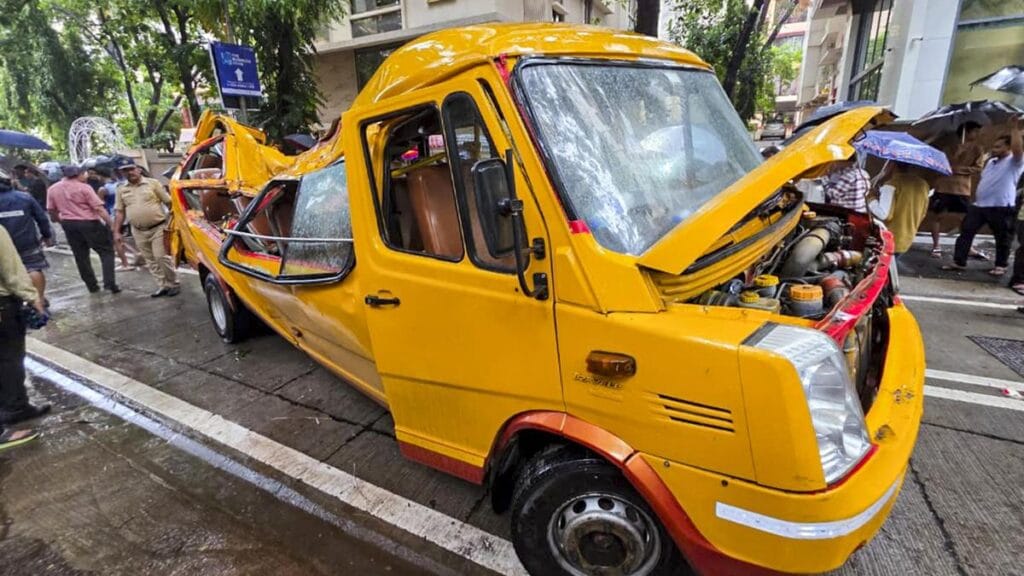
Officials inspect a tree-fall site in Chembur after the inquiry committee cleared BMC’s Gardens. Image Credit: The Hindu
The inquiry into the Chembur tree-fall incident has reached an important stage, with the committee on Monday, July 13, 2026, giving a clean chit to the Brihanmumbai Municipal Corporation’s Gardens and Roads Departments. At the same time, it held the contractor and the supervising consultancy accountable for negligence and recommended fines of ₹5 lakh and ₹2 lakh, respectively.
The report has drawn attention because tree-fall incidents in Mumbai are not just administrative issues; they are public safety matters that can have serious consequences during rains, storms and routine road work. By focusing responsibility on the contractor and consultancy, the committee has signalled that execution failures, not departmental intent, were central to this case. Yeh development kaafi important hai because it shifts the conversation from blame alone to accountability, prevention and better on-ground systems.
What the Committee Found
According to the committee’s findings, the BMC’s Gardens and Roads Departments did not act negligently in the Chembur case. Instead, the report points to shortcomings in how the contractor and the supervisory consultancy carried out their responsibilities. That distinction matters because it separates policy oversight from operational execution. This story was also covered by The Hindu.
In simple terms, the committee appears to have concluded that the departments may have had the right institutional role, but the actual work on the ground was not handled properly by the private parties involved. Such findings are common in civic incidents where the root cause is not one single failure but a chain of weak checks, poor maintenance or incomplete supervision. The recommended financial penalties are meant to reflect that chain of accountability.
The contractor has been recommended to pay ₹5 lakh, while the consultancy firm has been told to pay ₹2 lakh. The larger penalty on the contractor suggests the committee believed the primary lapse lay in direct execution. The consultancy, meanwhile, appears to have been penalised for failing in its supervisory duty, which is equally important in public works.
Why Tree-Fall Cases Matter in Mumbai
Tree-fall incidents in Mumbai are always serious because the city’s dense roads, ageing tree cover and monsoon exposure make public spaces vulnerable. When a tree falls, the impact can range from traffic disruption to injury, property damage or even death. That is why every incident triggers strong public concern and administrative review.
Mumbai’s urban environment makes this issue especially sensitive. Roads are narrow in many places, vehicles move closely together and footpaths are often busy. A weak tree root, poor pruning, waterlogging or delayed maintenance can turn a routine street into a hazard zone. Yeh issue kaafi important hai because city safety depends not just on emergency response but on preventive action long before an accident occurs.
The Chembur case has now added to the broader conversation on whether civic work is being monitored tightly enough. If contractors and consultants are not held to strict standards, the city risks repeating the same mistakes. The inquiry report therefore becomes more than a local finding; it becomes a warning about how public infrastructure is managed.
Also Read: Mumbai Monsoon Horror: 1,100 Trees Collapse in a Week as Rain and Wind Kill 3 People
The 25 Preventive Measures
One of the most notable parts of the report is its recommendation of 25 measures to prevent such incidents in the future. While the detailed list has not been fully reproduced in the information available, the very fact that the committee has proposed such an extensive set of steps suggests it is trying to move beyond blame and toward reform.
In practical terms, such measures usually include better inspection protocols, more frequent tree health assessments, stricter accountability for contractors, improved coordination between departments and faster response systems during weather alerts. The goal is not just to identify one fault but to reduce the chance of another tree-fall incident happening in the same city.
That is a sensible approach. Public safety reports are most useful when they do two things at once: assign responsibility and improve future systems. If the 25 recommendations are actually implemented, the report could help reduce risk across Mumbai’s road network. If they remain only on paper, however, then the city may continue to face the same dangers during the next storm or monsoon spell.
Background and Context
Chembur is one of Mumbai’s busy eastern suburbs, where residential pockets, commercial activity and major roads all operate in close proximity. That makes tree maintenance especially important because any failure can affect a large number of people quickly. Tree-fall cases in such areas are often linked to a mix of natural and human factors, including old trees, weakening roots, poor pruning and delayed inspections.
The Brihanmumbai Municipal Corporation has long faced public scrutiny over monsoon-related incidents. Each year, Mumbai residents watch closely for waterlogging, fallen trees and road safety issues. In that context, any inquiry into a civic mishap carries weight because people want to know whether the city learns from each incident or simply moves on to the next one.
This is also part of a wider Indian urban governance issue. Across major cities, contractor performance and consultancy oversight have become key factors in public works. It is no longer enough for a civic body to approve a project; the real test is whether the execution is monitored properly. The Chembur report reflects that growing expectation.
Timeline
Before July 13, 2026: The Chembur tree-fall incident occurs, triggering public concern and an inquiry.
Monday, July 13, 2026: The inquiry committee submits its findings.
Same day: BMC’s Gardens and Roads Departments receive a clean chit.
The report: The contractor and supervising consultancy are held negligent.
Recommendations: The committee suggests a ₹5 lakh fine on the contractor, ₹2 lakh on the consultancy and 25 preventive measures.
Why This Matters
This matters because civic safety is one of the basic responsibilities of urban governance. When a tree falls in a populated area, the public wants two things immediately: accountability and prevention. The committee’s report addresses both by identifying who was responsible and by recommending steps to avoid repeat incidents.
It also matters because the decision could affect how future civic contracts are handled. If contractors know that negligence will attract penalties, they may take maintenance and supervision more seriously. That creates a stronger incentive structure for public works. Yeh sab kaafi important hai because cities improve only when rules are enforced consistently, not just announced.
There is a broader social impact too. Residents want to feel safe walking, driving or living near public roads and trees. If people start believing that maintenance is taken lightly, trust in civic systems weakens. That is why such reports often become public-interest documents, not just technical files.
India Angle
For Indian readers, this story is a familiar example of how city infrastructure and accountability intersect. In Hinglish, seedhi baat yeh hai: urban India mein sirf road banana kaafi nahi hota, uska maintenance aur monitoring bhi equally zaroori hai. Mumbai, like many Indian metros, depends heavily on contractors, consultants and civic departments working in sync.
The case also reflects a common issue in Indian cities during monsoon-related hazards. Tree falls, potholes and drainage failures often reveal whether a city has actually prepared for seasonal risk or just reacted after the damage is done. The Chembur report is therefore relevant not only to Mumbai but to every Indian city trying to improve public safety.
It also sends a message about how blame should be assigned. Instead of automatically targeting the municipal departments, the committee has differentiated between oversight and execution. That kind of nuance is useful in Indian governance, where accountability often gets blurred between public agencies and private contractors.
Analysis
My opinion is that the report’s most valuable aspect is its focus on prevention. A clean chit alone would have been a limited story, but the addition of 25 measures makes it much more useful. It shows the committee is not just closing the case; it is trying to reduce future risk. That is how civic enquiries should work. They should not stop at naming fault. They should improve the system.
I also think the penalty structure is significant. By placing a larger fine on the contractor and a smaller one on the consultancy, the committee appears to be weighing primary versus supervisory negligence. That is a practical approach because public works fail in layers. The person doing the work and the person checking the work both matter. If either side is weak, the outcome can be dangerous.
Another important point is public perception. Many residents tend to blame the municipal body first when something goes wrong. This report suggests that, at least in this instance, the fault may have been in the execution chain rather than the department itself. That distinction can influence how future civic debates unfold. But of course, public trust will depend on whether the recommendations are followed through.
What Next
The next step will likely be the formal process of imposing the recommended penalties on the contractor and consultancy firm. If the recommendations are accepted, the fine will act as both punishment and deterrent. The BMC may also need to review how the 25 preventive measures will be implemented across wards and departments.
There may also be administrative follow-up within the civic system. Even though the Gardens and Roads Departments were cleared, the committee’s report could still lead to stronger inspection schedules, better documentation and tighter contractor monitoring. That would be a positive outcome if the city acts on it.
For residents, the most important next step is simple: seeing whether the city actually changes anything. Reports are useful only when they lead to visible improvements. If tree monitoring becomes stricter and hazards are identified earlier, then the Chembur incident may end up pushing Mumbai toward safer civic management.
Conclusion
The Chembur tree-fall inquiry has cleared the BMC’s Gardens and Roads Departments while placing responsibility on the contractor and supervising consultancy for negligence. With recommended penalties of ₹5 lakh and ₹2 lakh respectively, and 25 preventive measures proposed, the report goes beyond blame and points toward reform.
This is an important civic development because tree-fall incidents in Mumbai are not minor mishaps; they are public safety issues that demand accountability, stronger supervision and real preventive action. The real test now is whether the city turns these recommendations into practical change.
Written By A. Jack