
The National High Speed Rail Corporation Limited says the underground stretch is part of the 21-km tunnel connecting Sawli (Ghansoli) and Bandra Kurla Complex in Mumbai. The second TBM has now joined the first machine already working on the project.
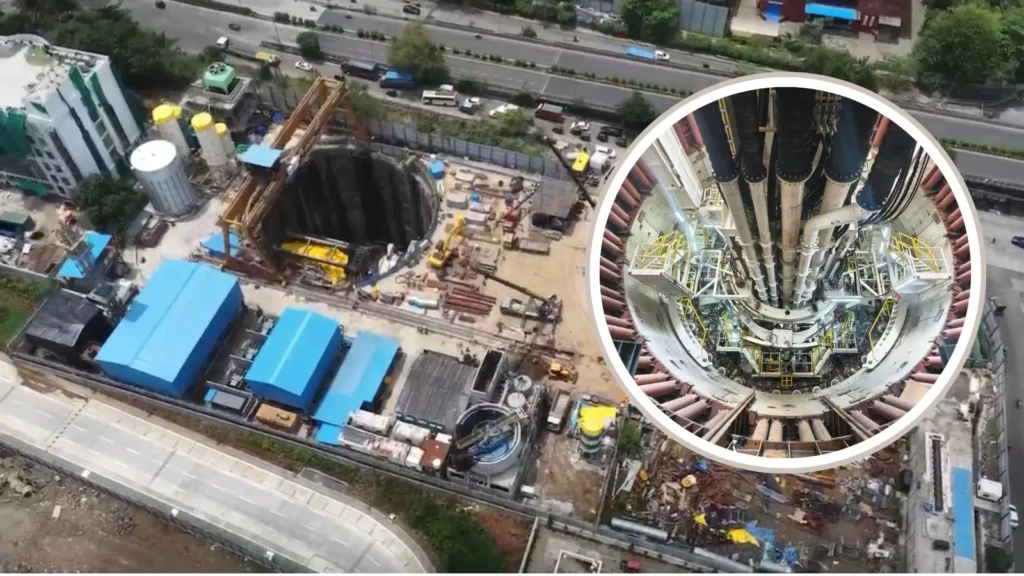
The second tunnel boring machine begins excavation for the Mumbai-Ahmedabad bullet train project. Image Credit: The IndianExpress
India’s most ambitious high-speed rail project has moved one step closer to reality. On Saturday, the National High Speed Rail Corporation Limited said the second tunnel boring machine, or TBM, has begun excavation work from Sawli (Ghansoli) toward Vikhroli in Maharashtra for the Mumbai-Ahmedabad bullet train project.
This is a major development because the tunnel section includes 7 km beneath Thane Creek, making it the country’s first undersea tunnel for a railway corridor. The broader underground stretch is 21 km long and will connect Sawli (Ghansoli) with Bandra Kurla Complex in Mumbai. With the first TBM already in operation and NATM work completed on another portion, the project is now visibly entering a more advanced phase. Yeh update kaafi important hai because it shows that one of India’s biggest infrastructure dreams is no longer just on paper – it is being built underground, piece by piece.
What Happened
The second TBM started its drive from Sawli (Ghansoli) toward Vikhroli in Maharashtra, according to NHSRCL. TBMs are giant machines used to cut through soil and rock underground while simultaneously supporting the tunnel structure. In a project like this, they are essential because they can dig long, precise routes under densely populated and environmentally sensitive areas. This story was also covered by the IndianExpress.
This section of the corridor is especially notable because 7 km of the 10-km tunnel segment will pass below Thane Creek. That means the machine is not only digging through land but also through a challenging undersea environment. For India, this is a first in railway construction and a major engineering milestone. The fact that two TBMs are now working in parallel shows how large and technically demanding the project is.
The tunnel being built between Sawli (Ghansoli) and BKC is 21 km long, making it one of the most complex underground rail stretches in the country. The first TBM began its 6-km drive from Vikhroli toward BKC on July 5, 2026. Meanwhile, the remaining 5 km has already been completed using the New Austrian Tunnelling Method, or NATM. That means different tunnelling techniques are being used depending on geological and structural requirements. Seedhi baat yeh hai: this is not ordinary digging, it is precision engineering on a massive scale.
Why This Tunnel Is Special
What makes this project stand out is not only the speed of the future train but also the tunnel itself. India has built many tunnels before, but an undersea rail tunnel adds another layer of complexity. The route beneath Thane Creek has to account for water pressure, soil stability, safety systems and long-term structural durability.
For railway engineers, this is the kind of project that tests planning, machine capability and coordination. It also represents a shift in how India builds transport infrastructure. In the past, many people associated bullet train headlines only with promises or delays. But visible excavation changes that perception. It turns the project into something concrete, measurable and difficult to dismiss.
The use of TBMs also reduces surface disruption compared with open construction. In a dense region like Mumbai, that matters a lot. It helps reduce impact on roads, buildings and daily life above ground. This is one reason why large underground rail projects are considered both expensive and technically elegant. Yeh issue kaafi important hai because India’s biggest cities need transport upgrades without creating even bigger surface chaos.
Background and Context
The Mumbai-Ahmedabad High-Speed Rail corridor has long been presented as India’s flagship bullet train project. It aims to connect two major economic centres with a high-speed rail link that could transform business travel, regional mobility and long-distance commuting. The project has drawn national attention because of both its scale and its ambition.
In Mumbai, the underground portion is among the most difficult sections. The 21-km tunnel between Sawli (Ghansoli) and BKC is being constructed with a mix of TBM and NATM methods. The first TBM started its 6-km drive from Vikhroli to BKC on July 5, and now the second TBM has begun work in the opposite direction from Sawli toward Vikhroli. That parallel progress is a sign that the underground phase is being executed in multiple segments to speed up the timeline.
The use of NATM for the remaining 5 km shows how tunnel design changes based on local ground conditions. Some sections are more suitable for boring machines, while others require controlled excavation methods. That combination of techniques is common in large urban tunnelling projects, but here it is happening on a first-of-its-kind undersea rail route in India. That gives the project both technical and symbolic significance.
Timeline
July 5, 2026: The first TBM begins its 6-km drive from Vikhroli toward BKC.
Before July 19, 2026: The remaining 5-km tunnel section is completed using NATM.
Saturday, July 19, 2026: NHSRCL announces that the second TBM has started excavation from Sawli (Ghansoli) toward Vikhroli.
Current phase: The 10-km tunnel segment, including 7 km under Thane Creek, is now under active excavation.
Why This Matters
This matters because the project represents a major step in India’s infrastructure capability. Building the country’s first undersea rail tunnel is not just about one rail line; it is about proving that Indian engineering can handle some of the most difficult urban and marine tunnelling conditions. That has implications for future projects in other cities too.
It also matters for mobility and economic growth. A bullet train between Mumbai and Ahmedabad could eventually reduce travel friction between two of the country’s most important commercial regions. Even before the full corridor is complete, the underground work in Mumbai shows that the project is advancing through its hardest terrain. Yeh issue kaafi important hai because transport projects like this can shape how cities grow, how businesses connect and how people move.
For everyday travellers, the significance is long-term but real. Faster and better-connected cities usually mean better access to jobs, education, tourism and business opportunities. If the project succeeds, it could change how people think about intercity rail in India. And if the engineering milestones keep coming, public confidence in high-speed rail could rise substantially.
India Angle
For Indian readers, this is more than just a construction update. It is a sign that India is entering a new phase of rail development. The country has long needed faster, cleaner and more efficient long-distance travel options, especially between major metros. In Hinglish, seedhi baat yeh hai: India ko aise projects ki zaroorat hai jo sirf headlines na ho, balki ground par bhi kaam karein.
Mumbai and Ahmedabad are both major economic hubs, and a bullet train connection between them is strategically important. If the project progresses as planned, it could reshape business travel patterns and improve regional integration. It could also set a benchmark for how India handles large underground and undersea infrastructure in the future.
The Mumbai undersea tunnel is particularly meaningful because it shows how Indian rail projects are moving into harder technical territory. This is not a standard elevated corridor or a surface-level track. It is a high-precision underground route with marine challenges. That makes the milestone more relevant for Indian engineering, planning and public policy.
Analysis
My opinion is that the second TBM start matters because it makes the project feel more real and balanced. When only one machine is working, the progress can seem slow and one-directional. With two TBMs operating, the underground work is clearly being pushed from multiple sides. That is a smart way to reduce time and show visible momentum. It also suggests that planners are serious about accelerating the most difficult part of the corridor.
I also think the undersea tunnel will become one of the defining images of the project. Public memory is often shaped by milestones that are easy to visualise. A tunnel under Thane Creek is exactly that kind of milestone. It is memorable, technically impressive and easy to explain in simple terms. From a communications standpoint, that makes the project more powerful and easier to follow.
At the same time, large infrastructure projects also attract questions about timelines, cost and delivery. So while this is clearly a positive update, the bigger test will be whether the excavation stays on schedule and whether the rest of the corridor advances at a similar pace. The public will want consistent progress, not isolated announcements. That is the real challenge for any mega-project.
What Next
The next step will be continued excavation by both TBMs as the underground section progresses toward completion. Engineers will monitor ground conditions, machine performance and tunnel alignment as work continues beneath land and water. Safety, precision and schedule control will remain the key priorities.
As the tunnel advances, more updates are likely on breakthrough points, structural lining and section-by-section completion. The remaining works in the underground zone will need careful coordination, especially where TBMs approach each other or different tunnel methods meet. That is where project management becomes just as important as engineering.
Public attention will likely remain focused on how fast the bullet train corridor can move from construction milestones to operational readiness. If progress remains steady, the project could continue to build confidence among supporters. If delays or technical issues arise, scrutiny will return quickly. For now, the second TBM’s start is a clear sign of forward motion.
Conclusion
The start of excavation by the second TBM in the Mumbai-Ahmedabad bullet train project marks a significant milestone in India’s first undersea rail tunnel. With 7 km of the 10-km tunnel passing beneath Thane Creek and a 21-km underground section linking Sawli (Ghansoli) to BKC, the project is entering one of its most technically demanding phases. The progress is important not only for the bullet train corridor itself but also for India’s wider infrastructure ambitions. As excavation continues, this underground breakthrough will likely stand out as one of the most symbolic steps in the country’s high-speed rail journey.
Written By A. Jack