For much of the final, Argentina had trouble finding its rhythm, and La Roja enjoyed the lion’s share of possession and opportunities. Torres scored the extra-time winner to give Spain their second World Cup crown and end Argentina’s reign.
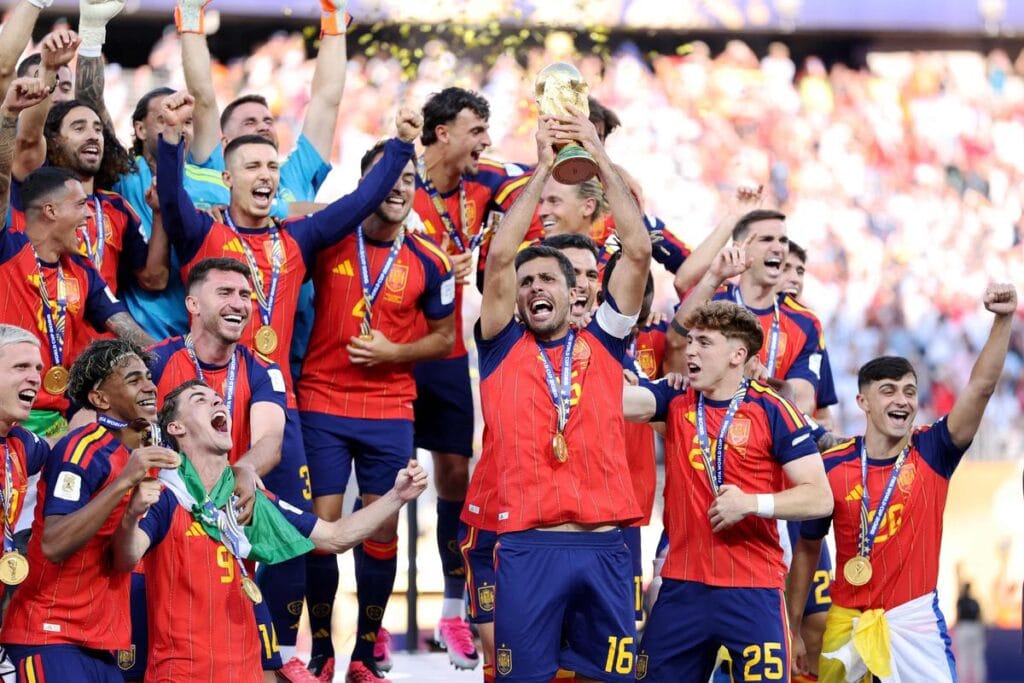
Spain lifts the FIFA World Cup Winner’s Trophy after the team’s victory following the FIFA World Cup 2026 Final match between Spain and Argentina at New York New Jersey Stadium. Image Credit: The Hindu
Spain defeated Argentina 1-0 in the FIFA World Cup final on Sunday, July 19, 2026, with substitute Ferran Torres scoring the winner in the 106th minute. The match was played under intense pressure, but Spain looked the more composed and dominant side from the start, controlling possession and creating far more chances than the defending champions.
Argentina, led by Lionel Messi, were able to survive for long stretches and force the game into extra time, but they rarely threatened with the same consistency as Spain. The final eventually tilted in La Roja’s favour when Torres made the breakthrough, securing Spain’s second World Cup crown. Yeh result kaafi important hai because it was a final decision not by chaos, but by patience, control and one perfectly timed moment.
How Spain Won the Final
Spain’s victory was built on dominance rather than drama. They controlled the ball for most of the match, kept Argentina pinned back in large spells and generated far more shot attempts. That kind of tactical control matters in finals because it forces the opponent to defend deep, absorb pressure and hope for a mistake or a counterattack that may never come.
Argentina’s plan seemed more cautious. They stayed compact and tried to survive Spain’s pressure, but they were tepid for much of the game and struggled to produce sustained attacking sequences. Lionel Messi, as always, remained a key reference point, but the defending champions could not turn individual brilliance into enough team momentum. Their best success came from delaying Spain’s breakthrough and dragging the contest into extra time. This story was also covered by TheHindu.
The decisive moment came in the 106th minute when substitute Ferran Torres found the net. That goal reflected both Spain’s persistence and their bench strength. Substitutes often change finals because tired legs and tactical fatigue create space late in matches. Torres took his chance, and that was enough. Seedhi baat yeh hai: Spain did not need a spectacular final — they needed one decisive strike, and they got it.
Why Spain Were So Effective
Spain’s win was not an accident. It came from structure, control and a clear game plan. In major finals, teams that dominate possession usually do so because they trust their passing patterns and pressing shape. Spain seemed comfortable keeping the ball and waiting for openings rather than forcing risky shots early.
That patience mattered. Finals often become tense because one mistake can decide everything, so teams tend to become cautious. Spain handled that pressure better than Argentina. They kept their shape, moved the ball with purpose and prevented the defending champions from turning the game into a transition battle. Argentina, by contrast, found it hard to settle into a rhythm.
It also helped that Spain kept generating pressure deep into the match. Even when a goal did not come in regulation time, the weight of control stayed with them. That kind of performance wears an opponent down mentally as much as physically. By the time extra time began, Argentina had already spent too much energy defending. Torres’ goal was the product of that cumulative pressure. Yeh issue kaafi important hai because finals are often won long before the goal is scored.
Background and Context
This final ended Argentina’s attempt to defend the title they had won previously. With Lionel Messi still central to their identity, the team arrived with huge attention and expectation. But Spain were the sharper side in this match and looked more like the team controlling the future of the game than the one chasing its past.
For Spain, this victory meant a second World Cup title. That places them again among the sport’s elite national teams and gives the current generation a defining international achievement. Winning a World Cup is always historic, but doing it with a controlled, tactically mature performance in the final adds extra weight.
The broader context also matters because World Cup finals are often remembered for iconic individual brilliance, late drama or penalty shootouts. This one followed a different pattern. Spain dominated, Argentina resisted, and the deciding moment came in extra time through a substitute. That makes it a more tactical final than a chaotic one, but no less memorable. In fact, many fans remember such matches precisely because the tension builds slowly and ends with a single swing.
Timeline
Before kickoff: Spain and Argentina enter the final as the two remaining teams in the FIFA World Cup 2026.
First 90 minutes: Spain dominate possession and shot attempts; Argentina stay compact and defensive.
End of regulation time: Argentina hang on and force extra time.
106th minute: Ferran Torres scores for Spain.
After the goal: Spain hold on to win 1-0 and claim the World Cup title.
Why This Matters
This matters because a World Cup final is the biggest match in international football, and its result shapes football history. Spain’s victory restores them to the top of the game and proves that possession-based, disciplined football can still win the biggest prize. For players, coaches and federations across the world, that is a valuable message. Yeh issue kaafi important hai because the final becomes a reference point for how elite football should be played.
It also matters because Argentina’s defeat ends a title defence and closes another chapter in Lionel Messi’s World Cup journey. Whether fans support Spain or Argentina, Messi’s presence makes every major final feel historic. His team’s struggle in this match will be studied for years, especially because they were unable to turn defensive resilience into enough attacking threat.
For the sport globally, this final reinforces the idea that modern football still rewards balance. Possession alone is not enough unless it leads to pressure and chances, and defence alone is not enough if it cannot hold forever. Spain combined control with patience and eventually found the breakthrough. That is why this final will be remembered as a lesson in structure and timing.
India Angle
For Indian football fans, this final is significant because World Cup finals are among the most watched sporting events in the country. In Hinglish, seedhi baat yeh hai: jab Spain aur Argentina jaisi teams final mein hoti hain, India ke football fans bhi poori raat ya subah ka wait karte hain. The match would have drawn attention not only from hardcore football followers but also from casual viewers who tune in for the biggest stage.
India’s football audience often learns a lot from these elite matches. Spain’s control, patience and tactical discipline offer a blueprint for teams that want to play modern football. For Indian players and coaches, finals like this show why structure matters as much as skill. Argentina’s struggle also shows that even great teams can look blunt when they cannot escape pressure or create enough attacking rhythm.
There is also a cultural angle. Indian fans have strong emotional connections with global football stars, especially Messi. Whenever he appears in a major final, interest spikes across social media, TV and streaming platforms. That means a result like this becomes part of India’s sports conversation immediately, even though the teams are thousands of kilometres away.
Analysis
My opinion is that Spain’s win will be praised by analysts because it came through method rather than spectacle. Finals often tempt teams into panic, but Spain stayed calm and controlled the match. That is not always the most glamorous way to win, but it is often the most reliable. The extra-time goal by a substitute is exactly the kind of moment that reflects squad depth and coaching trust.
I also think Argentina will be judged harshly because they could not threaten enough in a final where they had time to respond. Messi’s presence guarantees attention, but football still rewards the collective. If a team spends most of the match surviving rather than building, it is always vulnerable to a late decisive moment. Spain understood that and kept pressing until the game broke open.
From an editorial perspective, this final is especially strong because it offers both a result and a storyline. It has a champion, a historic goal, a superstar like Messi on the losing side and a clear tactical narrative. That combination is exactly what sports readers want: not just who won, but how and why.
What Next
The immediate next step is the celebration and review phase for Spain. Their players, coaching staff and federation will now begin reflecting on a title-winning tournament and what this means for the team’s future. Winning a World Cup usually reshapes expectations for the next cycle, especially for younger players and the national setup.
For Argentina, the focus will shift to rebuilding and deciding how to move beyond this defeat. Messi’s future will be a major talking point, as it always is after a high-profile tournament exit. The team will need to assess how to improve their attacking rhythm and reduce their reliance on defending under pressure.
For the football world, this final will now enter the archive of modern World Cup classics, not because it was wild, but because it was controlled and decisive. Fans, analysts and coaches will keep revisiting Spain’s approach and Argentina’s struggle to break out. Those discussions will continue well beyond the final whistle.
Conclusion
Spain’s 1-0 extra-time win over Argentina in the FIFA World Cup final gave La Roja their second world title and ended a tense, tactical match in dramatic fashion. Ferran Torres’ 106th-minute goal was the difference after Spain dominated possession and shot attempts for most of the contest. Argentina resisted bravely but could not find enough attacking spark to turn the final in their favour. In the end, Spain’s patience, depth and control proved decisive, delivering one of the most meaningful victories in their football history.
Written By A. Jack