
The wall fell on a parking shed inside the society and crushed two and four-wheelers parked below. Officials of the fire brigade said the collapse was caused due to incessant rains and only property damage was caused.
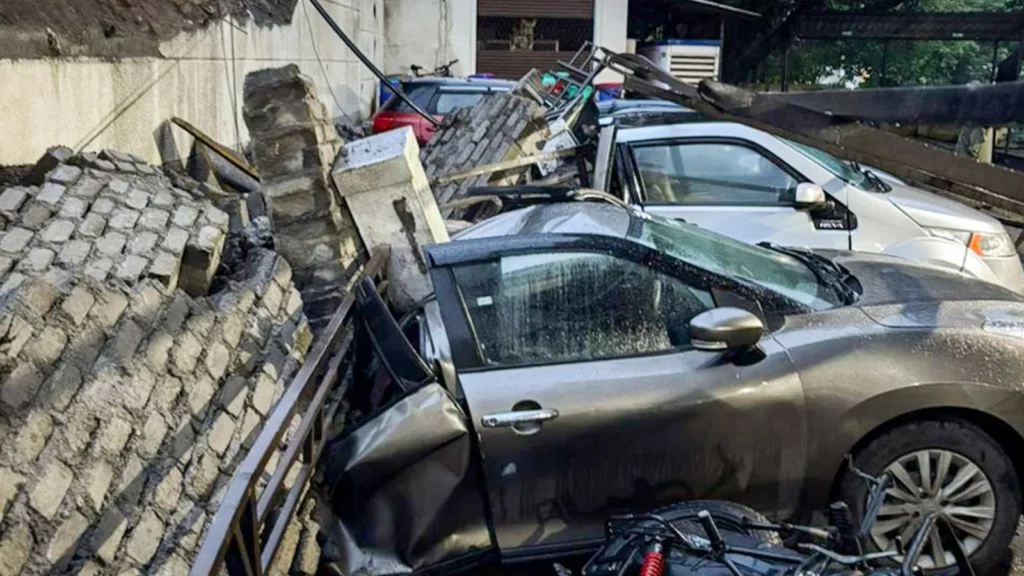
Damaged vehicles lie under debris after a residential society’s compound wall collapsed onto a parking shed in Pune’s Katraj area following heavy rainfall. IMage Credit: Indian Express
Pune witnessed another rain-related structural failure early on Sunday when the compound wall of a residential society in Katraj collapsed and damaged at least 14 vehicles. The incident took place around 3 a.m. on Jambhulwadi Road, after incessant heavy rainfall weakened the wall and caused it to cave in onto the parking shed below. Fire brigade officials confirmed that no person was injured.
The scene highlights the strain that Pune’s housing and drainage infrastructure can face during prolonged monsoon spells. While the loss in this case is limited to property, the incident could easily have turned dangerous if residents or security staff had been present in the parking area at the time. Yeh situation kaafi important hai because it shows how quickly rain can turn everyday residential spaces into risk zones.
What Happened
According to a fire official, the residential society is located on Jambhulwadi Road in Katraj. The compound wall collapsed following incessant rainfall and fell directly onto the parking shed. Several vehicles parked beneath the structure were damaged, including both two-wheelers and four-wheelers. The Hindu has covered the full story.
The exact structural reason for the collapse was not publicly detailed, but the pattern strongly suggests rain saturation and pressure buildup. In monsoon conditions, compound walls can weaken if water seeps into the base, especially if drainage around the wall is poor or if the wall has already developed cracks. Once the support gives way, the collapse can be sudden and destructive.
What makes this incident particularly concerning is the number of vehicles affected. Fourteen damaged vehicles mean a significant amount of property loss for residents, even though no human injury was reported. In residential societies, parking spaces are often crowded and tightly packed, so one collapse can damage multiple vehicles in a single event.
Why the Wall Likely Collapsed
Heavy rainfall is the immediate trigger, but monsoon damage usually has multiple layers behind it. Walls can collapse when the soil beneath them becomes too soft to support the structure. If water keeps collecting near the base, the pressure increases and the wall can fail suddenly. That is especially likely in areas where construction quality, maintenance and drainage systems are uneven.
Katraj, like many parts of Pune, has seen intense monsoon activity in recent years. When rain becomes continuous rather than brief, the risk grows because structures do not get enough time to dry out or stabilize. Parking sheds are also vulnerable because they are often built to protect vehicles, not to withstand a falling wall.
In this case, the collapse onto the parking shed added another layer of damage. Even if the wall itself had fallen elsewhere in the society, the impact may have been less severe. But once the wall came down onto a compact parking area, the vehicles below had little protection.
Official Response
Fire brigade officials reached the scene and assessed the damage. Their immediate confirmation that no one was injured helped reassure residents, but the property damage was still serious. Authorities typically focus first on whether any structural danger remains after such a collapse, because partial failures can lead to secondary incidents.
If a compound wall has already given way, nearby sections may also be unstable. That means residents usually need to avoid the affected area until engineers or civic staff inspect the site. Temporary precautions often include barricading, clearing parked vehicles, and checking whether waterlogging or soil erosion is still active around the base.
The response in this case appears to have been limited to emergency assessment and reporting, but the larger issue is the condition of the society’s perimeter wall and parking infrastructure. That is likely to become the focus in the next phase.
Background and Context
Pune’s monsoon season often exposes weak points in residential and civic infrastructure. Compound walls, retaining walls, parking sheds and low-lying basements are among the first structures to be affected when rain is intense and prolonged. These incidents are not always dramatic on the scale of a building collapse, but they still cause real losses for residents.
This particular case in Katraj is part of a broader pattern seen in many Indian cities during the rainy season. Walls weaken, drainage fails and parked vehicles become easy targets for falling debris. Even when injuries do not occur, the financial and emotional impact can be significant.
For many housing societies, vehicles represent expensive personal assets. Damage to a car or two-wheeler in a single incident can mean repair bills, insurance claims and days of inconvenience. That is why such incidents matter beyond the physical collapse itself.
Timeline
Early Sunday, around 3 a.m.: The compound wall of the residential society in Katraj collapses.
Immediately after collapse: The wall falls onto the parking shed inside the society.
At the scene: At least 14 vehicles, including two-wheelers and four-wheelers, are damaged.
Fire brigade response: Officials assess the site and confirm that no person is injured.
Aftermath: Residents are left dealing with property damage and concerns over structural safety.
Also Read: Mumbai-Pune Train Services Suspended After Landslides Hit Karjat-Lonavala Bhor Ghat Section
Why This Matters
This matters because even a single rain-triggered collapse can create a chain of losses for several families at once. A compound wall is often seen as a basic boundary structure, but in heavy rain it can become a hazard if not properly maintained. Yeh issue kaafi important hai because residential safety is not just about the inside of a building — it also includes walls, sheds, drainage and parking zones.
It also matters because monsoon-related damage is often predictable to some extent. If walls weaken every year during heavy rain, then preventive inspection becomes essential. The cost of checking and repairing a wall is usually much lower than the cost of replacing multiple damaged vehicles after a collapse.
For urban residents, this is another reminder that preparedness is a shared responsibility. Housing societies, builders, maintenance teams and civic agencies all have a role. When one link in that chain is weak, people pay the price.
India Angle
For Indian readers, the incident connects directly to a familiar monsoon problem: infrastructure that works in dry weather but struggles once the rain starts. In Hinglish, seedhi baat yeh hai — baarish aate hi asli test hota hai ki building aur boundary structures kitne strong hain. Pune is not alone in facing this issue; cities across India deal with similar wall collapses, waterlogging and property damage every year.
This story also resonates because many Indian families keep their vehicles in society parking lots where protection often depends on compound walls and sheds. When those structures fail, the damage is immediate and personal. That makes the incident not just a local Pune story but a wider urban safety issue.
There is also a public policy angle. As cities expand, residential societies increasingly rely on self-managed maintenance systems. That means regular inspections, drainage checks and monsoon preparedness plans matter more than ever. Without them, the same kind of incident can repeat in another building just a few streets away.
Analysis
My opinion is that this is not just about one wall falling down. It reflects a larger infrastructure management issue that becomes visible every monsoon. If a compound wall collapses after heavy rain, it often suggests either age, poor drainage, weak construction or a maintenance gap. Sometimes it is a combination of all four.
The fact that no one was injured should not reduce the seriousness of the incident. Property damage is still a major concern, especially when multiple residents are affected. In a society environment, these losses quickly turn into insurance claims, repair meetings and questions about who is responsible.
I also think this story will likely draw attention because of its timing. Pune has been seeing heavy rain-related disruptions, and each new incident adds to public anxiety. When such cases pile up, the conversation shifts from “rain damage” to “why are so many structures failing?” That is an important question for civic authorities and housing societies alike.
What Next
The next step will likely involve inspection of the remaining wall structure and the damaged parking area. Society managers may need to bring in structural experts to determine whether nearby sections of the wall are safe or whether more demolition and rebuilding is needed. Any waterlogging or drainage problem near the wall should also be checked immediately.
Residents will probably begin filing insurance claims for the damaged vehicles. Depending on policy coverage and the extent of the damage, repairs may take time. The society may also review whether the parking shed design offered enough protection in the event of a wall collapse.
On a broader level, the incident may push other housing societies in Pune to inspect their walls, sheds and drainage systems more carefully. That would be a positive outcome if it leads to prevention rather than just reaction. Monsoon safety works best when people act before the next collapse, not after.
Conclusion
The Katraj wall collapse is a reminder that monsoon damage in Indian cities often begins with small weaknesses that grow into bigger incidents under heavy rain. In this case, a residential society’s compound wall fell onto a parking shed early Sunday, damaging at least 14 vehicles but fortunately injuring no one. The property loss is significant, and the incident underlines the need for better maintenance, drainage planning and structural checks before each rainy season. In a city like Pune, where monsoon stress is a recurring reality, prevention remains the most practical form of protection.
Written By A. Jack