Demonstrations were held at Shivaji Park, Chaityabhoomi, Chembur and Shiv Sena Bhavan without permission, with a large crowd gathering outside Sena Bhavan in Dadar to raise slogans against Union Education Minister Dharmendra Pradhan and PM Narendra Modi.
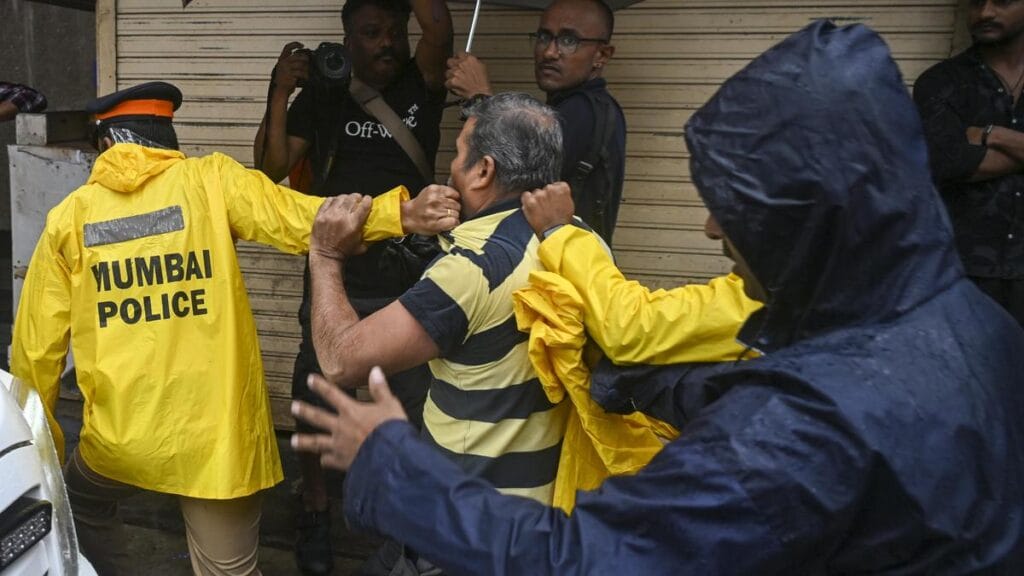
Protesters gather outside Shiv Sena Bhavan in Dadar, Mumbai. Image Credit: The Hindu
In a significant crackdown on unauthorised protests, Mumbai Police have registered 13 FIRs and booked around 400 people in five days for staging demonstrations in support of the Cockroach Janata Party (CJP) without obtaining prior permission. The cases, filed since July 18, cite unlawful assembly and breach of prohibitory orders as key charges against the accused. The protests, which were held at various locations including Shivaji Park, Chaityabhoomi, Chembur and Shiv Sena Bhavan, were part of the broader CJP-led agitation over alleged examination irregularities and demands for the resignation of Union Education Minister Dharmendra Pradhan.
A large number of people gathered outside Shiv Sena Bhavan in Dadar on Wednesday (July 22, 2026) and raised slogans against Pradhan and Prime Minister Narendra Modi. While demonstrations were staged at various places, no permission had been granted, an official said. The Mumbai Police have taken action regarding a protest that transpired at Chaityabhoomi in Dadar on July 20 without authorisation, and they are in the process of filing an FIR, according to the official.
What Happened and Why
The Mumbai Police have documented 13 cases connected to the demonstrations in the city that supported the CJP movement at Jantar Mantar in New Delhi. These First Information Reports (FIRs) have been filed since July 18, citing various violations related to unlawful gatherings and contraventions of prohibitory orders. Approximately 400 individuals have been identified as suspects in these reports.
In all 13 cases, the accused have been charged with offences including disobeying a lawful order issued by a public servant, wrongful restraint, and unlawful assembly, among other legal provisions. Cases have been registered at different police stations, and notices were issued to those named in the FIRs, following which they were allowed to leave, officials said on Wednesday. This story was also covered by The Hindu.
The protests were part of the broader CJP-led agitation over alleged examination irregularities and demands for the resignation of Union Education Minister Dharmendra Pradhan. The movement has drawn widespread attention, with supporters from across the country joining the protests in Delhi and other cities. In Mumbai, the Shiv Sena (UBT) has announced open support for the CJP movement and its demands, including accountability over alleged exam paper leaks, resignation of Pradhan, and an overhaul of India’s education system.
Detailed Breakdown of Locations and Charges
The demonstrations occurred at multiple locations across Mumbai, including Shivaji Park in Dadar, Chaityabhoomi in Dadar, Chembur in eastern Mumbai, and Shiv Sena Bhavan in Dadar. At Shivaji Park, over 2,000 people gathered on Wednesday, leading to detentions and a standoff with police. In Chembur, protesters faced similar action, with police making preventive detentions and filing FIRs.
The charges against the accused include disobeying a lawful order issued by a public servant (Section 186 of the Bharatiya Nyaya Sanhita), wrongful restraint (Section 341 BNS), and unlawful assembly (Section 143 BNS). These provisions are part of the new criminal laws that replaced the Indian Penal Code in 2023, and they carry penalties ranging from fines to imprisonment.
The Mumbai Police said further investigation into the registered offences is underway. Officials noted that the protests were held without prior permission, violating the Maharashtra Police Act and the Public Meetings, Agitations and Processions Rules, 2025, which require organisers to obtain permission from authorities before holding public gatherings.
Background and Context
The CJP protest at Jantar Mantar began on June 20, 2026, with activists demanding education reforms and the resignation of Union Education Minister Dharmendra Pradhan over alleged examination irregularities. The movement has drawn widespread attention, with supporters from across the country joining the protests in Delhi and other cities.
In Mumbai, the Shiv Sena (UBT) has announced open support to the CJP movement and its demands. The main demonstration of the Opposition party was held outside its headquarters, the Shiv Sena Bhavan, in Dadar, and it was joined by students. The agitators also denounced the alleged police brutality against CJP supporters during their ‘Sansad Chalo’ march in New Delhi on July 20.
The Bombay High Court has previously ruled that public places cannot be occupied indefinitely and that demonstrations should be held only at designated places. In a recent judgement, the court said that while democracy and dissent go hand in hand, demonstrations should be held only at designated places and after obtaining prior permission from authorities.
Timeline
June 20, 2026: The CJP protest begins at Jantar Mantar, demanding education reforms and the resignation of the Union Education Minister.
July 18, 2026: Mumbai Police begin registering FIRs against protesters for staging demonstrations without permission.
July 20, 2026: Protest at Chaityabhoomi in Dadar without authorisation; police begin filing FIR.
July 21, 2026: Shiv Sena (UBT) stages protests in different parts of Mumbai, including outside Shiv Sena Bhavan.
July 22, 2026: Over 2,000 gather at Shivaji Park; police make preventive detentions and file FIRs.
July 23, 2026: Mumbai Police confirm 13 FIRs and around 400 booked in five days for unauthorised protests.
Also Read: Teen Protester May Lose Sight in One Eye After Pellet Injury at CJP Delhi March
Why This Matters
This matters because it highlights the tension between the right to protest and the requirement to obtain prior permission for public gatherings. The Mumbai Police’s action against 400 protesters shows that authorities are taking a strict stance on unauthorised demonstrations, even in the context of a broader movement demanding education reforms. Yeh issue kaafi important hai because it affects not only the protesters but also public order and the rule of law.
It also matters because the charges against the accused include disobeying a lawful order issued by a public servant, wrongful restraint, and unlawful assembly, which carry penalties ranging from fines to imprisonment. The use of these provisions against protesters raises questions about the balance between maintaining public order and protecting the right to dissent.
For families across India, the issue is personal. Many have children or relatives who are studying for competitive exams or facing job uncertainty. That makes the protest relatable and emotionally powerful. It is not just about one activist; it is about the future of millions of young people.
India Angle
For Indian readers, this story matters because it touches on the right to protest, the use of force by security forces and the accountability of law enforcement. In Hinglish, seedhi baat yeh hai: jab protest hota hai, toh police ka kya role hona chahiye?
The case also highlights the growing youth movement in India demanding education reform and government accountability. The CJP protest has become a rallying point for the broader youth movement, which has drawn widespread support across the country. The alleged use of pellet guns has added to the sense of anger and frustration among protesters, who feel their safety is being compromised.
For families across India, the issue is personal. Many have children or relatives who are studying for competitive exams or participating in protests. That makes the protest relatable and emotionally powerful. It is not just about one activist; it is about the safety of young people who are exercising their right to protest.
Analysis
My opinion is that the Mumbai Police’s action against 400 protesters is a significant development that shows authorities are taking a strict stance on unauthorized demonstrations. However, the use of charges like disobeying a lawful order and unlawful assembly against protesters raises questions about the balance between maintaining public order and protecting the right to dissent.
I also think the case highlights the importance of transparency and accountability in crowd control measures. The Bombay High Court’s ruling that demonstrations should be held only unauthorised places and after obtaining prior permission is clear, but the enforcement of this rule against protesters raises questions about the credibility of official statements.
From an editorial perspective, this is a strong story because it has a clear central event, human interest angle and broader public safety implications. It is not just about one protester; it is about the rules of engagement for security forces and the potential for non-lethal weapons to cause severe injuries. The challenge is to explain the story in a way that is both factual and accessible to readers who want to understand the big picture.
What Next
The next step will depend on the outcome of the ongoing investigations into the 13 FIRs and whether the accused face trial or are granted bail. If the accused are convicted, they could face penalties ranging from fines to imprisonment, depending on the severity of the charges.
There may also be further legal challenges or appeals related to the charges against the protesters or the state’s handling of the protest. The CJP movement is likely to continue its protests, and the safety of protesters will remain a key issue. The government’s response to the protest will also be closely watched.
For now, the situation remains fluid. The Mumbai Police’s action against 400 protesters is a significant development, but the underlying issues that led to the protest remain unresolved. Whether the government responds to the CJP’s demands or the movement gains further momentum will determine the next phase of the protest.
Conclusion
The Mumbai Police’s registration of 13 FIRs and booking of around 400 people in five days for staging protests in support of the CJP without permission marks a significant development in the ongoing agitation over NEET paper leaks and education reforms. The cases, filed since July 18, cite unlawful assembly and breach of prohibitory orders as key charges against the accused.
The protests, which were held at various locations including Shivaji Park, Chaityabhoomi, Chembur and Shiv Sena Bhavan, were part of the broader CJP-led agitation over alleged examination irregularities and demands for the resignation of Union Education Minister Dharmendra Pradhan. Whether the accused face trial or are granted bail, the underlying issues that led to the protest remain unresolved, and the balance between maintaining public order and protecting the right to dissent will continue to be a key issue.
Written By A. Jack