The government gave written assurance that cases against non-violent students will be withdrawn and that compensation for NEET aspirants who took their lives will be considered. Prime Minister Modi also announced fast-track courts to deal with paper leak cases.
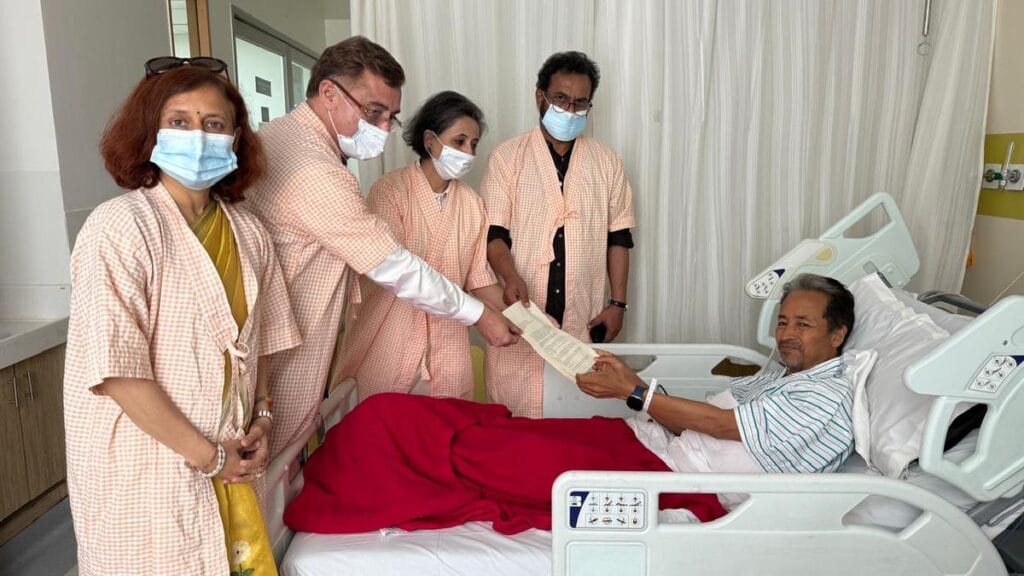
Sonam Wangchuk breaks his 26-day fast at Medanta Hospital in Gurugram in the presence of Union Ministers JP Nadda and Jitendra Singh. Image Credit: The Hindu
In a significant development in the ongoing CJP-led protest over NEET paper leaks and education reforms, activist Sonam Wangchuk broke his 26-day hunger strike late on Thursday (July 23, 2026) at Medanta Hospital in Gurugram. The fast was broken in the presence of Union Ministers JP Nadda and Jitendra Singh, following long negotiations on various conditions. Wangchuk announced the end of his fast on social media, saying he did so “in view of possible violence in the country” and after receiving assurances from the government on key demands.
Leh Apex Body co-convenor Cherring Dorjay Lakruk said the government gave a written assurance that cases against students will be taken back if they are not violent. He also said the government gave a written assurance that they will consider compensation for NEET aspirants who took their own lives. However, CJP founder Abhijeet Dipke made it clear that the protest will continue until Education Minister Dharmendra Pradhan resigns, saying the peaceful demonstration at Jantar Mantar will persist until that demand is met.
What Happened and Why
Wangchuk began his indefinite hunger strike on June 28 after joining the CJP-led protest at Delhi’s Jantar Mantar over the NEET paper leak. He fasted in solidarity with students calling for the resignation of Union Education Minister Dharmendra Pradhan and broader education reforms. Over the course of his 26-day fast, the activist lost nearly 11 kgs, even as he repeatedly appealed for calm and urged protesters to remain peaceful despite the police crackdown during the ‘Sansad Chalo’ march on July 20. This story was also covered by The Hindu.
On July 18, Delhi Police shifted Wangchuk from the protest site to Safdarjung Hospital, citing concerns over his deteriorating health. His wife, Gitanjali Angmo, challenged the move in the Delhi High Court, which later ordered his transfer to Medanta Hospital in Gurugram. The court said the transfer was necessary to ensure his safety and protect his fundamental rights under Articles 19 and 21 of the Constitution.
In an open letter and video on Wednesday, Wangchuk had said he was ready to break his fast if the government gave him assurances on key demands, including no legal action against agitators who mounted a massive protest that rocked Delhi earlier this week. He said he would explain the conditions in detail in a separate video very soon.
Government Assurances and PM Modi’s Address
The government’s written assurances to Wangchuk included two key points: first, that cases against students will be taken back if they are not violent, and second, that compensation for NEET aspirants who took their lives will be considered. These assurances were given in the presence of Union Ministers JP Nadda and Jitendra Singh, who met Wangchuk at Medanta Hospital.
Earlier in the day, Prime Minister Narendra Modi, through his social media posts, sought to address student concerns on NEET paper leaks. He said, “I am deeply aware that a paper leak is no ordinary lapse; it is an injustice that inflicts severe distress upon millions of aspiring students and their families. It is in response to this gravity that we have executed swift, uncompromising measures over the past two and a half months. The offenders have been arrested, and they now stand behind bars.”
PM Modi also announced fast-track courts to ensure swift punishment for paper leaks. The Delhi High Court, in another late-night development, designated Judge Anu Grover Baliga as Special Judge of the fast-track court to deal with criminal cases arising out of paper leaks and the use of unfair means in public examinations.
CJP’s Response and Continued Protest
Despite Wangchuk’s decision to end his fast, the CJP has made it clear that its protest will continue until Education Minister Dharmendra Pradhan resigns. CJP convener Abhijeet Dipke welcomed Wangchuk’s decision to end his fast but added that their protest demanding Pradhan’s resignation will continue.
Dipke said, “The peaceful demonstration at Jantar Mantar will persist until Pradhan resigns. We will ensure that Sonam sir’s hunger strike is not in vain. We will not allow the brutal assault on students to go unaddressed.” He also humorously suggested that Pradhan should resign as a birthday gift, saying, “We would appreciate it if you could do us a favour by submitting your resignation. We will prepare a resignation letter as a present for your birthday, and all we ask is for you to stamp it with your thumb.”
A government source said a delegation of the CJP will meet with Ministers on Friday (July 24, 2026) at 12.30 p.m., but the venue has not been disclosed. The CJP is yet to comment on this meeting.
Also Read: 17 Delhi Metro Stations To Remain Shut From 7.30 AM Today
Background and Context
The CJP protest at Jantar Mantar began on June 20, 2026, with activists demanding education reforms and the resignation of Union Education Minister Dharmendra Pradhan over alleged examination irregularities. The movement has drawn widespread attention, with supporters from across the country joining the protests in Delhi and other cities.
Wangchuk’s 26-day hunger strike has become a symbol of the broader youth movement demanding education reform and government accountability. His fast has drawn widespread attention, with supporters from across the country joining the CJP protests in Delhi and other cities. The movement has grown to include students, professionals and families who feel the education system is failing them.
The ‘Sansad Chalo’ march on July 20 erupted in chaos and clashes, with at least 60 protesters injured, according to Delhi Police estimates. The repeated closures of 17 Delhi Metro stations from July 22 to July 24 have also caused significant inconvenience to commuters, office-goers and students in the capital.
Timeline
June 20, 2026: The CJP protest begins at Jantar Mantar, demanding education reforms and the resignation of the Union Education Minister.
June 28, 2026: Sonam Wangchuk begins indefinite hunger strike in solidarity with CJP protesters.
July 18, 2026: Delhi Police shift Wangchuk from protest site to Safdarjung Hospital, citing health concerns.
July 21, 2026: Delhi High Court orders Wangchuk’s transfer to Medanta Hospital in Gurugram.
July 20, 2026: ‘Sansad Chalo’ march erupts in chaos; at least 60 protesters injured.
July 22–24, 2026: 17 Delhi Metro stations remain closed for three consecutive days due to security arrangements.
July 23, 2026 (late night): Wangchuk breaks a 26-day fast at Medanta Hospital in the presence of Union Ministers.
July 23, 2026 (late night): PM Modi announces fast-track courts for paper leak cases.
July 24, 2026 (12.30 p.m.): The CJP delegation is scheduled to meet with Ministers.
Also Read: Teen Protester May Lose Sight in One Eye After Pellet Injury at CJP Delhi March
Why This Matters
This matters because it highlights the tension between the government’s willingness to engage with protesters and the CJP’s insistence on the resignation of the Education Minister. Wangchuk’s decision to end his fast after receiving assurances from the government is a significant development, but the CJP’s continued protest shows that the underlying issues remain unresolved. Yeh issue kaafi important hai because it affects not only the injured protesters but also public trust in the education system and law enforcement.
It also matters because the use of fast-track courts and the government’s written assurances on withdrawing cases against non-violent students and considering compensation for NEET aspirants who took their lives are significant steps toward addressing the protesters’ demands. However, the CJP’s insistence on Pradhan’s resignation shows that the movement is not just about exam reforms; it is also about accountability and political responsibility.
For families across India, the issue is personal. Many have children or relatives who are studying for competitive exams or facing job uncertainty. That makes the protest relatable and emotionally powerful. It is not just about one activist; it is about the future of millions of young people.
India Angle
For Indian readers, this story matters because it touches on the right to protest, the use of force by security forces and the accountability of law enforcement. In Hinglish, seedhi baat yeh hai: jab protest hota hai, toh government ka kya role hona chahiye?
The case also highlights the growing youth movement in India demanding education reform and government accountability. The CJP protest has become a rallying point for the broader youth movement, which has drawn widespread support across the country. The alleged use of pellet guns has added to the sense of anger and frustration among protesters, who feel their safety is being compromised.
For families across India, the issue is personal. Many have children or relatives who are studying for competitive exams or participating in protests. That makes the protest relatable and emotionally powerful. It is not just about one activist; it is about the safety of young people who are exercising their right to protest.
Analysis
My opinion is that the government’s written assurances on withdrawing cases against non-violent students and considering compensation for NEET aspirants who took their lives are significant steps toward addressing the protesters’ demands. However, the CJP’s insistence on Pradhan’s resignation shows that the movement is not just about exam reforms; it is also about accountability and political responsibility.
I also think the case highlights the importance of transparency and accountability in crowd control measures. The Delhi Police’s denial of pellet gun use, despite medical evidence to the contrary, raises questions about the credibility of official statements. The CRPF’s silence on the matter is also concerning, as it suggests a lack of willingness to address the allegations.
From an editorial perspective, this is a strong story because it has a clear central event, human interest angle and broader public safety implications. It is not just about one protester; it is about the rules of engagement for security forces and the potential for non-lethal weapons to cause severe injuries. The challenge is to explain the story in a way that is both factual and accessible to readers who want to understand the big picture.
What Next
The next step will depend on the outcome of the CJP’s meeting with Ministers on Friday (July 24, 2026) and whether the government is willing to consider the resignation of Education Minister Dharmendra Pradhan. If the government refuses to accept Pradhan’s resignation, the CJP is likely to continue its protests, and the safety of protesters will remain a key issue.
There may also be further legal challenges or appeals related to the alleged use of pellet guns or the state’s handling of the protest. The CJP movement is likely to continue its protests, and the safety of protesters will remain a key issue. The government’s response to the protest will also be closely watched.
For now, the situation remains fluid. Wangchuk’s decision to end his fast after receiving assurances from the government is a significant development, but the underlying issues that led to the protest remain unresolved. Whether the government responds to the CJP’s demands or the movement gains further momentum will determine the next phase of the protest.
Conclusion
Sonam Wangchuk’s decision to end his 26-day hunger strike after receiving written assurances from the government marks a significant development in the CJP-led protest over NEET paper leaks and education reforms. The government’s assurances on withdrawing cases against non-violent students and considering compensation for NEET aspirants who took their lives are significant steps toward addressing the protesters’ demands.
However, the CJP’s insistence on the resignation of Education Minister Dharmendra Pradhan shows that the movement is not just about exam reforms; it is also about accountability and political responsibility. Whether the government responds to the CJP’s demands or the movement gains further momentum will determine the next phase of the protest and the impact on public transport.
Written By A. Jack