
Mujammil Khokhar has been named as the victim, and police and fire brigade teams rushed to the spot in the Thane district. Officials are still trying to figure out the exact cause of the collapse.
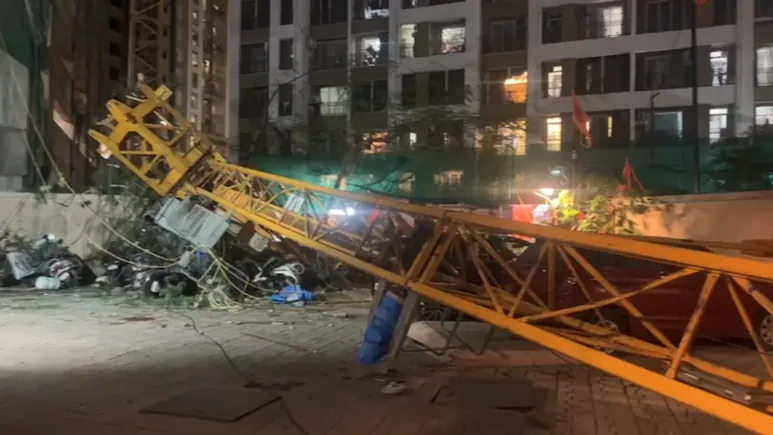
Rescue teams respond after a construction crane collapsed from the 13th floor of an under-construction building at JP North Society in Mira Road near Mumbai. Image Credit: NDTV
A serious accident at the JP North Society in Mira Road (East), on the outskirts of Mumbai, has left one person dead and three others injured after a construction crane collapsed from the 13th floor of an under-construction high-rise. The crane came crashing down on Thursday, damaging several vehicles parked below and sending shockwaves through the residential complex.
The victim has been identified as Mujammil Khokhar, while the injured were rushed for medical attention. Police and fire brigade teams reached the spot quickly and carried out rescue and relief work on a war footing. The exact cause of the crane collapse is still under investigation, but the incident has again raised questions about construction-site safety in densely populated urban areas. Yeh incident kaafi serious hai because a single equipment failure ended a life and injured others in a residential zone.
What Happened at the Site
According to the available information, the crane was being used at the under-construction high-rise when it collapsed from the 13th floor and fell into the residential complex. The impact damaged multiple vehicles parked below, showing how severe the collapse was. Such accidents are especially dangerous in mixed-use and residential construction zones because workers, residents, visitors and parked vehicles can all be at risk at the same time.
The immediate response from authorities was fast. Police and fire brigade personnel rushed to the location after receiving information about the accident. Rescue operations were completed on a war footing, suggesting that emergency teams treated it as a high-priority site with possible trapped victims or further danger. At this stage, the number of injured people had not been fully clarified in the initial report, but three injuries were confirmed. This story was also covered by NDTV.
The most important unanswered question is why the crane fell. Was it a mechanical failure, an issue with installation, a lapse in maintenance, or an operational error? Those details will matter a great deal once investigators examine the machinery, site conditions and construction practices. Until then, the accident remains a tragic example of how quickly a worksite can turn into a disaster zone.
Rescue and Emergency Response
Emergency response is critical in accidents like this because the first few minutes often decide the extent of further harm. In this case, police and fire brigade teams were deployed quickly, which likely helped contain the situation and begin rescue work before the area could become even more dangerous. The fact that several vehicles were damaged also suggests the collapse generated a significant impact zone around the building.
Rescue operations at construction-related accidents typically involve checking for trapped workers, clearing debris safely and securing the site to prevent secondary collapses. Since the crane reportedly fell from the 13th floor, the structure may have created unstable debris around the tower and parking area. That means the response would have needed careful coordination between emergency teams and site personnel.
Even though official details are limited, the scale of the response shows that the incident was treated as a major safety event. That is appropriate because high-rise construction sites are complex and any collapse involving heavy machinery can quickly become life-threatening. Seedhi baat yeh hai: when a crane falls in a populated area, every minute counts.
Background and Context
Mira Road and the broader Thane-Mumbai belt have seen rapid urban growth and large-scale residential construction over the years. With this growth comes more high-rise projects, more machinery on site and more pressure on safety systems. Cranes, in particular, are essential tools in tall-building construction, but they also require strict inspection, careful operation and constant maintenance.
Construction accidents in urban India often raise the same concerns: was the equipment checked properly, were safety protocols followed? Was the site supervised adequately? These questions become even more important when the accident happens inside or near a residential society. People living nearby are not just bystanders; they are directly exposed to the risks of construction activity.
This case is especially alarming because the crane collapse happened from such a height and caused damage in a populated complex. That suggests the consequences could have been far worse. The fact that only one death and three injuries have been reported so far is tragic enough, but it also indicates that a larger disaster may have been narrowly avoided. Yeh issue kaafi important hai because high-rise safety in city suburbs affects thousands of families living around active construction zones.
Timeline
Thursday: The crane collapses from the 13th floor at JP North Society in Mira Road (East).
Immediately after the incident: Several parked vehicles are damaged by the falling crane.
Soon after: Police and fire brigade teams arrive on the spot.
During rescue efforts: One death and three injuries are confirmed.
Following the incident: The victim is identified as Mujammil Khokhar.
Now: Authorities are still investigating the exact cause of the collapse.
Why This Matters
This matters because construction safety is not just an engineering issue; it is a public safety issue. In crowded urban zones, a single failure can injure workers, residents and anyone nearby. When a crane collapses from a high floor, the consequences can be fatal and expensive in equal measure. Yeh issue kaafi important hai because it shows how industrial risk can spill directly into residential life.
It also matters because India’s cities are building upward at a rapid pace. High-rise development is becoming common in Mumbai, Thane and surrounding areas, which means more cranes, more machinery and more dependence on safety discipline. If construction sites are not carefully managed, accidents like this can become more frequent. That affects not only the families of victims, but also the confidence of residents living near such projects.
The damage to parked vehicles is another reminder that construction risk does not stay inside the site boundary. Falling machinery can affect public property and create additional financial loss. More importantly, it can create fear among residents who live beside active projects. Trust in urban development depends on the belief that construction will not endanger the people it is meant to serve.
India Angle
For Indian readers, this story hits close to home because large-scale construction is everywhere in our cities. From Mumbai to Bengaluru to Delhi-NCR, high-rise projects are now a normal part of urban life. In Hinglish, seedhi baat yeh hai: jab construction itni fast ho rahi hai, safety ko utni hi seriousness deni padegi. Otherwise, one mistake can lead to death and major damage.
This is also relevant because residential societies and construction zones often exist side by side in Indian metros. That makes local safety monitoring even more important. People living near such sites often accept noise and disruption as part of development, but they should not have to accept deadly accidents. The public will naturally want to know whether this crane had been inspected properly and whether the project followed standard safety checks.
The incident also reflects a wider urban governance issue. As cities expand, enforcement must keep up with construction growth. If safety rules are weak or poorly monitored, residents end up bearing the risk. That is why this story should matter not just to people in Mira Road but also to anyone living near a high-rise project in India.
Analysis
My opinion is that the most urgent issue now is accountability. The exact cause of the collapse has not yet been confirmed, and that means the investigation must be thorough. Was the crane overloaded, poorly secured, damaged by wear and tear, or improperly operated? These are the kinds of findings that can prevent a repeat. Without clear answers, the incident risks becoming just another tragic headline rather than a lesson for future projects.
I also think the location makes this case more serious. A crane collapse in a residential complex is not the same as an incident deep inside a closed industrial zone. There are civilians nearby, parked vehicles below and potentially many more people at risk. That means construction safety around housing projects must be treated with extra care, not just standard compliance. The public will likely expect stronger checks after this.
From an editorial perspective, this story has a strong human angle because it involves a death, injuries and visible property damage. But it also needs to be framed as more than just an accident report. It is a reminder of how urban development, if not managed responsibly, can turn deadly. The bigger question is whether India’s construction safety culture is keeping pace with its vertical growth.
What Next
The next step will be a detailed investigation into the crane collapse. Authorities will likely examine the equipment, site procedures, maintenance records and the roles of contractors or supervisors involved in the project. If negligence is found, legal action could follow.
The site may also undergo safety review before work resumes, especially if the crane or associated structures are found to be unstable. Nearby residents may seek assurances that the complex has been secured and that no further risks remain. That kind of confidence-building will be important after an event like this.
For the broader construction industry, the incident may prompt fresh scrutiny of crane operation and site supervision in high-rise projects. If lessons are not learned, similar accidents could happen elsewhere. If they are, this tragedy may at least lead to better safety standards going forward.
Conclusion
A serious accident at the JP North Society in Mira Road (East), on the outskirts of Mumbai, has left one person dead and three others injured after a construction crane collapsed from the 13th floor of an under-construction high-rise. The crane came crashing down on Thursday, damaging several vehicles parked below and sending shockwaves through the residential complex.
The victim has been identified as Mujammil Khokhar, while the injured were rushed for medical attention. Police and fire brigade teams reached the spot quickly and carried out rescue and relief work on a war footing. The exact cause of the crane collapse is still under investigation, but the incident has again raised questions about construction-site safety in densely populated urban areas. Yeh incident kaafi serious hai because a single equipment failure ended a life and injured others in a residential zone.
Written By A. Jack