Kejriwal accused the Centre of failing India’s students and said Wangchuk, an educationist and climate activist, would be better suited to lead the country’s education system. The protest has now become a wider political flashpoint.
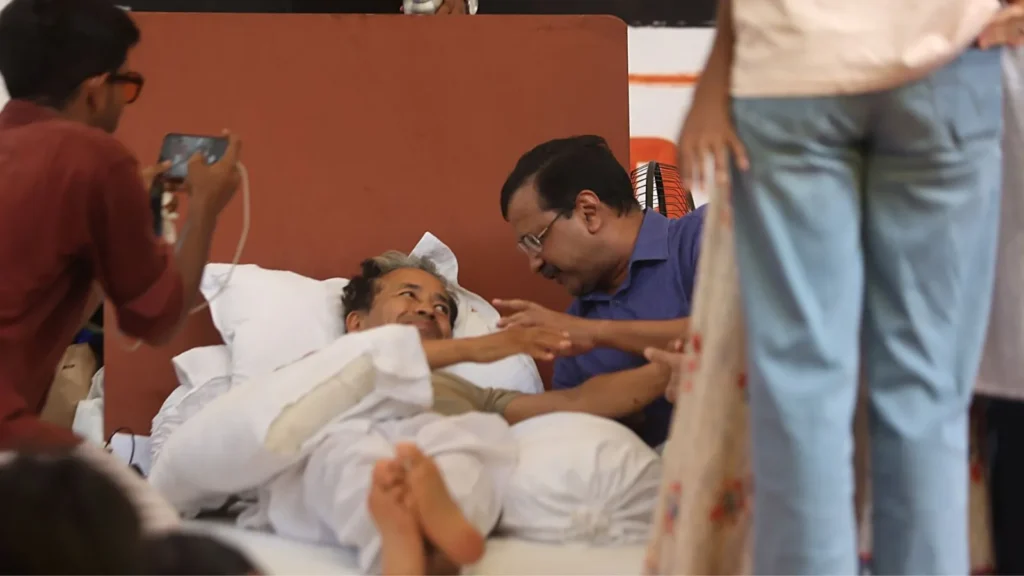
Arvind Kejriwal stands with Sonam Wangchuk at Jantar Mantar as the climate activist continues his hunger strike over exam reform demands. Image Credit: IndianExpress
In a dramatic political intervention at Delhi’s Jantar Mantar, AAP national convenor Arvind Kejriwal on Thursday voiced support for climate activist Sonam Wangchuk and suggested that he should be made Union Education Minister if Dharmendra Pradhan resigns. The remark came as Wangchuk’s hunger strike entered its 19th day, turning a student-related protest into a larger national debate on education, accountability and governance.
Wangchuk has been fasting since June 28 as part of a protest organised by the Cockroach Janta Party, demanding the resignation of the Union Education Minister over repeated examination paper leaks and broader reforms in India’s exam system. By joining him in person, Kejriwal gave the movement a fresh political spotlight. Yeh issue kaafi important hai because it connects student anger, public protests and the credibility of the education system in one place.
What Happened at Jantar Mantar
Kejriwal’s appearance at Jantar Mantar was not just symbolic; it was a direct political endorsement of Wangchuk’s protest. Standing beside the activist, Kejriwal accused the Centre of failing India’s students and urged Prime Minister Narendra Modi to replace Pradhan with Wangchuk. His message was clear: if the government truly wants reform, it should entrust the education system to someone who has spent years working on education and innovation. This story was also covered by The IndianExpress.
The comment was striking because it moved beyond criticism and into a public challenge. Instead of simply asking the government to investigate exam leaks, Kejriwal proposed a new ministerial name. That kind of statement can generate attention very quickly because it personalises the larger policy debate. In political terms, it shifts the question from “what went wrong?” to “who should fix it?”
This also helped the protest gain new visibility. Hunger strikes often rely on moral force rather than institutional power. Once a major political figure joins in, the issue can move from a civil society protest into a mainstream political story. That is exactly what happened here.
Why Wangchuk’s Protest Matters
Sonam Wangchuk’s hunger strike is rooted in a broader dissatisfaction with India’s examination ecosystem. The protest, according to the reported details, is aimed at repeated paper leaks and demands reform in the way the system works. These are not small complaints. For lakhs of students, exam integrity is tied directly to careers, family expectations and future mobility.
Wangchuk has been on hunger strike since June 28, which means the protest has already crossed into a serious physical and emotional phase. An 18- or 19-day fast is not just a symbolic gesture anymore; it becomes a health emergency and a public test of how authorities respond. In that sense, the protest has already become bigger than one person. It is now about whether the system is willing to listen to the voices of students and reform advocates.
The involvement of the Cockroach Janta Party also adds a political layer. The group describes itself as a “political front of the youth, by the youth, for the youth”, which shows how the protest is being framed as a youth movement rather than a single-issue campaign. That framing matters because exam issues in India often have mass resonance, especially among first-time voters, students and parents.
Kejriwal’s Political Message
Kejriwal’s suggestion that Wangchuk should become Union Education Minister is clearly political, but it also carries a message about public trust. By naming Wangchuk, he is implying that the education system needs someone with credibility outside party politics. That is a common opposition strategy: present an alternative face that appears more rooted in expertise and public service.
The remark also allows Kejriwal to attack the Centre without focusing only on one grievance. He can argue that repeated leaks and poor exam management reflect a deeper governance failure. At the same time, by praising Wangchuk, he aligns AAP with students and reform-minded voices. That creates a strong political image, especially in Delhi, where education has long been a major issue.
From a broader perspective, this is the kind of statement that generates headlines because it is both provocative and simple. It is easy for audiences to understand: if the existing minister is not doing the job, pick someone who cares deeply about education. That is why the comment is likely to travel widely across media and social platforms.
Background and Context
Sonam Wangchuk is best known as an educationist and climate activist. His work has often focused on innovation, sustainability and practical solutions for communities, especially in Ladakh and beyond. That gives him a public profile distinct from career politicians. In many ways, that is what makes him appealing to those who want reform-orientated leadership in education.
The current protest is linked to repeated exam paper leaks and concerns over the broader examination system. These issues have become increasingly sensitive in India because exam credibility is central to social mobility. When a paper leaks, the damage is not just technical. It affects merit, morale and trust in institutions. For many students, that can feel like the future has been stolen before the exam even begins. Seedhi baat yeh hai: jab paper system pe bharosa hilta hai, toh poora student ecosystem disturbed ho jaata hai.
The hunger strike also matters in the context of protest culture in India. Hunger strikes have historically been used to highlight moral urgency. But they also put pressure on governments to react quickly because the protester’s health becomes part of the political equation. That is why this case is drawing attention far beyond the original demand.
Timeline
June 28: Sonam Wangchuk begins an indefinite hunger strike.
During the protest: The movement is organised by the Cockroach Janta Party.
Over the following days: The protest focuses on exam paper leaks and education reforms.
Thursday: Arvind Kejriwal joins Wangchuk at Jantar Mantar.
Same day: Kejriwal suggests Wangchuk should be made Union Education Minister if Pradhan resigns.
Now: The protest has entered its 19th day and continues to draw national attention.
Also Read: Delhi High Court to Hear Plea Seeking Emergency Intervention in Sonam Wangchuk Hunger Strike Case
Why This Matters
This matters because education is one of the most sensitive policy areas in India. Every leak, every exam irregularity and every failure in administration affects lakhs of young people. When a high-profile activist is fasting over the issue and a national political leader joins him, it signals that the problem has moved from grievance to governance crisis. Yeh issue kaafi important hai because students cannot afford a system where trust is repeatedly broken.
It also matters because the protest is forcing a public conversation about who should lead education policy. Should the ministry be run only by politicians, or should there be greater room for people with field credibility and reform experience? Kejriwal’s remark is a political answer to that question, but it reflects a real public frustration. Many Indians want education leaders who are seen as problem-solvers, not just office-holders.
There is a human side too. Hunger strikes are not ordinary protests. They are physically dangerous and emotionally intense. When a protest reaches this stage, it challenges the state to respond with urgency and seriousness. That makes the story significant not only for politics but also for civil society and public health.
India Angle
For Indian readers, the story hits multiple layers at once: student anxiety, exam fairness, protest politics and Delhi’s role as the national political stage. In Hinglish, seedhi baat yeh hai: agar exam system sahi nahi hoga, toh student ka future shaky ho sakta hai. That is why this protest resonates so widely.
Delhi is also the perfect stage for such a political message. Jantar Mantar has long been a symbolic protest site, where activists, students and groups gather to seek national attention. When Kejriwal joins a protest there, the optics are powerful. It sends a message not just to the Centre but also to voters watching the issue closely across India.
The story also matters because it reflects a broader Indian demand for accountability in education. Paper leaks are not just a bureaucratic issue; they touch the lives of millions of families. A protest centred on that concern is likely to attract widespread sympathy, especially among young voters and parents who see exams as a major life milestone.
Analysis
My opinion is that Kejriwal’s proposal is partly symbolic and partly strategic. It is not likely to be accepted as-is, but it does sharpen the message. It tells the public that the opposition wants to frame the education debate around credibility and reform rather than routine politics. that makes the story more clickable and more searchable because it combines an activist, a major political leader and a policy crisis.
I also think the protest’s emotional force is increasing because of duration. The longer Wangchuk remains on hunger strike, the more pressure builds on authorities to respond. That means the story can evolve quickly. If the government issues a statement, offers talks or changes its approach, the angle could shift again. For now, the protest is being read as a moral challenge to the state.
There is another layer here: people are increasingly judging education leaders not only by official position but also by public trust. That is why the idea of Wangchuk as a potential education minister is resonating. It may be rhetorically dramatic, but it taps into a real public sentiment that education needs reformers, not just administrators.
What Next
The next step will depend on how the Centre responds to the protest and the political pressure around it. If the government addresses the concerns about exam leaks or opens a dialogue, the protest could enter a new phase. If it stays silent, the strike and the surrounding political criticism may intensify.
Wangchuk’s health will remain a major concern as the fast continues. If the hunger strike goes on much longer, pressure for medical intervention or formal talks will grow. That could bring more civil society voices into the discussion.
Politically, AAP may continue to use the protest to attack the Centre on education governance. For the opposition, this is an opportunity to align with students and reform-minded voters. For the government, it is a test of how it handles a movement that is both symbolic and emotionally charged.
Conclusion
Arvind Kejriwal’s appearance with Sonam Wangchuk at Jantar Mantar has turned a hunger strike over exam reform into a sharper national political story. By suggesting that Wangchuk should become Union Education Minister if Dharmendra Pradhan resigns, Kejriwal made the protest more visible and more pointed. The issue now goes beyond one activist or one minister. It is about student trust, exam integrity and the future of education governance in India. As the hunger strike enters its 19th day, the pressure on the Centre is likely to grow.
Written By A. Jack