
Global sea levels hit record 5.9 mm rise in 2024; low-lying deltas in South Asia—Mumbai, Kolkata, Dhaka—face immediate threat of permanent inundation and mass displacement.
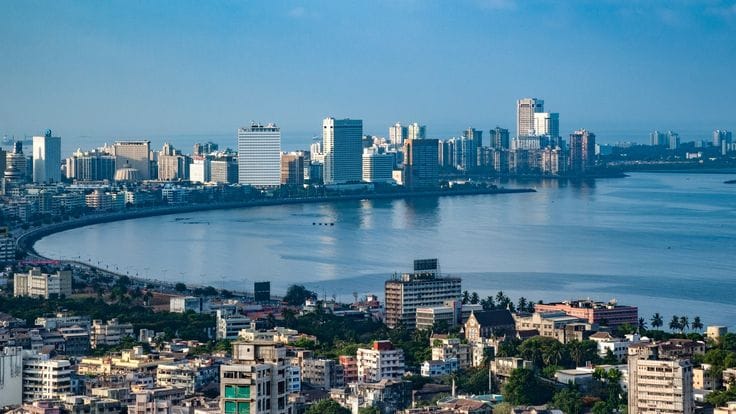
A view of a densely populated coastal area in Mumbai, with high-rise buildings along the shoreline. The image is only for illustrations.
Millions of people in Mumbai and Kolkata are at “immediate risk” of losing their homes as rising sea levels threaten low-lying coastal areas across South Asia, according to a new United Nations report released on Monday, September 1, 2026.
The UN Secretary-General’s report on sea level rise identifies more than 14 million people across low-lying South Asian cities—including Mumbai and Kolkata in India, and Dhaka in Bangladesh—as being at immediate risk of displacement from permanent inundation.
Global sea levels rose by an average 4.7 mm every year between 2014 and 2023. In 2024, sea levels rose by 5.9 mm, setting a new record driven mainly by exceptional ocean warming, the report said. This story was also covered by The FirstPost.
Nearly 770 million people—about 10% of the world’s population—live in coastal areas less than 5 metres above the high-tide line, placing them at acute risk from rising seas, intensifying coastal flooding, freshwater salinisation, erosion and ecosystem degradation.
What the UN Report Says
The report, titled “Challenges related to sea level rise and ways and approaches to address it”, outlines stark figures and regional differences:
Global sea-level rise:
4.7 mm per year (2014–2023)
5.9 mm in 2024 (record high)
Annual rate averaged 4.75 mm during 2012–2025
Population at risk:
Nearly 770 million people live in coastal zones <5 m above high tide.
In South Asia’s low-lying deltas, more than 14 million people in cities like Kolkata, Mumbai and Dhaka face immediate risk of losing homes to permanent inundation.
Regional impact:
South Asia: Primary concern is human displacement and loss of livelihoods.
High-income coastal cities (Miami, New York, Guangzhou): Assets worth an estimated USD 2–3.5 trillion at risk.
Infrastructure under threat: Rising seas are already damaging urban infrastructure, water systems, transport networks, energy grids, buildings and groundwater resources, with consequences for human rights, development and financial stability.
UN Deputy Secretary-General Amina Mohammed presented the report at the 55th Pacific Islands Forum Leaders Meeting, underscoring that the threat is accelerating and requires urgent long-term adaptation planning.
Why and How Sea Levels Are Rising So Fast
The report attributes the record sea-level rise in 2024 mainly to exceptional ocean warming, driven by climate change.
Key mechanisms:
Thermal expansion: As oceans absorb heat from the atmosphere, water expands and sea levels rise.
Melting ice: Glaciers and ice sheets in Greenland and Antarctica are melting faster, adding more water to the oceans.
Regional factors: Land subsidence (sinking ground) in delta cities like Mumbai and Kolkata compounds the relative sea-level rise, making flooding worse.
As oceans rise:
Storm surges can travel further inland, increasing flood depth and duration.
Saltwater intrusion contaminates freshwater supplies and agricultural land.
Coastal erosion undermines buildings, roads and critical infrastructure.
Ecosystems such as mangroves and wetlands are degraded, reducing natural protection.
The question is no longer whether coastal cities need to prepare, but whether they can adapt quickly enough.
Why These Cities Are Especially Vulnerable
Both Mumbai and Kolkata sit on low-lying, densely populated coastal and deltaic terrain, making them highly sensitive to sea-level rise.
Mumbai:
Built on a series of islands and reclaimed land along the Arabian Sea.
Large parts of the city are only a few metres above sea level.
Home to over 20 million people, with critical infrastructure—airports, railways and financial districts—close to the coast.
Already experiences severe monsoon flooding; rising seas will worsen waterlogging and storm-surge impacts.
Kolkata:
Located on the Ganges–Brahmaputra delta, with extensive low-lying areas.
Dependent on river and tidal systems; highly exposed to salinisation and flooding.
Dense informal settlements along canals and wetlands are particularly at risk.
Rising seas threaten freshwater sources, drainage and transport links.
In both cities, the defining impact is human displacement: more than 14 million people across these South Asian deltas are at immediate risk of losing their homes to permanent inundation.
Quotes and Official Statements
UN report: “In the low-lying deltas of South Asia, in cities such as Kolkata and Mumbai in India and Dhaka, the defining impact is human displacement, with more than 14 million people at immediate risk of losing their homes to permanent inundation.”
UN Deputy Secretary-General Amina Mohammed: The threat from sea-level rise is accelerating and calls for urgent long-term adaptation planning.
Report on infrastructure: “Rising seas are already damaging urban infrastructure, water systems, transport networks, energy grids, buildings and groundwater resources, with consequences for human rights, development and financial stability.”
Global context: “Global sea level rose by 4.7 mm per year between 2014 and 2023, while the rise reached 5.9 mm in 2024, a new record driven mainly by exceptional ocean warming.”
These statements highlight both the scale of the risk and the urgency of action.
Past Trends and Recent Extremes
Sea-level rise has been accelerating over recent decades:
1993–2002: Average rise of about 2.1 mm per year (satellite era start).
2014–2023: Average rise of about 4.7 mm per year.
2024: Record 5.9 mm rise in a single year.
In India, extreme rainfall events and coastal flooding have become more frequent:
Mumbai’s 2005 floods, 2017 deluge and repeated monsoon crises show how drainage systems are overwhelmed.
Kolkata regularly faces waterlogging during monsoons; salinisation in the Sundarbans and surrounding delta is already affecting agriculture and drinking water.
Cyclones such as Amphan (2020) and Yaas (2021) demonstrated how storm surges can breach embankments and flood large areas.
The UN report makes clear that these are not isolated events but part of a long-term trend driven by climate change.
Timeline of Sea-Level Rise and Key Milestones
1993: Satellite altimetry begins precise global sea-level monitoring.
2000s: Acceleration in sea-level rise observed; coastal flooding increases.
2014–2023: Average global sea-level rise of 4.7 mm per year.
2024: Record 5.9 mm rise; exceptional ocean warming noted.
2025: Global mean sea level remains close to 2024’s record-high level.
September 1, 2026: UN Secretary-General’s report released, highlighting immediate risks to Mumbai, Kolkata, Dhaka and other low-lying cities.
Why This Matters
Yeh issue kaafi important hai because it affects not just coastlines but entire economies, food systems and social stability.
Human displacement: Over 14 million people in South Asian deltas risk losing homes; migration pressures on inland cities will increase.
Infrastructure damage: Roads, railways, ports, power plants and IT hubs in Mumbai and Kolkata are exposed to flooding and salinisation.
Water and food security: Saltwater intrusion threatens drinking water and agriculture in delta regions.
Financial stability: Insurers, banks and investors face growing climate risk in coastal assets.
Inequality: Poor communities in informal settlements are hit first and hardest, with the least capacity to adapt.
For India’s megacities, the challenge is not just engineering but also social: how to protect the most vulnerable while planning for long-term change.
From Mumbai’s Marine Drive to Kolkata’s Canals
India’s coastal megacities are economic engines but also climate frontlines.
Mumbai:
Financial capital with stock exchanges, corporate HQs and major ports.
Coastal roads, metro lines and airports near sea level.
Slums and low-income housing are often in flood-prone zones.
Kolkata:
Gateway to eastern India and the Northeast; critical port and industrial hub.
Extensive canal network and wetlands already stressed by pollution and encroachment.
The Sundarbans region faces rising salinity and land loss.
Other Indian coastal cities—Chennai, Kochi, Visakhapatnam and Surat—are also exposed, but Mumbai and Kolkata stand out due to population density and deltaic geography.
Yeh situation dikhati hai ki climate change sirf future ki baat nahi hai; abhi se planning aur investment zaroori hai.
Analysis
This report shifts the narrative:
From “future risk” to “immediate threat”: Unlike earlier projections focused on 2050–2100, this assessment flags current and near-term displacement risks.
From asset loss to human displacement: In South Asia, the core issue is not just property damage but millions losing homes and livelihoods.
From generic to city-specific: Mumbai, Kolkata and Dhaka are explicitly named as critical zones.
In my view, three things must happen:
Honest risk mapping: Identify which neighbourhoods can be protected and which may eventually need managed retreat.
Nature-based solutions: Restore mangroves, wetlands and floodplains; avoid over-concretising every coastline.
Social protection: Ensure slum dwellers, fisherfolk and informal workers are central to adaptation plans, not an afterthought.
Without this, “adaptation” may become a euphemism for protecting wealthy enclaves while the poor are left to drown.
What Next
Possible outcomes over the coming decades depend on emissions and adaptation:
If emissions remain high: Sea-level rise accelerates; permanent inundation of low-lying pockets becomes likely; mass relocation pressures grow.
If emissions are curbed: Rise slows but does not stop; adaptation buys time but cannot eliminate all risks.
Adaptation pathways:
Elevated housing and infrastructure
Improved drainage and flood barriers
Zoning restrictions in highest-risk zones
Planned relocation for the most vulnerable communities
For Mumbai and Kolkata, the next 10–20 years are critical for locking in resilient urban forms.
Practical steps include:
For governments: Integrate sea-level rise into city master plans; fund climate-resilient infrastructure; enforce coastal zone regulations.
For businesses: Assess physical climate risk to assets; invest in resilience; support community adaptation.
For citizens: Understand local flood risk; support sustainable urban policies; prepare for extreme events.
Conclusion
A new UN report warns that more than 14 million people in low-lying South Asian deltas—including Mumbai and Kolkata—are at immediate risk of losing their homes to permanent inundation as sea levels rise at record speed.
Global sea levels rose by 5.9 mm in 2024, the highest on record, driven by exceptional ocean warming, with nearly 770 million people worldwide living in coastal zones less than 5 metres above the high-tide line.
For India’s megacities, the question is no longer whether to prepare, but whether they can adapt quickly enough to protect lives, livelihoods and critical infrastructure.
Yeh report ek clear warning hai: climate change ka asar ab hamare shehron par seedha dikh raha hai, aur deri ki keemat bahut bhari hogi.
Written By A. Jack