
A planning lapse on the 3.4-km Andheri East–CSMIA Metro Line 7A has left nearly 1 km of viaduct in Vile Parle East 2.5 metres short of required clearance for overhead electric wires, forcing work to a halt.
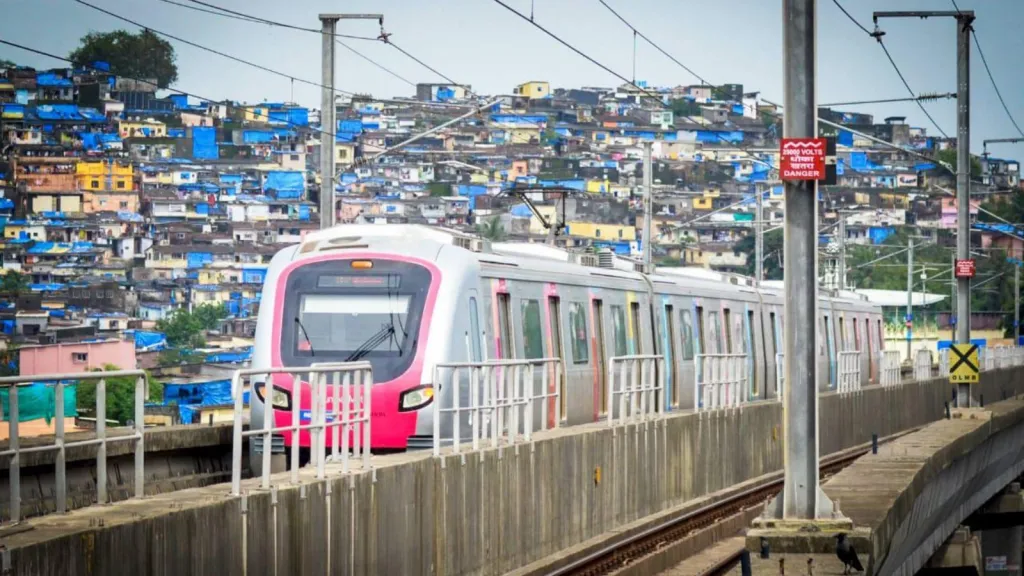
This image is only for illustrations. image credit: IndianExpress
A serious planning error on Mumbai’s Metro Line 7A could force the demolition and reconstruction of nearly 1 km of an elevated viaduct in Vile Parle East, with authorities warning that work worth around ₹250 crore may have to be redone if a technical solution is not found.
The issue relates to the height of overhead electric wires (OHE) on the elevated stretch, which exceeds the clearance permitted by the Airports Authority of India (AAI) in the airport funnel zone near Chhatrapati Shivaji Maharaj International Airport (CSMIA).
The mismatch, involving about 2.5 metres, has brought work on the stretch to a halt even though most of the civil construction is already complete.
The 3.4-km Metro Line 7A is meant to connect Andheri East with the domestic and international terminals of CSMIA, and any further delay will impact one of Mumbai’s most critical last-mile airport connectivity projects.
What Went Wrong
Metro Line 7A is an elevated corridor that runs through the airport’s “funnel zone”, an area where strict height restrictions apply to ensure safe aircraft operations. This story was also covered by The IndianExpress.
According to officials, the Airports Authority of India had issued no-objection certificates (NOCs) for the project when permissions were sought, but the additional height required for the overhead electrical equipment (OHE) was not fully factored into the original design.
As a result:
The elevated viaduct was built at a height that appeared compliant based on initial clearances.
Later, when the OHE system design was finalised, it became clear that extra vertical space was needed for poles, wires and safety clearances.
This additional requirement created a mismatch of about 2.5 metres between the permitted height and the height needed for safe metro operations.
The concern was reportedly raised in 2025, after which construction on the affected stretch was paused and revised permissions were sought from AAI.
Since then, work has remained halted while authorities explore options.
The Financial and Operational Stakes
If no technical workaround is found, nearly 1 km of the elevated viaduct may have to be demolished and rebuilt to meet AAI’s height norms.
Key implications:
Estimated cost at risk: Around ₹250 crore of civil work could have to be redone.
Project length: The entire Line 7A is only 3.4 km, so the affected stretch represents a significant portion of the corridor.
Completion status: By February 2026, MMRDA data showed that the entire elevated viaduct was complete and 95% of overall work was done, making the halt especially costly.
Delay risk: The line has already faced delays; this error could push back the commissioning date further, affecting commuters and airport connectivity.
For a city that has struggled with prolonged metro delays, cost overruns and safety concerns, a ₹250 crore redesign or demolition is a major blow.
Who Is Being Held Responsible?
The Mumbai Metropolitan Region Development Authority (MMRDA), which is implementing the project, has reportedly held its general consultant responsible for the design lapse.
According to reports, MMRDA has named SYSTRA-CEG-SMCIPL, its general consultant for Metro 7A, as responsible for failing to adequately account for the additional height needed for the OHE system at the design and planning stage.
MMRDA officials have indicated that:
The additional height required for OHE poles was not properly highlighted during design.
The oversight came to light only after significant civil work was completed.
The authority is now pursuing the matter with AAI and awaiting a final technical report on permissible height clearances.
Depending on the contract terms, MMRDA may seek to recover part of the cost from the consultant or impose penalties for the lapse.
Metro Line 7A and the Airport Link
Metro Line 7A is a short but strategically important corridor:
Route: Andheri East to Chhatrapati Shivaji Maharaj International Airport (CSMIA).
Length: Approximately 3.4 km.
Type: Fully elevated metro line.
Interchange: It connects with Metro Line 3 (Aqua Line) and other corridors, linking the airport to south Mumbai, Mira-Bhayandar and other parts of the metropolitan region.
The line is intended to provide a fast, reliable rail link between western suburbs and the airport terminals, reducing dependence on road transport and easing congestion on the Western Express Highway and airport road.
However, the project has faced multiple challenges:
Land acquisition and utility shifting
Coordination with airport authorities on height restrictions
Complex construction in a dense urban and aviation-sensitive zone
Now, a major design and planning error affecting a key stretch
The current OHE height issue is the latest in a series of setbacks for Mumbai’s ambitious metro expansion programme.
Timeline of the Issue
2022: AAI issues initial no-objection certificates for Metro Line 7A, but the additional height needed for OHE is not fully factored into the design.
2024: AAI issues a revised NOC (March 18, 2024) permitting viaduct heights ranging from 0.53 metres to 2.75 metres in certain sections, which is lower than what is later found necessary for safe OHE installation.
2025: The height-clearance concern for OHE is raised internally; construction on the affected stretch is paused and revised permissions are sought from AAI.
By February 2026: MMRDA data shows the entire elevated viaduct is complete and 95% of overall work is done, but the OHE-related height issue remains unresolved.
August 2026: Media reports reveal that nearly 1 km of viaduct in Vile Parle East may have to be demolished and rebuilt, with around ₹250 crore at risk.
Current status: Work on the stretch is halted; MMRDA is in discussion with AAI and reviewing technical options.
Also Read: Maharashtra Gives Auto and Taxi Drivers One Year to Learn Functional Marathi: Fadnavis
Why This Matters
Yeh issue kaafi important hai because it touches on public money, urban mobility and trust in large infrastructure projects.
Public funds at risk: ₹250 crore is a substantial amount; if the viaduct must be rebuilt, it will be seen as a waste of taxpayer money due to a planning lapse.
Airport connectivity: Line 7A is a key airport link; further delays will prolong reliance on road transport and affect commuter experience.
Safety and regulations: The case underscores the importance of strictly adhering to aviation safety norms in dense urban environments.
Consultant accountability: Holding consultants responsible for design errors is crucial to ensure better planning in future metro projects.
Mumbai’s metro reputation: The city has already faced criticism over delays, cost escalations and safety incidents; this error adds to public scepticism.
For daily commuters, business travellers and airport workers, a functional Metro 7A could mean faster, cheaper and more predictable access to terminals.
India Angle
India is investing heavily in urban metro systems, with projects underway in dozens of cities. But repeated design and planning errors can erode public confidence.
Key lessons from the Mumbai Metro 7A case:
Integrated design: Civil structure, OHE, signalling and safety clearances must be designed together from the start, not in isolation.
Aviation zones: In cities with major airports—Delhi, Mumbai, Bengaluru, Hyderabad—metro alignments near runways need extra scrutiny and early coordination with AAI.
Contractual safeguards: Agreements with consultants should include clear penalties for design lapses that lead to rework or delays.
Independent checks: Third-party design reviews and independent engineering audits can catch such errors before construction advances too far.
Yeh sirf Mumbai ki problem nahi hai. Across India, metro authorities must ensure that fast-tracked projects do not compromise on basic planning and coordination.
Analysis
The sequence suggests:
Initial AAI NOCs were obtained, but the OHE height requirement was not fully integrated into the structural design.
Civil construction progressed significantly before the OHE clearance issue was fully appreciated.
By the time the mismatch was identified, a large portion of the viaduct was already built, making any fix expensive and disruptive.
In my view, this points to a systemic problem:
Siloed design processes (civil vs electrical vs aviation clearance)
Insufficient cross-checks between consultant, MMRDA and AAI at critical stages
Pressure to show physical progress may have overshadowed detailed design validation
While MMRDA’s move to hold the consultant accountable is welcome, the real test will be whether this leads to stronger internal processes and independent design audits for future corridors.
What Next
Several outcomes are possible in the coming months:
AAI relaxation or technical workaround: AAI may agree to a minor relaxation or accept a modified OHE design that fits within existing clearances, avoiding demolition.
Partial reconstruction: Only the most critical sections (such as ramps or specific viaduct pockets) may need to be rebuilt, reducing cost and time impact.
Full demolition of 1 km stretch: If no alternative is found, nearly 1 km of viaduct may have to be dismantled and reconstructed to meet height norms, at a cost of around ₹250 crore.
Contractual action: MMRDA may impose penalties on the consultant or seek recovery of part of the cost, depending on contract terms.
Timeline revision: The commissioning date for Line 7A may be pushed back again, with fresh announcements on expected completion.
For commuters, the best-case scenario is a technical solution that avoids large-scale demolition. The worst case is a prolonged reconstruction phase that delays the airport link further.
Conclusion
A planning error on Mumbai Metro Line 7A has put nearly 1 km of elevated viaduct in Vile Parle East at risk of demolition, with around ₹250 crore of work potentially needing to be redone.
The core issue is a 2.5-metre mismatch between the height of the overhead electrical equipment and the clearance permitted by the Airports Authority of India in the airport funnel zone.
Work on the stretch has been halted since 2025, even though most civil construction was complete, and MMRDA has reportedly held its general consultant responsible for the design lapse.
Yeh situation highlights the need for better integrated design, stricter independent checks and stronger accountability in India’s fast-expanding metro network.
For Mumbai, the stakes are high: Line 7A is a critical airport link, and any further delay will be felt by thousands of daily commuters and travellers.
Written By A. Jack