Rescue teams have evacuated over 3,700 people, including 163 foreigners, while China reports reduced risk of a glacier-formed lake bursting; Nepal estimates $4–5 billion needed for rebuilding.
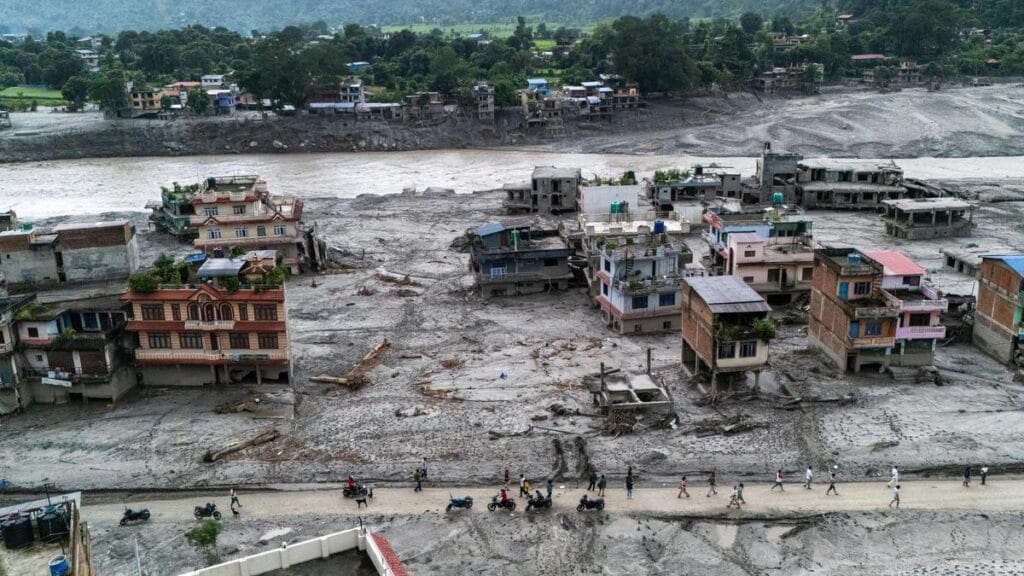
Flood-hit areas along the Nepal–Tibet border. The death toll has climbed to 675 in Nepal. Image Credit: The Hindu
Nepal Flash Floods: Devastating flash floods in the Nepal–Tibet border region have killed at least 675 people in Nepal alone, with authorities warning that nearly 3,000 people remain missing across Nepal and China as rescue operations continue amid difficult terrain and fresh rainfall threats.
Nepali police and disaster agencies confirmed the updated death toll on Saturday, August 29, 2026, as rescue teams worked to reach isolated villages, hydropower project sites and tourist areas cut off by destroyed roads and bridges.
Nearly 3,000 stranded people, including 163 foreigners, have been evacuated so far, with more than 3,700 individuals rescued or brought to safety in Nepal as search and relief operations entered their fourth and fifth days.
Meanwhile, Chinese authorities have said the threat of a glacier-formed lake bursting near the border has decreased, offering some relief to downstream rescue teams, while Nepal’s Finance Minister Swarnim Wagle has estimated that the country will need $4 billion to $5 billion for rebuilding.
What Happened
The disaster began on Wednesday, August 26, 2026, after a massive ice-rock avalanche and glacial collapse in the high Himalayas near the Nepal–China border.
A sudden surge of water, ice and debris swept through the Bhotekoshi and Trishuli river valleys, destroying settlements, hotels, guesthouses, hydropower projects and key infrastructure. This story was also covered by The Hindu.
By Saturday and Sunday, official figures showed:
Death toll in Nepal: 675 confirmed dead, according to Nepal’s disaster authority and police.
Deaths in Tibet (China): At least 16 confirmed dead, with seven initially reported and later updates indicating higher numbers.
Missing in Nepal: Around 2,426 to 2,498 people unaccounted for within Nepal.
Missing in Tibet: More than 540 to 550 people are still missing on the Chinese side.
Total missing: Close to 3,000 people across Nepal and Tibet.
Evacuated/rescued: Over 3,700 people rescued or evacuated in Nepal, including 163 foreigners.
The Red Cross has estimated that as many as 93,000 people may have been affected by the catastrophe, with the death toll expected to rise further as search teams reach remote areas.
How Rescue Operations Are Unfolding
The Nepal Army’s Public Relations Directorate said that 2,465 people have been evacuated so far, including 163 foreign nationals from multiple countries.
Among the foreigners evacuated:
Indians: 113
Chinese: 26
South Koreans: 15
Germans: 4
Italians: 2
Americans: 2
Omani national: 1
Rescue teams have also evacuated 191 workers from tunnels of various hydropower projects in Trishuli and Rasuwa, where many were trapped when the flood surge hit.
Helicopters have been used extensively to airlift stranded tourists, pilgrims, hydropower workers and local residents from cut-off areas. More than 3,700 people have been rescued or evacuated in Nepal so far, with over 11,000 security personnel, including more than 5,000 Nepal Army troops, mobilised for search and rescue.
However, operations have been complicated by:
Ongoing heavy rain and thunderstorms
Rising river levels in the Bhotekoshi basin
Risk of fresh landslides and flooding
Damaged roads, bridges and communication networks
Unstable terrain near the border
Limited access to remote valleys
Nepal’s meteorology department has warned of fresh rainfall and thunderstorms in the flash flood-affected areas, threatening to disrupt ongoing rescue and relief operations.
Glacier-Formed Lake Threat Decreases
One of the major fears after the initial flood was that debris from the glacier collapse had dammed a river, forming a large lake that could burst and cause secondary flooding downstream.
Chinese authorities have now said that this risk has decreased significantly.
According to China’s Ministry of Water Resources, satellite images from Thursday, August 27, to Saturday morning, August 29, show that the lake—straddling the border at the confluence of two rivers—has been slowly releasing water, gradually shrinking the reservoir.
Key details:
Lake location: Purepu Tsangpo (Phurephu Xiangpo) River near the Nepal–Tibet border.
Lake size on August 29: About 99,000 square metres, roughly the size of 14 football fields.
Reduction since August 27: The lake has shrunk by about 21,000 square metres as water drains naturally.
Chinese state broadcaster CCTV, citing the Water Resources Ministry, said that with the natural drainage of water, search and rescue efforts downstream could proceed safely if outflows remain low or manageable and the lake levels recede completely within two to three days.
This is a significant relief for rescue teams who had been working under the threat of a sudden secondary flood.
Finance Minister’s Rebuilding Estimate
Nepal will need between $4 billion and $5 billion to rebuild after the devastating floods that struck its border areas this week, Finance Minister Swarnim Wagle told reporters.
“This is just an estimate. Loss and damage is being assessed,” Wagle said.
The estimate covers:
Reconstruction of roads, bridges and highways
Repair of hydropower projects and energy infrastructure
Rebuilding homes, schools and health facilities
Restoring water supply, sanitation and communication networks
Relocation of communities from high-risk zones
Strengthening disaster-resilient infrastructure
The government has already begun mobilising domestic funds. More than ₹2.295 billion (Nepalese rupees) has been collected for the Prime Minister’s Disaster Relief Fund (PMDRF) by Friday night, with deposits made to accounts at 10 different commercial banks.
Nepal is also coordinating with international partners, including the World Bank, Asian Development Bank, India, China and other donors, for additional financial and technical support.
Quotes and Official Statements
Nepal disaster authority: “The death toll from flash floods in central Nepal rose to 675 on Saturday, with more than 2,400 people still missing.”
Nepal Army: “2,465 people have been evacuated so far, including 163 foreigners… 191 workers were evacuated from tunnels of various hydropower projects in Trishuli and Rasuwa.”
China’s Ministry of Water Resources: “The danger signals from the glacier-collapse-formed lake near the China–Nepal border have begun to decline as the lake’s size appears to be shrinking.”
Finance Minister Swarnim Wagle: “Nepal needs $4 billion to $5 billion for rebuilding… This is just an estimate. Loss and damage is being assessed.”
These statements highlight both the human tragedy and the enormous rebuilding challenge ahead.
Why the Floods Were So Devastating
The disaster began with a glacial collapse and ice-rock avalanche in the high Himalayas near the Nepal–Tibet border.
Such events can release massive volumes of water, ice and debris in a short time, creating a wall of floodwater that moves rapidly down narrow river valleys.
Key factors that increased the impact:
Steep terrain: The Bhotekoshi and Trishuli valleys are narrow and steep, amplifying the speed and force of the flood.
Settlements near rivers: Many hotels, guesthouses, hydropower sites and villages are located close to the riverbanks.
Cross-border infrastructure: Roads, bridges and the Gyirong border crossing complex were heavily damaged or destroyed.
Tourist and pilgrim traffic: The area is a key route for Kailash Mansarovar pilgrims and adventure tourists, increasing the number of people at risk.
Hydropower projects: Several under-construction and operational projects in Trishuli and Rasuwa were hit, trapping workers in tunnels and camps.
Chinese rescue teams reaching the Gyirong border crossing reportedly found extensive destruction, underlining the intensity of the surge.
Timeline
Wednesday, August 26, 2026: Ice-rock avalanche and glacial collapse trigger catastrophic flash floods in the Bhotekoshi and Trishuli river valleys.
Immediate aftermath: Hundreds killed, roads and bridges destroyed, hydropower sites damaged, many tourists and workers stranded.
August 27–28: Death toll rises past 600; more than 2,000 initially reported missing; rescue operations intensify.
August 29 (Saturday): Nepal reports 675 dead; missing count in Nepal is around 2,426; total missing across Nepal and Tibet is close to 3,000.
August 29: China says the risk of a glacier-formed lake bursting has decreased as water drains naturally.
August 29–30 (Sunday): Over 3,700 people rescued or evacuated in Nepal; more than 11,000 security personnel deployed.
August 29: Finance Minister Swarnim Wagle estimates $4–5 billion needed for rebuilding; over ₹2.295 billion collected in PMDRF.
Why This Matters
Yeh disaster kaafi important hai because it affects not only Nepal but also India, China and the wider region.
Human cost: More than 675 confirmed dead and nearly 3,000 missing means thousands of families are waiting for news of loved ones.
Regional connectivity: The floods damaged a key border crossing and major highways, disrupting trade and travel between Nepal, India and China.
Energy infrastructure: Hydropower projects in Trishuli and Rasuwa were hit, potentially affecting Nepal’s power generation and investment climate.
Tourism and pilgrimage: The Kailash Mansarovar route and adventure-tourism circuits were severely disrupted, impacting livelihoods and travel plans.
Climate-risk warning: Glacial collapses and flood surges are likely to become more frequent as the Himalayas warm, making disaster planning critical.
For India, the impact is direct: many Indians were in the affected zone, and floodwaters have carried debris and bodies into Indian rivers downstream.
India Angle
India has a strong stake in this disaster.
Indian nationals affected: 113 Indians were among the 163 foreigners evacuated; many more Indians were reported missing or stranded in the initial phase.
Pilgrims and tourists: A significant number of Kailash Mansarovar pilgrims and adventure tourists from India were travelling through the affected routes.
Downstream impact: Floodwaters from Nepal flow into Indian rivers, raising alert levels in border districts of Bihar and Uttar Pradesh.
Rescue cooperation: India has been in close contact with Nepal, offering assistance, including technical teams and equipment.
Diaspora concern: Families across India are tracking updates on missing relatives, with Indian missions and state governments coordinating information.
Yeh situation shows how closely linked India and Nepal are in terms of people, rivers and disaster response.
Analysis
The disaster is a stress test for:
Nepal’s disaster-management capacity
Cross-border coordination with India and China
Rescue logistics in difficult Himalayan terrain
Communication with families of missing persons
Long-term rebuilding finance and planning
The reduction in the glacier-lake burst risk is a positive development, but the human tragedy is far from over. With nearly 3,000 people still missing, many families are living in uncertainty.
In my view, the $4–5 billion rebuilding estimate is only the beginning. Climate-resilient infrastructure, early-warning systems and strict zoning near rivers will be essential to avoid repeating such losses.
What Next
The coming days and weeks will focus on:
Continued search operations: Teams will keep looking for missing persons in remote valleys and along riverbanks.
Weather monitoring: Heavy rain could trigger fresh landslides or flooding, so alerts will remain active.
Identification of victims: Authorities will work to identify recovered bodies and inform families.
Rehabilitation: Temporary shelters, food, medical care and psychological support will be needed for survivors.
Infrastructure repair: Roads, bridges, power lines and communication networks will be prioritised.
International aid: Nepal is likely to receive financial and technical assistance from India, China, multilateral banks and other partners.
Policy review: The government may revisit land-use rules, hydropower-site safety and border-area disaster planning.
For Indians, the focus will remain on tracing missing relatives, supporting evacuation efforts and preparing for any downstream flood risk.
Conclusion
Nepal’s flash floods have killed at least 675 people, left nearly 3,000 missing and forced the evacuation of more than 3,700 stranded individuals, including 163 foreigners.
Rescue teams have airlifted thousands from cut-off areas, and Chinese authorities have reported a reduced risk of a glacier-formed lake bursting, easing fears of secondary disasters.
Finance Minister Swarnim Wagle has warned that rebuilding will cost between $4 billion and $5 billion, with loss assessments still ongoing.
Yeh disaster is a stark reminder of the Himalayas’ vulnerability and the need for stronger regional cooperation. For now, the priority remains saving lives, finding the missing and supporting survivors.
Written By A. Jack