
Mumbai Metro Line 3 services were disrupted for nearly 50 minutes on Friday following a technical glitch, causing a delay during peak rush hour. Passengers described being left anxious, unable to contact staff and trapped in overcrowded conditions before normal services resumed.
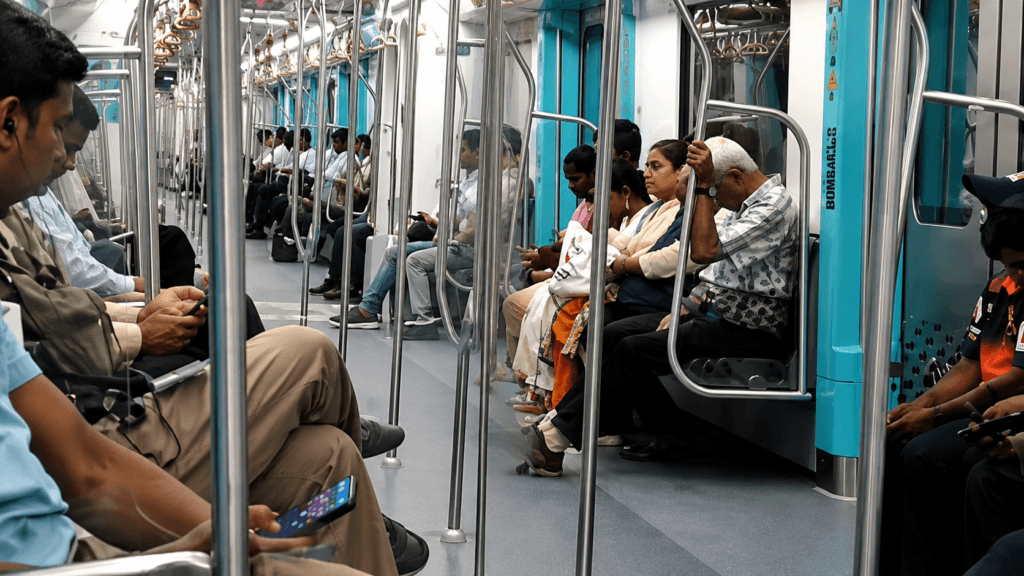
Commuters at a Mumbai Metro Line 3 station during the rush-hour disruption caused by a technical fault on the Aqua Line.
A major disruption on Mumbai Metro Line 3 turned Friday’s rush-hour commute into a stressful ordeal for hundreds of passengers, as services were halted for nearly 50 minutes due to a technical glitch. The issue affected the Aqua Line, which runs 33.5 km between Cuffe Parade in south Mumbai and Aarey JVLR in the north, and quickly created panic inside trains and at stations.
Passengers described the situation as frightening and chaotic, with some saying they felt suffocated inside the trains and could not reach any Metro staff for help. One commuter told NDTV, “It felt like a dark nightmare.” Another said there was no mobile network, no visible staff, and no way to get assistance. Mumbai Metro Rail Corporation Limited later said the fault had been rectified and normal services were restored. Yeh incident kaafi important hai because it highlights how a brief technical failure can create serious stress for thousands of daily commuters in a city like Mumbai.
What Happened
The disruption took place during peak travel hours, when the trains on Mumbai Metro Line 3 suddenly stopped because of a technical problem. According to the report, services on both downline and upline routes were delayed, which meant the issue was not limited to one direction. Once the trains halted, crowds started building at stations, and passengers inside the coaches were left waiting without immediate clarity on what had gone wrong. NDTV has covered the full story.
For commuters, the lack of communication made the situation worse. Many passengers said they were unable to contact Metro staff and had no idea when the trains would move again. In an underground or enclosed Metro environment, even a short delay can feel much longer because of limited ventilation, crowding, and uncertainty. That is why several commuters described the experience as mentally exhausting and even suffocating.
The technical glitch was eventually fixed, and the Mumbai Metro Rail Corporation Limited said services were restored. However, the event exposed a familiar weakness in urban transport systems: when a fault happens during rush hour, the actual inconvenience is not just the delay itself but the panic, confusion, and lack of timely updates that follow.
Why the Glitch Became a Big Problem
This was not just a routine technical delay. It happened on Mumbai Metro Line 3, a major route that has become important for daily commuters traveling across the city. Because the disruption happened in rush hour, the effect multiplied quickly. Trains stopped where they were, stations got crowded, and passengers on board started worrying about breathing, communication, and timing.
The line itself is also significant. The Aqua Line stretches from Cuffe Parade to Aarey JVLR, connecting key parts of Mumbai and carrying people who depend on timely transit for work, education, and other commitments. A 50-minute stoppage on such a route can ripple through the entire urban schedule. People miss office arrivals, meetings, school timings, and connecting transport. In a city where every minute matters, even a temporary stoppage can feel huge.
There is also the psychological side. Commuters said they were unable to establish contact with Metro staff, and that absence of visible support likely increased fear. When people are trapped in a delayed train and cannot get updates, the mind starts filling in worst-case possibilities. That is why transport communication is as important as technical repair. In simple words, problem sirf fault ka nahi tha — problem yeh bhi tha ki logon ko samajh mein hi nahi aa raha tha kya ho raha hai.
Passenger Experience
The strongest reaction came from the passengers themselves. One commuter told NDTV that the experience felt like a “dark nightmare,” which captures how frightening an enclosed delay can feel during rush hour. Another said the trains were so crowded and stagnant that some people seemed close to fainting because of suffocation.
A further complaint was the lack of network inside the Metro. In modern urban transport, passengers expect connectivity, at least enough to send a message or call for help. When that is absent, people feel cut off. That sense of isolation can make even a short delay feel much more serious. The fact that passengers were unable to reach Metro staff added to the frustration and fear.
These reactions matter because they show the difference between a technical incident and a public-facing transport failure. A system can recover from a glitch, but passenger trust takes longer to rebuild. That is especially true in a city like Mumbai, where people rely heavily on public transport to keep the city functioning.
Official Response
In its statement, Mumbai Metro Rail Corporation Limited said train services on both downline and upline routes experienced delays because of a technical issue. The corporation also said the fault had been rectified and that normal services were restored.
That response is important because it confirms the issue was technical rather than anything more serious. It also suggests that the Metro system’s operational team was able to bring the service back online within a manageable timeframe. But from a passenger perspective, the immediate challenge is not just the correction of the fault—it is whether there is enough communication during the fault.
In such situations, commuters usually expect announcements, staff presence, visible assistance, and guidance on whether to wait, exit, or reroute. When those things are missing, frustration rises quickly. The official statement explains the cause, but passengers are more likely to remember how they felt during the 50 minutes of uncertainty.
Also Read: Massive Blaze Engulfs Shastri Park Furniture Market in Delhi, 25 Fire Tenders Rushed In
Background
Mumbai Metro Line 3, also known as the Aqua Line, is one of the city’s most important new transit corridors. It is designed to offer a major east-west and north-south connection while reducing road congestion and providing an efficient underground travel option. Since it connects Cuffe Parade in south Mumbai with Aarey JVLR in the north, it plays a key role in linking business districts, residential areas, and key commuter zones.
Large urban metro systems are expected to operate with high reliability, but even the most advanced systems can face occasional technical faults. The challenge is not avoiding every problem forever; it is making sure that breakdowns are brief, well-managed, and clearly communicated. Friday’s event shows that Mumbai’s Metro system still has to prove itself not only in engineering but also in crisis communication.
Timeline
Friday, rush hour: Mumbai Metro Line 3 experiences a technical glitch.
Immediately after: Trains on both downline and upline routes are delayed.
During the stoppage: Passengers report suffocation, crowding, and no network access.
Within about 50 minutes: The fault is rectified.
Afterward: Mumbai Metro Rail Corporation Limited restores normal services.
Why This Matters
This matters because Mumbai is a city that runs on punctuality and public transport. A 50-minute delay on a major metro line can affect thousands of people at once, especially during rush hour. It also matters because commuter confidence in a new metro corridor depends on both reliability and response quality.
If passengers feel stranded without information, the system loses trust even if the technical fault is fixed quickly. That is why communication, signage, staff visibility, and emergency support are so crucial. Yeh issue kaafi important hai because urban transport is not just about moving trains—it is about managing people safely and calmly when things go wrong.
India Angle
For Indian readers, this incident reflects a larger reality about growing metro networks across the country. Cities like Mumbai, Delhi, Bengaluru, Hyderabad, and others are investing heavily in mass transit, and these systems are now part of daily life for millions. With that growth comes a new expectation: not just speed, but reliability and user comfort.
The India angle is also about urban crowd management. As more Indians shift from road transport to metro systems, even small technical faults can have massive public impact. In a crowded city like Mumbai, delays quickly become commuter crises. In Hinglish, the seedhi baat yeh hai: metro good hai, but jab fault aata hai toh passenger experience bhi strong honi chahiye.
Analysis
My opinion is that the technical fault itself is not the most damaging part of this incident. The bigger issue is how vulnerable commuters felt while waiting. Modern transit systems are judged not only by uptime but also by how they behave during failures. If passengers are left without updates, staff visibility, or communication, the experience becomes much worse than the delay alone. Mumbai Metro will likely need to look closely at its incident communication protocols. The lesson here is simple: a fast repair is good, but a calm passenger is better.
What Next
The next step will likely involve a technical review to identify what exactly caused the glitch and whether similar faults can be prevented. The Metro operator may also examine its communication response to see why passengers could not reach staff and whether on-ground support was sufficient.
Passengers will want reassurance that this was an isolated incident and not a sign of broader operational weakness. If such glitches repeat, public scrutiny will rise quickly. The good news is that services were restored, but the long-term priority will be to make sure future disruptions are better managed with timely updates, visible assistance, and crowd control. That will decide whether this incident becomes a one-off setback or a warning sign.
Conclusion
Mumbai Metro Line 3’s 50-minute rush-hour glitch was short in duration but big in impact. What began as a technical fault turned into a stressful and frightening experience for commuters who felt trapped, uninformed, and unable to contact staff.
The issue was eventually fixed and normal services restored, but the incident highlights a broader truth about modern urban transport: passengers expect more than just movement. They expect communication, safety, and calm in moments of disruption. For Mumbai Metro, the lesson is clear — reliability matters, but so does the way the system behaves when reliability fails.
Written By A. Jack