
Tensions escalated in Mumbai’s Mira Road after an argument over goats kept inside an apartment complex ahead of Eid al-Adha, resulting in clashes and a FIR. The incident has resulted in accusations from both sides, with one side accusing the other of illegally keeping goats and the other side saying that the situation worsened after attempts to rebuild a shed.
Police personnel and protesters stand outside an apartment complex in Mira Road after clashes broke out over alleged keeping of goats ahead of Eid al-Adha.
A fresh communal flashpoint has emerged in Mumbai’s Mira Road after clashes broke out over the alleged plan to sacrifice goats ahead of Eid al-Adha festivities. According to the details shared, the dispute began outside an apartment complex in Poonam Cluster 1, where a protest was held against goats being kept on the premises.
The situation escalated after members of the Muslim community reportedly began to rebuild a shed, leading to renewed tension between the two groups. Police registered an FIR after the confrontation, while allegations and counter-allegations continued to circulate. The matter has now become a sensitive law-and-order issue with religious and civic dimensions. Yeh issue kaafi important hai because it shows how quickly a local dispute can turn into a wider public order problem.
What Happened
As per the report, a group gathered outside the apartment complex to protest against goats being kept there ahead of Eid al-Adha. Visuals shared by ANI showed the protest taking place in the Mira Road area, which falls under the Mumbai metropolitan region and often sees dense residential activity. The Hindustan Times has covered the full story.
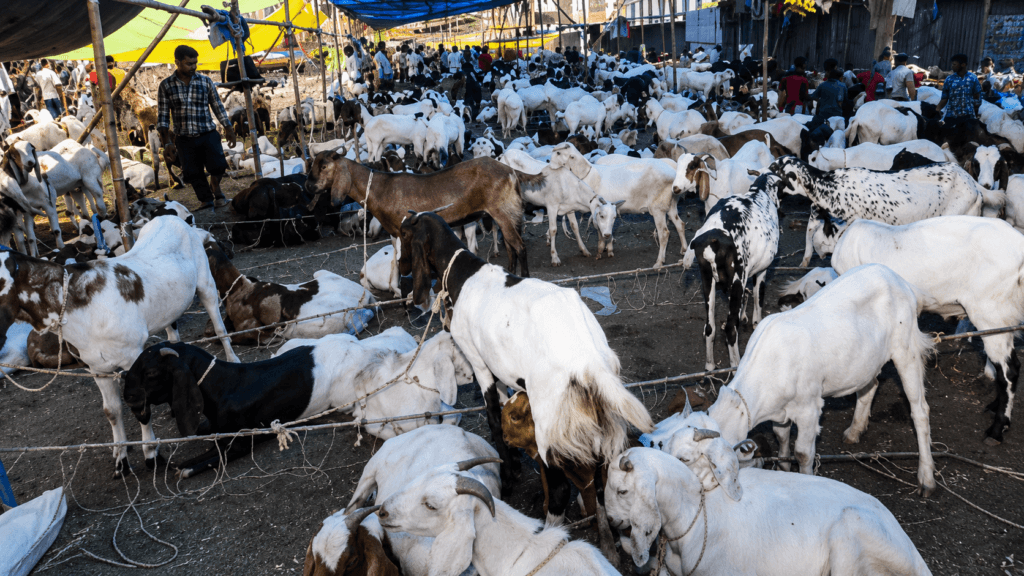
Vishwa Hindu Parishad coordinator Harsh Singh alleged that around 40 to 50 goats were brought inside the premises. He claimed that the presence of the goats created problems for residents, including breathing difficulties for senior citizens. His side also alleged that the goats were brought in illegally and that the Brihanmumbai Municipal Corporation had not permitted such activity.
According to Singh, the conflict did not end with the protest. He alleged that he was attacked by a Muslim person with a knife and injured on his hand. He further said the police registered an FIR but did not include Section 307, the attempt to murder charge, which his side now wants added to the case.
At the same time, the report says tensions flared again after members of the Muslim community began to rebuild the shed. That detail is important because it suggests the dispute was not resolved after the initial protest and instead escalated further. In such situations, even a small act can be interpreted by the other side as provocation, which makes local calm even harder to restore.
Why the Dispute Escalated
The core of the issue appears to be a clash between religious practice, residential comfort, and administrative permission. Ahead of Eid al-Adha, keeping animals for sacrifice can become a sensitive matter in dense urban housing societies. If there is no prior permission or if residents believe rules have been violated, objections can emerge quickly.
The protest apparently began with the claim that a large number of goats had been brought into the complex without proper approval. The concern raised by the protesting side was not only religious but also civic. Singh said senior citizens were having breathing issues due to the goats’ presence. On the other side, the rebuilding of the shed seems to have been perceived as a continuation of the same activity, which may have worsened tempers.
This is the pattern in many urban disputes: once the issue moves from paperwork and permissions to direct confrontation, emotions take over. The moment a protest turns physical, the situation changes from a civil disagreement into a police matter. In this case, the FIR shows that law enforcement had to step in after tempers got out of hand.
FIR and Legal Questions
An FIR has already been filed, according to the report. But the question being raised by the VHP side is whether the stronger charge of attempt to murder should also be included. Singh claimed he was attacked with a knife and injured his hand, and he wants Section 307 to be added.
This is significant because the legal classification of the incident can affect how seriously the case is investigated. If police determine that the attack was intended to kill or cause grievous injury, then the charges could become more severe. If, however, the injury is considered less serious or if the evidence does not support that claim, the charge may remain limited.
At this stage, what matters most is that the facts need to be examined carefully and not turned into instant political slogans. In communal-sensitive cases, every side tends to frame the incident in a way that strengthens its own narrative. But for the sake of public trust, the final version must rest on evidence, not only outrage.
Background and Context
Eid al-Adha is one of the most important festivals in the Islamic calendar, and animal sacrifice is part of its religious observance for many families. In Indian cities, however, such practices can become contentious when they intersect with housing societies, municipal bylaws, and local sentiment.
Mumbai and its satellite urban areas have seen similar tensions in the past whenever religious customs meet shared residential spaces. In dense localities like Mira Road, where many communities live close together, disputes can quickly become public controversies. If proper permissions are not taken in advance or if residents feel their concerns are ignored, suspicion grows rapidly.
That is why administrative clarity becomes crucial. When civic bodies like the BMC, housing societies, and local police give clear rules early on, the chance of conflict drops. Without that, a religious practice can be wrongly seen by one side as provocation, while the other side may see objections as interference in worship. This is where communication matters as much as enforcement.
Timeline
Before Eid al-Adha: Goats are reportedly brought into Poonam Cluster 1 in Mira Road.
Protest begins: Members of one group demonstrate outside the apartment complex.
Tensions rise again: Conflict flares after the Muslim community begins rebuilding the shed.
Alleged assault: Harsh Singh claims he was attacked with a knife and injured.
Police action: An FIR is registered.
Next demand: The VHP side seeks inclusion of Section 307 in the case.
Also Read: Police Enforces 14-Day Jamavbandi Restrictions, Clarify There Is No Lockdown
Why This Matters
This matters because communal tensions often begin as local disputes but can quickly become much bigger if they are not handled carefully. A housing society conflict over animals may sound small on the surface, but when religion enters the picture, the emotional and political stakes rise sharply. That makes timely police intervention and fair fact-finding extremely important.
It also matters for ordinary residents who just want peace in their neighborhoods. Most people do not want their daily lives disrupted by tension, protests, or threats. Yeh issue kaafi important hai because in a city like Mumbai, where people from different communities live side by side, even one flashpoint can create fear far beyond the immediate location.
India Angle
The India angle here is very clear: this is not just a Mira Road issue; it is part of a larger urban India challenge. Across the country, festivals, rituals, and community practices often overlap with residential rules and local sensitivities. When that happens, the question becomes how to balance faith, law, and neighborly coexistence.
In Hinglish, the seedhi baat yeh hai: yahan issue sirf goats ka nahi hai; issue trust aur space management ka hai. Indian cities are becoming denser, more mixed, and more rule-driven. That means religious practice now needs smoother civic coordination than ever before. If that coordination fails, local disputes can escalate fast and create lasting bitterness.
Analysis
My view as a news writer is that the most important thing here is restraint. In communal-sensitive incidents, words travel faster than evidence. If every side starts making only the strongest possible allegation, the situation becomes harder to de-escalate. The report suggests there was a real administrative and local-resident dispute over goats and a shed, but the attack allegation and the demand for Section 307 should be verified through police investigation. The story is important not because it is dramatic, but because it reveals how fragile peace can be in a crowded, diverse city when communication breaks down.
What Next
The next step will likely involve the police examining CCTV footage, witness accounts, and the exact sequence of events that led to the clash. They will also need to determine whether the goats were brought in with permission, whether the shed was legal, and whether the alleged attack fits the charge of attempt to murder.
If tensions remain high, the administration may step up police presence around the complex and in nearby areas. Officials may also try to mediate between the groups to prevent fresh flare-ups, especially as Eid al-Adha approaches. The bigger question is whether the dispute remains a local law-and-order matter or grows into a more politically charged confrontation. That will depend on how quickly authorities establish facts and communicate them clearly.
Conclusion
The Mira Road clash over alleged goat sacrifice ahead of Eid al-Adha has turned into a serious local dispute involving protest, allegations of assault, and an FIR. While one side claims goats were kept illegally and caused discomfort to residents, the other side faces accusations of using violence during the standoff.
At its heart, this is a story about the need for civic clarity and community restraint. In a crowded city like Mumbai, differences are inevitable, but violence is not. The only way forward is a fair investigation, calm communication, and responsible reporting so that a local disagreement does not harden into a deeper communal divide.
Written By A. Jack