
Tree fall crisis has hit parts of Mumbai including Goregaon, Kurla, Matunga and Dadar damaging vehicles, blocking roads and exposing the city’s vulnerability during intense monsoon spells. Civic officials said rescue teams and fire brigade staff were rushed in as complaints and the toll mounted.
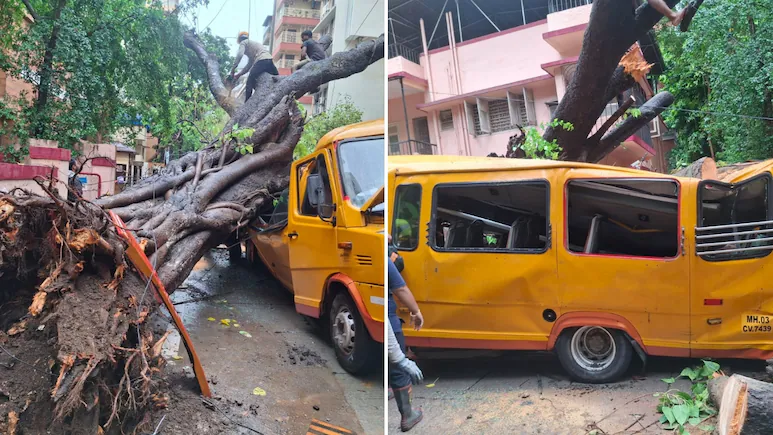
A fallen tree blocks a road in Mumbai after heavy monsoon rain and strong winds caused widespread damage across the city. Image credit: NDTV
Mumbai Monsoon Horror: The Monsoon has taken a deadly turn, with 1,124 trees falling between June 30 and July 6 and three people killed in separate incidents linked to tree falls and branches collapsing under stormy weather. The most alarming spike came on July 6, when 523 trees came down in just one day — the highest daily count of the season so far — as intense rain and gusty winds swept across the city.
The impact has been felt across both the western and eastern suburbs, as well as the island city, with roads blocked, vehicles damaged and emergency teams rushed into action. This is not just a weather story; it is a civic safety story. Mumbai rain is no longer only about flooding or traffic delays. It is also about falling trees, weakened roots and the human cost of poor urban planning. Yeh issue kaafi serious hai because people are dying from something that should be preventable.
What Happened
According to civic data, tree falls increased sharply through the week as the monsoon intensified. On June 30, Mumbai recorded 36 tree falls and one death. The numbers then climbed steadily: 90 on July 1, 99 on July 2, 121 on July 3, 91 on July 4, 164 on July 5 and then a dramatic 523 on July 6. In total, that adds up to 1,124 trees falling in seven days. This story was also covered by NDTV.
The incidents were spread across the city, but the western suburbs saw the highest number of tree falls at 448, followed by the eastern suburbs with 340 and the city area with 336. The BMC also received 276 tree-related complaints in just 24 hours, showing how quickly the situation escalated. Fire brigade teams and civic staff were deployed across Mumbai to clear roads, remove fallen trunks and restore traffic movement.
The human toll has been especially painful. Among those killed was 11-year-old Vihaan Shrivastav, who died on June 30 when a roadside tree uprooted and fell onto his school bus in Chembur. Four other children were injured in that incident. Two more deaths followed this week: 18-year-old Hasan Raza Jahangir Alam Syed in Aarey Colony on July 5 and 63-year-old Yunus Kundawala in Kurla West on July 6. These deaths have turned a seasonal hazard into a citywide alarm.
Why the Trees Are Falling
The reasons behind this week’s tree collapse crisis appear both natural and man-made. Heavy rainfall and gusty winds are the immediate trigger, but experts say deeper urban problems are making trees more vulnerable. One major issue is unplanned construction near roadside trees. When roots are damaged during roadworks or buried under concrete slabs, trees lose the support they need to stand firm during storms.
Experts have also pointed to poor maintenance and long-term neglect. A healthy tree can usually withstand strong rain and wind, but a stressed or damaged tree becomes a danger in bad weather. In Chembur, residents alleged that they had repeatedly warned the BMC about a dangerous tree before the accident involving Vihaan Shrivastav. Internal civic communication reportedly also flagged that road construction on Road No. 11 had damaged tree roots and raised the risk of collapse during monsoon.
That detail is important because it shifts the discussion from “weather accident” to “avoidable failure”. If warnings were already available and the tree was still left standing in a risky condition, then the tragedy raises serious questions about civic response. The system may not be able to stop the rain, but it absolutely can respond to danger signs before they turn deadly.
A Tragic Case in Chembur
The most heartbreaking incident in this week’s series of tree deaths was the death of 11-year-old Vihaan Shrivastav. He was travelling in a school bus near Heritage Pride on Road No. 11 in Chembur around 3 pm on June 30 when a roadside tree uprooted and fell onto the vehicle. Vihaan, a student of Universal High School, suffered critical injuries to the head and abdomen and was declared dead at Zen Hospital. Four other children suffered minor injuries.
This case has angered many residents because it appears to have involved a known risk. Locals say they had warned the civic authorities about the tree before it fell. The BMC later suspended a garden department official pending inquiry, indicating that the administration is treating the case as more than a simple weather-related accident. Still, for the family, no inquiry can undo the loss. The tragedy has become a powerful reminder that urban negligence can kill.
Quotes and Official Responses
While the city has not released a full forensic explanation for every tree collapse, civic actions so far show that authorities are under pressure to respond quickly. The BMC’s decision to suspend a garden department official after the Chembur tragedy suggests that internal accountability is now being examined. The civic body also announced Rs 5 lakh compensation for the family of Yunus Kundawala, who died in Kurla West when a tree collapsed on the shop he was in.
A civic safety official could fairly describe the situation this way: “When rainfall intensifies and trees are already weakened by construction stress or poor maintenance, the risk rises sharply. The priority is to remove dangerous trees before they fall, not after.” That is not a dramatic statement — it is basic urban risk management.
Residents, meanwhile, are clearly worried. With more rain forecast this week, the repeated message from officials is for people to avoid parking vehicles under trees and to report leaning or damaged trees immediately. That advice is sensible, but it also reveals the scale of the problem: citizens are being asked to compensate for a tree-safety system that is not always fast enough.
Background and Context
Mumbai has always had a tense relationship with monsoon weather. Every year the city braces for flooding, traffic disruption and infrastructure strain. But in recent years, falling trees have become one of the most visible and dangerous monsoon hazards. What makes them particularly serious is that they often strike suddenly and can cause death or major injury within seconds.
The challenge is not only rainfall. It is the way the city has grown around its trees. Roads are widened, buildings come up, concrete slabs cover soil and roots struggle to expand. When trees are boxed in by urban development, they may survive in normal conditions but become unstable in storms. That is why tree care has become part of city safety, not just landscaping.
Mumbai’s civic system has long faced criticism for reacting after damage occurs rather than preventing it. This week’s numbers will likely renew that debate. If more than 1,100 trees can fall in one week, then the issue is no longer isolated bad luck. It is a pattern.
Timeline
June 30: 36 trees fall; 11-year-old Vihaan Shrivastav dies in Chembur after a tree crashes onto his school bus.
July 1: 90 trees fall across Mumbai.
July 2: 99 trees fall as rain continues.
July 3: 121 trees fall during worsening weather.
July 4: 91 trees fall; another death is reported.
July 5: 164 trees fall; 18-year-old Hasan Raza Jahangir Alam Syed dies in Aarey Colony.
July 6: 523 trees fall in one day; 63-year-old Yunus Kundawala dies in Kurla West.
This week: The BMC receives 276 tree-related complaints in 24 hours and deploys rescue teams citywide.
Also Read: Mumbai Lake Levels Cross 41% as Heavy Rain Boosts Water Stock, But 10% Cut Will Continue
Why This Matters
This matters because tree-fall incidents are now a real monsoon safety issue in Mumbai, not a rare accident. These are not just damaged roads or delayed traffic signals. They are injuries, deaths, trauma and fear for ordinary families. Yeh problem is important hai because it affects schoolchildren, commuters, shopkeepers and pedestrians who have no control over when a tree gives way.
It also matters because the city’s risk is growing at the intersection of climate and infrastructure. Stronger winds and heavier rain can be part of a changing weather pattern, but urban stress makes the danger worse. If roots are damaged and trees are not inspected properly, the city becomes more vulnerable every monsoon.
The wider social impact is also clear. A city that cannot safely manage its roadside trees is a city with a maintenance problem, not just a weather problem. That affects trust in civic governance. It also changes how people move around the city during the rains, often making them avoid streets that should be safe.
India Angle
For Indian readers, Mumbai’s tree-fall crisis is a warning for every major city. In Hinglish, seedhi baat yeh hai: if monsoon mein trees gir rahe hain aur log mar rahe hain, toh it’s not just bad luck — it’s a planning failure too. Similar risks exist in other metro cities where road widening, construction and poor greenery management are common.
This story also ties into India’s larger urban-growth challenge. Cities are expanding fast, but green cover is often treated as decoration rather than infrastructure. Trees need soil space, water, pruning and inspection. Without that, they can become hazardous in extreme weather. Mumbai’s example shows why urban forestry is now a public-safety issue.
For families across India, the lesson is practical as well. During storms, stay away from weak trees, parked cars under large branches and waterlogged roads with overhead hazards. In dense Indian cities, caution is sometimes the only immediate defence while civic systems catch up.
Analysis
My opinion is that the most important takeaway is not the number 523 on one day, though that figure is striking. The real story is that people had reportedly warned authorities about a dangerous tree before one of the deaths. That suggests a preventable breakdown somewhere in the chain of inspection, response or maintenance. If the warning system exists but action is delayed, then the system is only half-working.
I also think the city needs to look beyond emergency response and ask a harder question: how many more trees are quietly stressed in the same way? The current week’s collapse numbers may be a symptom of a much larger risk map across Mumbai. If that map is not updated and acted on quickly, more families may face the same heartbreak.
From an SEO perspective, the story works because it has urgency, emotion and clear civic relevance. But beyond search, it matters because this is exactly the kind of public-safety problem that should lead to visible policy change, not just temporary cleanup.
What Next
The next step should be a citywide review of dangerous trees, especially in areas where roadworks, construction and root damage have been reported. The BMC will likely continue emergency tree removal and complaint response as rain persists. If more weather is forecast, the pressure on civic teams will remain high.
There may also be more accountability action if investigations confirm that warnings were ignored in the Chembur case. The suspension of the garden department official suggests that internal scrutiny has already begun. That may expand if officials conclude that preventable negligence contributed to the death of Vihaan Shrivastav.
In the short term, residents should expect more advisories, more tree-fall response work and possibly more road closures during rain spells. In the longer term, the city may need a stronger and better-funded tree management system. Mumbai cannot afford to treat falling trees as routine monsoon damage anymore.
Conclusion
Mumbai’s monsoon tree-fall crisis is now a full-blown civic emergency, with 1,124 trees falling in seven days and three lives lost. The most tragic case remains the death of 11-year-old Vihaan Shrivastav in Chembur, but the deaths of Hasan Raza Jahangir Alam Syed and Yunus Kundawala show how widespread the danger has become. Heavy rain and gusty winds may trigger the collapses, but damaged roots, poor upkeep and urban neglect appear to be making the problem far worse. If the city wants to protect lives this monsoon, tree safety must be treated as a core public-safety priority, not a seasonal afterthought.
Written By A. Jack