
A 30-year-old sailor was found hanging; his wife and two kids—aged 3 and 2 months—are suspected of being poisoned; bodies were sent for postmortem as the Navy and police probe begins.
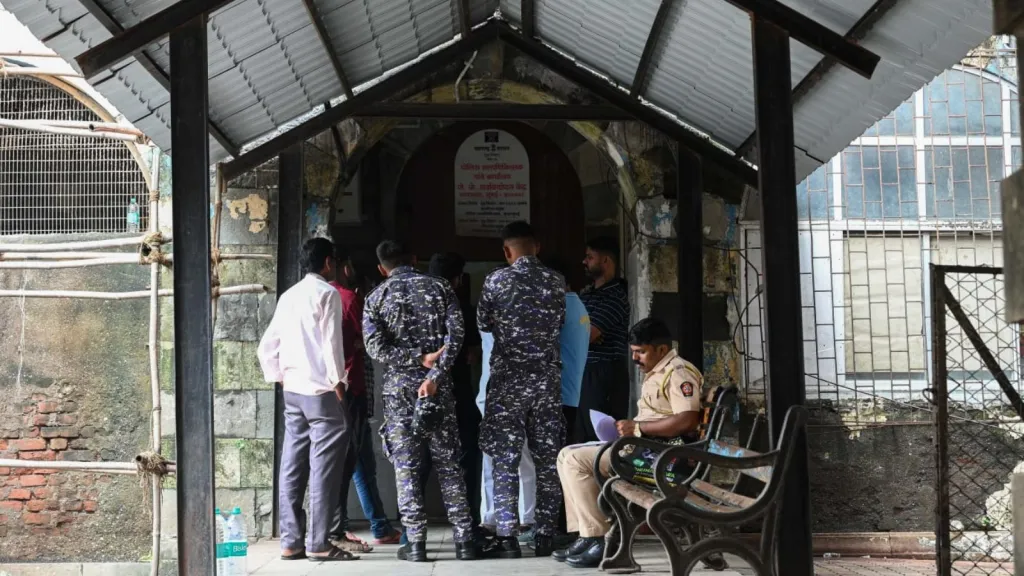
A view of the Navy Nagar area in Colaba, south Mumbai, where an Indian Navy sailor, his wife and their two young children were found dead at their residence. Image Credit: Indian Express
In a shocking incident that has sent ripples through Mumbai’s military and civilian communities, an Indian Navy sailor, his wife and their two children—including a three-year-old boy and a two-month-old infant—were found dead at their home in Navy Nagar, Colaba, on Saturday night (August 15, 2026).
Cuffe Parade police, who are investigating the case, said they received information about a man found hanging in Navy Nagar on the night of August 15. When they reached the spot, they found four bodies inside the house: the sailor, his wife, and their two children. Preliminary findings suggest the sailor died by hanging, while his wife and children may have been administered poison.
The deceased have been identified as 30-year-old Puranmal Shambhulal Mehra, an Indian Navy sailor; his 28-year-old wife, Oma Puranmal Mehra; their three-year-old son, Yash Puranmal Mehra; and their two-month-old daughter. All four bodies were sent to JJ Hospital for postmortem and further examination.
What Police Know So Far
According to Cuffe Parade police, the deaths came to light on the night of August 15, when they received information that a man was found hanging in Navy Nagar. On reaching the residence, officers discovered the sailor’s body, along with those of his wife and two children, on a bed inside the house. This story was also covered by The IndianExpress.
A senior police official from south Mumbai said, “It is suspected that the sailor died by hanging and the wife and children died by poisoning. The bodies have been sent for postmortem and further examination. A detailed report is awaited to ascertain the exact cause of death.”
Deputy Commissioner of Police (DCP) Maneesh Kalwaniya told media that prima facie, it appears the sailor committed suicide, while his wife and children died due to poisoning. He added that no suicide note has been recovered from the scene so far, and all possible angles are being investigated.
An Accidental Death Report (ADR) has been registered, and police are awaiting forensic and toxicology reports to confirm the cause and manner of death.
Statements and Reactions
Police version:
Cuffe Parade police confirmed that on August 15, they received information that a man was found hanging in Navy Nagar. “When we reached the spot, we found one man, one woman and two children dead inside the house,” a police official said. “We are investigating the case. Preliminary information suggests that the sailor died by hanging. It is premature for us to determine the reason behind the family taking extreme steps.”
Indian Navy statement:
In a brief statement, the Indian Navy said, “In an unfortunate incident at Navy Nagar, Colaba, an Indian Navy sailor along with his wife and 2 children were found dead at their residence on 15 Aug 26. Investigation is in progress by the police, and the Indian Navy is extending all possible assistance towards the same.”
Community reaction:
While detailed neighbour statements were still emerging, such incidents in high-security cantonment areas typically send shockwaves through military colonies, where families live in close-knit communities and rely on each other for support.
Background
Navy Nagar in Colaba is one of the largest naval residential complexes in Mumbai, housing serving and retired Navy personnel and their families. It is a high-security zone, with controlled access and a strong sense of community among residents.
The Indian Navy, like other armed forces, deals with unique stressors: long deployments at sea, separation from family, frequent transfers, and the psychological burden of high-responsibility roles. While the Navy has counseling services, welfare officers, and medical support systems, mental health issues—depression, anxiety, and relationship stress—can still affect personnel and their families, sometimes with tragic outcomes.
Family tragedies involving armed forces personnel, though rare, draw intense scrutiny and grief, both within the force and in the wider public.
Timeline
August 15, 2026 (evening/night): Information received by Cuffe Parade police that a man was found hanging in Navy Nagar, Colaba.
Police reach the spot: Officers find four bodies inside the house—sailor, wife, a three-year-old son, and a two-month-old daughter.
Preliminary findings: Sailor suspected to have died by hanging; wife and children suspected poisoned; bodies found on a bed.
August 15–16, 2026 (night/early morning): Bodies shifted to JJ Hospital for postmortem and further examination; Accidental Death Report registered.
August 16, 2026 (Sunday): Police confirm identities: Puranmal Shambhulal Mehra (30), Navy sailor; Oma Puranmal Mehra (28), wife; Yash Puranmal Mehra (3), son; and a two-month-old daughter.
August 16, 2026 (later): Indian Navy issues statement confirming incident, says investigation in progress, offers all possible assistance to police and family.
Ongoing: Police await postmortem, toxicology, and forensic reports; no suicide note recovered so far; all angles being investigated.
Also Read: Two Killed After E-Rickshaw Battery Blast Triggers Fire in Delhi Godown
Why This Matters
Yeh issue kaafi important hai kyunki yeh seedha asar pad raha hai armed forces families ki mental health support systems, domestic safety, aur urban community response par.
Mental health in armed forces: The incident underscores the need for robust, stigma-free mental health support for service personnel and their families, especially during deployments and transitions.
Family dynamics under stress: Long separations, financial pressures, and relationship issues can create intense stress, which, if unaddressed, can lead to extreme outcomes.
Child safety: The deaths of two very young children raise difficult questions about vulnerability in domestic settings and the need for early intervention mechanisms.
Community vigilance: In close-knit military colonies, neighbors and welfare officers often play a key role in spotting distress signals; this case may prompt reviews of support protocols.
India Angle
This is not just a Mumbai story; it’s an India-wide armed forces and mental health moment.
Armed forces welfare: The Army, Navy, and Air Force all run counseling and welfare programs, but reach and uptake can vary. Incidents like this renew calls for stronger, more accessible mental health infrastructure.
Urban military housing: Navy Nagar, like many cantonment areas, is a microcosm of disciplined, structured living. Yet, behind closed doors, families can face private crises that go unnoticed until it’s too late.
Public discourse: In India, discussions around mental health are slowly becoming more open, but stigma remains. For armed forces families, the pressure to “stay strong” can sometimes delay seeking help.
Agar har tragedy ke baad sirf inquiry hoti rahegi aur counselling, peer support, aur early intervention par serious kaam nahi hoga, toh yeh silsila rukne wala nahi hai.
Analysis
But beyond search, the narrative is emotionally and socially complex:
Murder-suicide framing: Police are treating this as a possible murder-suicide, with the sailor suspected of hanging and the family poisoned. This framing raises tough questions about motive, mental state, and domestic dynamics.
Absence of suicide note: No suicide note has been found so far, which leaves room for multiple hypotheses—personal crisis, undiagnosed mental illness, or other factors.
Institutional response: The Navy’s swift statement and offer of assistance reflect standard protocol, but such cases often prompt internal reviews of welfare and counseling mechanisms.
For follow-ups, newsrooms can track postmortem and toxicology results, any new evidence about motive or prior distress signals, and whether the Navy announces any review of support systems for families.
What Next
Postmortem and toxicology: The exact cause of death for all four will be confirmed through forensic reports, which will guide whether the case is treated purely as suicide or has other dimensions.
Police investigation: Cuffe Parade police will examine digital records, financial transactions, medical history, and neighbour testimonies to reconstruct the timeline and possible motives.
Navy internal review: The Indian Navy may conduct an internal welfare review, looking at the sailor’s service record, deployments, and any prior indications of distress.
Community support: Expect increased focus on counseling, peer support groups, and awareness drives within naval colonies to encourage early help-seeking behaviour.
Conclusion
The deaths of Puranmal Shambhulal Mehra, his wife Oma, and their two young children in Navy Nagar, Colaba, are a stark reminder of how hidden crises can erupt into public tragedy. A 30-year-old sailor, a 28-year-old mother, and two small children are gone in a single night, leaving behind a grieving community and many unanswered questions.
As police await postmortem reports and the Navy extends assistance, the larger conversation must turn to mental health support for armed forces families, early intervention, and destigmatizing help-seeking.
Ab dekhna yeh hai ki investigation kya khulasa karti hai, lekin is haadse ne ek baat clear kar di hai: mental health aur family welfare par aur zyada dhyan dena hoga, taaki aise tragedies future mein roke ja sakein.
Written By A. Jack