A glacier-collapse debris flow from Tibet, initially mistaken for an earthquake, triggered catastrophic flooding in Nepal; 133 Indians are among those missing as rescue teams search damaged border districts.
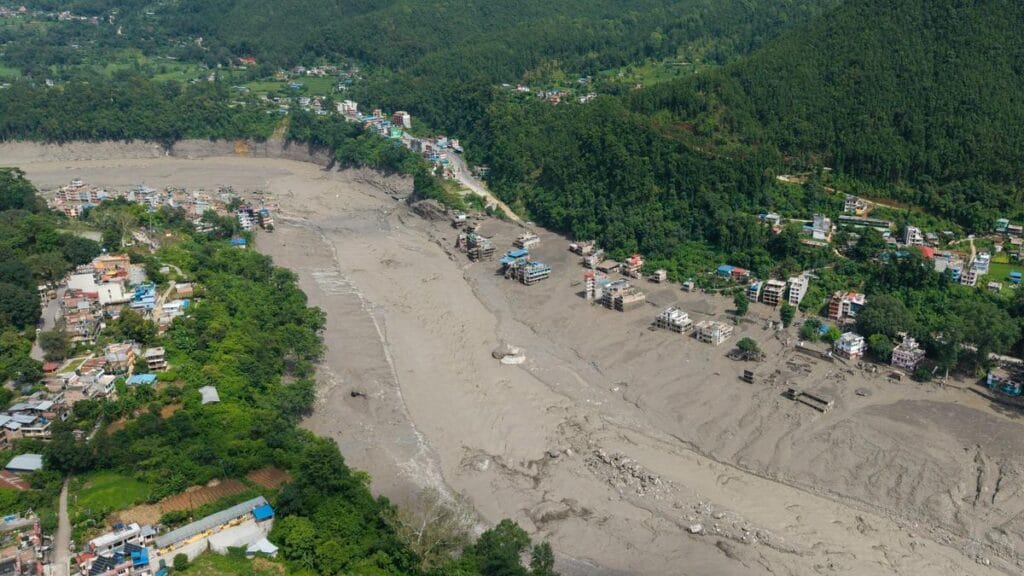
Nepal’s border with Tibet after a glacial collapse debris flow sent water, ice, rock and mud downstream. Image Credit: The Hindu
Nepal Flash Floods: Nearly 160 people have been killed and more than 750 remain missing after a catastrophic flash flood originating in Tibet swept through central Nepal and areas near the Nepal–China border on Wednesday, August 26, 2026.
The missing include 133 Indian nationals, many of them Kailash Mansarovar pilgrims traveling through the high-altitude border route.
The U.S. Geological Survey (USGS) said seismic activity initially reported as an earthquake was actually caused by a glacial collapse and debris flow. The event sent a huge mass of ice, rock, mud and water into a tributary system, triggering destructive flooding downstream across Nepal and Tibet.
Nepalese rescue teams, including the Nepal Army, Armed Police Force and Nepal Police, have been deployed to find survivors and recover those missing.
What Caused the Flash Floods
The disaster was initially linked to seismic activity, with early reports suggesting that an earthquake may have triggered the flooding. However, the USGS later revised its assessment.
According to the agency, the seismic signal was generated by a glacial collapse and debris flow, not a conventional earthquake.
The USGS said the event involved a large landslide-like collapse of ice and rock that produced a seismic signal equivalent to a magnitude 5.2 event. This story was also covered by The Hindu.
“No earthquake had occurred,” the USGS said, explaining that the apparent seismic activity resulted from the glacial collapse and the debris mass moving downstream.
The collapse sent water, ice, rocks and mud into the Lhende Khola, a tributary of the Bhote Koshi River. The sudden surge then traveled downstream, devastating settlements, roads, bridges, tourism facilities and hydropower sites.
The Bhote Koshi reportedly flooded around 9 am on Wednesday, sweeping through communities and infrastructure in the Rasuwa and Nuwakot areas.
Scale of Destruction
The flash flood caused massive destruction across central Nepal, especially in border districts and along river valleys.
According to the latest official figures:
| Impact | Reported figure |
|---|---|
| Deaths | Nearly 160 |
| Missing people | More than 750 |
| Missing Indian nationals | 133 |
| Bridges washed away | At least 19 |
| Roads washed away or heavily damaged | Nearly 40 km |
| Operational hydropower projects damaged | 8 |
| Under-construction hydropower projects damaged | 5 |
| Combined capacity of damaged operational hydropower projects | 354 MW |
Authorities said at least 19 bridges and almost 40 km of road were washed away. These losses have cut off towns and villages, slowed down rescue operations and made it difficult to establish communication with stranded tourists, workers and local residents.
The hydropower impact is also significant. Nepal’s Independent Power Producers’ Association said eight operational hydropower projects with a combined generation capacity of 354 MW were damaged, along with five under-construction projects in Rasuwa and Nuwakot districts.
Major projects reportedly affected include:
Rasuwagadhi Hydropower Project — 111 MW
Sanjen Khola Hydropower Project — 78 MW
Upper Trishuli 3A — 60 MW
133 Indians Missing
The disaster has triggered major concern in India because 133 Indian nationals are among the people reported missing.
Many of those affected were on pilgrimage to Mount Kailash in Tibet or traveling through Nepal on the Kailash Mansarovar Yatra route.
The region around Rasuwagadhi and Kerung/Gyirong is a key transit point for pilgrims traveling from Nepal towards Tibet. When flooding struck the border zone, many travelers were reportedly near immigration or customs facilities, hotels, camps and road links.
The missing count should be treated with caution because communication networks have been severely affected. Some people listed as missing may be stranded, temporarily uncontactable, separated from groups or awaiting evacuation.
But the scale of disruption means every missing-person report is being treated as urgent.
The Indian Embassy in Kathmandu and the Ministry of External Affairs and state governments are coordinating with Nepalese authorities, tour operators and families to trace affected nationals.
Helplines for Indian Nationals
Families searching for Indian nationals affected by the Nepal flash floods can contact the following official emergency numbers:
| Authority | Emergency contact |
|---|---|
| Indian Embassy, Kathmandu | +977 985 131 6807 |
| Indian Embassy, Kathmandu | +977 970 910 7500 |
| Indian Embassy, Beijing | +86 185 1428 4905 |
The Kathmandu numbers can reportedly also be accessed through WhatsApp.
Families should share all available identifying details:
Full name as per passport
Passport number
Mobile number
Tour operator name
Travel route and itinerary
Last known location
Hotel, camp or immigration center details
Names of fellow travellers
Emergency contact in India
Accurate information can help officials cross-check immigration records, hotel logs, rescue lists and tour-group manifests.
Bihar and Uttar Pradesh Watch Water Levels
The Ministry of Home Affairs said the Centre is closely monitoring the Nepal flood situation because rising water levels could affect areas along the India–Nepal border, particularly Bihar and Uttar Pradesh.
Floodwaters from Nepal have reportedly reached the Gandak River, prompting Bihar to remain on high alert.
India and Nepal share several river systems, so major flooding in Nepal can have downstream consequences in Indian border states.
The concern is not limited to immediate floodwater flow. Damaged hydropower infrastructure, landslide debris, unstable riverbanks and continued rainfall can create secondary risks.
Authorities are likely to monitor:
Reservoir water levels
River discharge into India
Embankment conditions
Low-lying villages
Road connectivity
Weather forecasts
Possible additional landslides or glacial-lake-related events
For residents in border districts, official weather and flood alerts should be followed carefully. Rumors or unverified social-media claims can create unnecessary panic.
Rescue Operations Under Extreme Conditions
The Nepal Army, Armed Police Force and Nepal Police teams have been mobilized for rescue and relief work.
Search efforts are difficult because of:
Washed-out roads and bridges
Landslides and unstable slopes
Broken phone and internet networks
Remote Himalayan terrain
Continuing rain and poor weather
Debris-filled river channels
Stranded people in isolated settlements
Damage to border and immigration facilities
Rescuers are using whatever access routes remain available. In some locations, helicopter evacuation, temporary bridges, local guides and manual search efforts may be required.
The possibility of survivors in isolated areas cannot be ruled out, particularly where communication has been cut off but people may have reached higher ground or temporary shelters.
At the same time, the rapidly rising death toll shows the extreme force of the flood.
Why Himalayan Glacial Disasters Are Dangerous
The Himalayas are highly vulnerable to sudden disasters involving glaciers, landslides, intense rainfall and river blockages.
Glacial collapses can occur when ice, rock and snow detach from unstable slopes. If the material falls into a river valley or lake, it can trigger a debris flow or flash flood that races downstream with enormous force.
Unlike gradual river flooding, a glacial-collapse flood may arrive with little warning. It can carry rocks, mud, trees, vehicles and parts of buildings, destroying roads and bridges in minutes.
Climate change is often cited by scientists as one of several factors increasing risks in high-mountain regions because rising temperatures can destabilize glaciers, thaw permafrost and alter rainfall patterns. But determining the exact contribution of climate change to any single event requires scientific investigation.
The Nepal disaster reinforces the need for better early-warning systems, satellite monitoring, river sensors, evacuation routes and cross-border disaster planning.
Also Read: Nepal Flash Floods: 59 Kailash Mansarovar Pilgrims Among 130+ Missing Indians
Timeline
Wednesday morning, August 26, 2026: A glacial collapse involving ice and rock occurs in Tibet, generating seismic activity initially mistaken for an earthquake.
Around 9 am: Debris and water flow into the Lhende Khola and surge downstream into the Bhote Koshi River system.
Wednesday: Floodwaters devastate towns and villages in central Nepal and border areas, washing away roads, bridges and hydropower infrastructure.
Initial rescue phase: The Nepal Army, Armed Police Force and Nepal Police deploy to affected districts for search and relief operations.
August 26–27: Authorities report nearly 160 deaths and more than 750 people missing, including 133 Indian nationals.
Thursday, August 27: USGS clarifies that the seismic event was caused by a glacial collapse and debris flow, not a conventional earthquake.
Ongoing: The Indian Embassy, MEA, Nepalese agencies and Indian states coordinate to trace missing pilgrims and tourists while rescue operations continue.
Ongoing: India monitors water levels and flood risks in Bihar and Uttar Pradesh along the Nepal border.
Why This Matters
Yeh disaster kaafi important hai because it is one of the most severe recent Himalayan flash-flood events, with a high death toll, hundreds missing and major infrastructure damage.
Humanitarian crisis: Nearly 160 deaths and over 750 missing people make rescue work urgent.
Indian pilgrims affected: The missing include 133 Indian nationals, many linked to the Kailash Mansarovar Yatra.
Infrastructure collapse: At least 19 bridges and nearly 40 km of road have been damaged or washed away.
Energy impact: Damage to 13 hydropower projects could affect Nepal’s power supply and regional infrastructure.
Cross-border flood risk: Bihar and Uttar Pradesh are monitoring water levels due to possible downstream effects.
Climate and disaster preparedness: The event shows why Himalayan monitoring and early-warning systems are essential.
India Angle
For India, the Nepal flash floods are both a humanitarian emergency and a border-management concern.
Thousands of Indian citizens travel through Nepal each year for pilgrimage and tourism. The Kailash Mansarovar route particularly involves remote roads, high-altitude weather and border formalities, making travelers vulnerable when infrastructure collapses.
India will also need to support Nepal through rescue coordination, medical assistance, communication restoration and evacuation operations.
For states like Bihar and Uttar Pradesh, the focus is on river monitoring and preparedness for possible downstream flooding.
Yes, tragedy shows that Himalayan disasters do not respect national borders. A glacier collapse in Tibet can affect Nepal’s towns, Indian pilgrims and river systems in India within hours.
Analysis
The biggest challenge in the current crisis is information management. Early disaster figures can change rapidly, especially when hundreds of tourists and pilgrims are uncontactable.
Authorities need to avoid two extremes:
Understating the crisis because people are only “out of contact”
Treating every unverified social-media claim as confirmed death or disappearance
A central, regularly updated list of missing, rescued, hospitalized, and evacuated individuals is essential.
In my view, the long-term lesson is equally serious. Hydropower projects, roads, border facilities and tourist routes in the Himalayas need stronger hazard mapping. It is not enough to respond after a collapse. Authorities need systems that identify dangerous glacial, slope and river conditions before disaster strikes.
What Next
The coming days will focus on rescue, verification and cross-border coordination.
Search for survivors: Nepalese teams will continue searching debris fields, riverbanks, isolated settlements and damaged border facilities.
Tracing Indian nationals: The Indian Embassy and MEA will verify missing-person lists through tour operators, immigration records and rescue teams.
Medical and evacuation support: Stranded people may require an airlift, emergency treatment, food, shelter and temporary communication access.
Hydropower assessment: Engineers will inspect damaged plants, dams, tunnels and transmission lines before any restoration work begins.
River monitoring in India: Bihar and Uttar Pradesh will continue tracking water levels and flood risk.
Scientific review: Experts will study the glacial-collapse event, its trigger and the downstream debris flow to improve forecasting.
Travel advisories: Authorities may issue further restrictions or advisories for high-altitude pilgrimage and border routes.
Conclusion
The Nepal flash floods have become a devastating regional disaster, with nearly 160 people dead, more than 750 missing and 133 Indian nationals unaccounted for.
The USGS assessment that a glacial collapse—not an earthquake—triggered the catastrophe shows the growing danger of sudden high-mountain hazards.
For now, the priority is simple but urgent: locate survivors, restore communication, evacuate stranded travelers, and provide families with verified information.
Yeh sirf Nepal ki tragedy nahi hai. It is a Himalayan warning for Nepal, India, Tibet and every community living or traveling near fragile mountain rivers.
Written By A. Jack