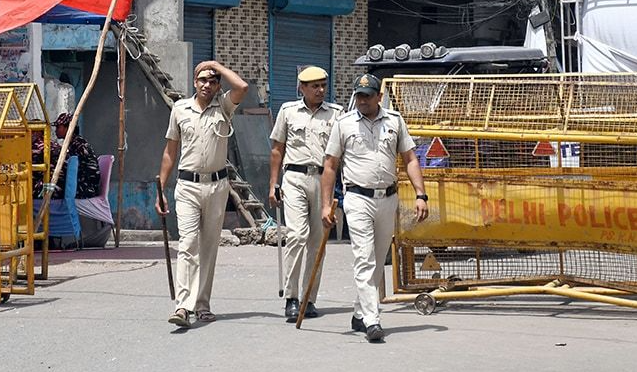
A 64-year-old man and his 49-year-old associate have been arrested for allegedly killing his 38-year-old son, Gul Hasan, by smashing his head with a stone and strangling him in an abandoned container near Kalindi Kunj.
This image is only for illustrations. Image Credit: Hindustan Times
In a shocking case of familial violence linked to mental illness, a 64-year-old man and his 49-year-old associate have been arrested for allegedly killing the man’s 38-year-old son, who was suffering from schizophrenia, police in Delhi said on Saturday, August 29, 2026.
The victim, Gul Hasan, was allegedly lured to an abandoned shipping container near the Delhi–Mumbai Motorway in south Delhi’s Kalindi Kunj on the pretext of being taken to a doctor, where he was first hit on the head with a stone and then strangled, according to police.
His body, with severe head injuries and ligature marks around the neck, was discovered inside the container on August 23. A murder case was registered under the Bharatiya Nyaya Sanhita (BNS), and four investigation teams were formed to trace the suspects.
The accused have been identified as Talukdar Ansari, the victim’s father, and Mohammad Wasim alias Akram, a 49-year-old associate. Both were arrested after CCTV analysis and a probe led police to a stitching factory in Govindpuri, south Delhi.
The Crime and Investigation
The case came to light on August 23, 2026, when police received information around 7:13 pm about the body of an unidentified man lying inside an abandoned container near the NTPC wall in Kalindi Kunj, about 500 metres east of the Delhi–Mumbai Motorway. This story was also covered by The Hindustan Times.
When officers reached the spot, they found:
The body inside the container
A deep injury on the victim’s head
A concrete stone with apparent blood stains nearby
Ligature marks around the neck, indicating strangulation
Initially, the victim’s identity was unknown. Police launched a “blind murder” investigation, scanning CCTV cameras around the crime scene and adjoining locations to establish a camera-to-camera movement trail.
From CCTV analysis, investigators traced:
The victim’s movement in the company of two people towards the crime scene
The two suspects returning alone without the victim
The suspects’ subsequent presence at a stitching factory in Govindpuri
This led to the arrest of Talukdar Ansari and Mohammad Wasim alias Akram on Friday, August 28, and the identification of the victim as Gul Hasan, Ansari’s son.
Why and How the Killing Happened
During interrogation, Talukdar Ansari disclosed that he killed his son with the help of his associate because Gul Hasan had been suffering from mental health-related problems and schizophrenia.
According to police:
The father told his son he was taking him to a doctor.
Instead, he and his associate led Gul Hasan to the abandoned container.
There, they allegedly hit him on the head with a concrete block or stone.
They then strangled him with a rope made out of cloth.
The body was left inside the container.
Police said the accused told investigators that Gul Hasan had become aggressive due to his condition, and the father was frustrated by his behaviour and unable to arrange proper treatment for him.
A case of murder has been registered under the Bharatiya Nyaya Sanhita (BNS), and the accused are being interrogated further to establish the full motive and sequence of events.
Quotes and Official Statements
DCP (Southeast) Vineet Kumar: “During the investigation, it emerged that Gul Hasan was suffering from schizophrenia and other mental health-related problems.”
Police account: “The accused first smashed the victim’s head with a stone and then strangled him.”
Investigation update: “From CCTV analysis, the movement of the victim was traced, showing him in the company of two people proceeding towards the scene of the crime and the suspects returning alone without the victim.”
Arrest details: “The suspects were subsequently traced to a stitching factory in Govindpuri, South Delhi, leading to their arrest and identification of the victim.”
These statements underline how digital surveillance and traditional detective work helped solve what was initially a “blind” murder case.
Schizophrenia and Carer Stress
Schizophrenia is a chronic mental health condition that can affect a person’s thinking, emotions and behaviour. People with schizophrenia may experience:
Hallucinations (hearing or seeing things that others do not)
Delusions (strong beliefs that are not based in reality)
Disorganised thinking and speech
Agitation or, at times, withdrawal
Difficulty managing daily tasks without support
In India, many families caring for members with severe mental illness face:
Limited access to affordable, continuous psychiatric care
Social stigma around mental health
Financial strain from long-term treatment
Emotional exhaustion and carer burnout
Lack of respite care or institutional support
While none of this justifies violence, experts often highlight that without proper support systems, some carers reach a breaking point. The Delhi case appears to be an extreme and criminal manifestation of such stress, compounded by alleged frustration over the victim’s aggressive behaviour and the father’s inability to arrange treatment.
Also Read: Delhi H1N1 Cases Cross 2,300: CM Rekha Gupta Calls Emergency Review Meeting
Timeline of the Case
Before August 2026: Gul Hasan, 38, lives with his father, Talukdar Ansari, 64, in south Delhi. He suffers from schizophrenia and mental health-related problems.
August 22–23, 2026: Ansari and his associate, Mohammad Wasim alias Akram, allegedly plan to kill Gul Hasan.
Day of the crime: The father lures his son to an abandoned shipping container near Kalindi Kunj on the pretext of taking him to a doctor.
At the container: They allegedly hit Gul Hasan on the head with a stone/concrete block and then strangle him with a cloth rope.
August 23, 2026 (evening): Police receive information about an unidentified body inside a container near the Delhi–Mumbai Motorway.
Initial investigation: A murder case is registered under BNS; four teams led by ACP Sarita Vihar and Anil Kumar Sharma are formed.
CCTV analysis: Victim’s movement with two people is traced; suspects seen returning alone.
August 28, 2026 (Friday): Suspects are traced to a stitching factory in Govindpuri and arrested.
August 29, 2026 (Saturday): Police publicly disclose details of the arrest and the victim’s identity.
Why This Matters
Yeh case kaafi important hai because it touches on mental health, family responsibility and criminal justice.
Mental health stigma: The alleged motive—frustration over a son’s schizophrenia—highlights how stigma and lack of support can turn tragic.
Carer burden: Many families in India care for mentally ill relatives without adequate professional help, counselling or financial aid.
Criminal response: Regardless of stress or illness, killing a family member is a grave crime that must be prosecuted firmly.
Access to care: The case underscores the need for affordable psychiatric treatment, community mental health services and crisis intervention.
Public awareness: People need to know that help exists—government hospitals, NGOs, helplines—and that violence is never a solution.
For society, this is a reminder that mental health is not just a medical issue but a social one.
India Angle
India has made progress on mental health policy, but gaps remain.
Key elements:
Mental Healthcare Act, 2017: Recognises the right to mental healthcare, decriminalises suicide, and emphasises community-based care.
Government facilities: Institutions like IHBAS (Delhi), NIMHANS (Bengaluru) and state mental hospitals provide low-cost care but are often overburdened.
Insurance coverage: Mental illnesses are supposed to be covered like physical illnesses under insurance norms, but implementation is uneven.
Criminal law: The Bharatiya Nyaya Sanhita (BNS) now governs murder and other offences; this case is being prosecuted under BNS.
Yet, on the ground:
Many families still hide mental illness due to shame.
Long-term medication and therapy can be expensive.
Rural and semi-urban areas have very few psychiatrists.
Carers often have no respite or counselling support.
Yeh situation dikhati hai ki sirf kanoon kaafi nahi hai; accessible, affordable mental healthcare aur social support bhi zaroori hai.
Analysis
This case must be understood clearly:
The father’s alleged frustration does not excuse murder.
Schizophrenia is a treatable condition; many people live stable lives with proper care.
Violence against mentally ill family members is a crime, not a “mercy killing”.
In my view, this incident reflects multiple systemic failures:
Lack of early intervention: If Gul Hasan had consistent psychiatric care, his symptoms might have been better managed.
No respite for carers: Families need counselling, support groups and temporary relief options.
Stigma-driven secrecy: When mental illness is hidden, families miss out on help until crises erupt.
Criminal mindset: Planning a killing, luring the victim and disposing of the body show premeditation, not a momentary loss of control.
While the emotional strain on carers is real, the legal and moral line is clear: taking a life is not an acceptable response.
What Next
The case will now move through the criminal justice system.
Likely developments:
Chargesheet filing: Police will file a chargesheet under the Bharatiya Nyaya Sanhita (BNS) for murder and related offences.
Judicial custody: The accused may be sent to judicial custody after initial police remand.
Trial: Evidence will include CCTV footage, forensic reports, witness statements and the accused’s confessions.
Mental health evaluation: Courts may order psychiatric evaluation of the accused, though this does not negate criminal liability.
Public discourse: The case may spark debate on mental health support, carer stress and legal protections for persons with mental illness.
For families in similar situations, the key message is:
Seek professional help early—government hospitals, community clinics, NGOs.
Use helplines and crisis services when behaviour becomes unmanageable.
Do not hide the illness; involve trusted relatives and community resources.
Remember: violence is a crime, not a solution.
Conclusion
A 64-year-old Delhi man and his 49-year-old associate have been arrested for allegedly killing the man’s 38-year-old son, Gul Hasan, who suffered from schizophrenia, by luring him to an abandoned shipping container on the pretext of a doctor’s visit.
Police say the accused first smashed the victim’s head with a stone and then strangled him, leaving his body inside the container near Kalindi Kunj.
CCTV analysis and a focused investigation led to the arrest of Talukdar Ansari and Mohammad Wasim alias Akram, with police linking the crime to the victim’s mental health condition and the father’s alleged frustration over treatment challenges.
This case is a grim reminder that mental illness cannot be met with violence. It also highlights the urgent need for affordable, accessible mental healthcare and stronger support systems for carers across India.
Written By A. Jack