Joshi, who currently holds the Food and Consumer Affairs portfolio, said he would take up the new responsibility with “duty and humility.” The transition comes just hours after Pradhan stepped down, ending one of the most closely watched protest episodes in recent weeks.
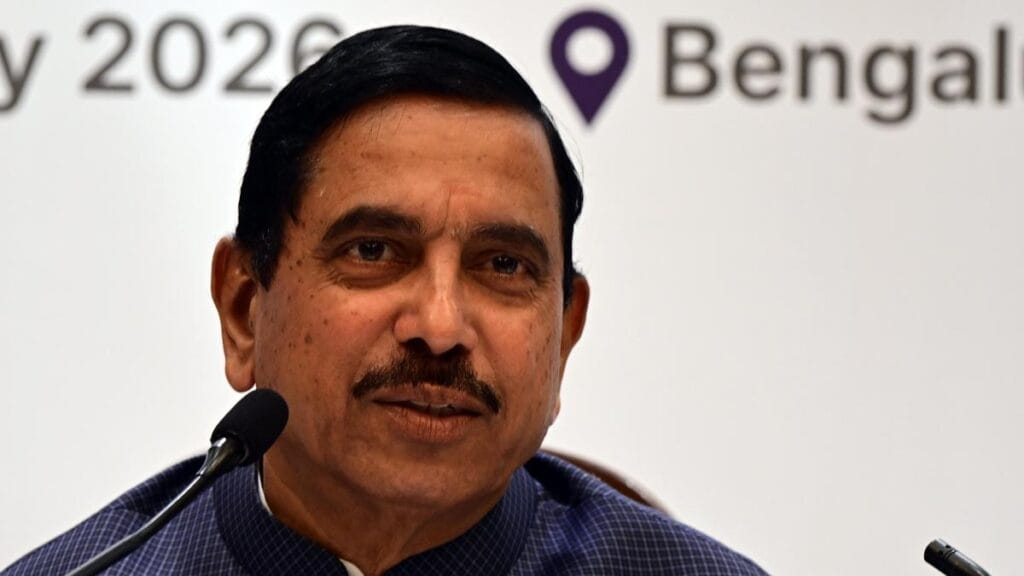
Union minister Pralhad Joshi after being assigned additional charge of the Education Ministry following Dharmendra Pradhan’s resignation amid exam leak protests. Image Credit: The Hindu
New Delhi witnessed a major ministerial reshuffle on Saturday evening as Pralhad Joshi was assigned additional charge of the Ministry of Education after Dharmendra Pradhan’s resignation was formally accepted by the President’s office. The move comes in the middle of a politically charged national debate over exam-paper leaks, student protests, and the Centre’s response to the growing unrest.
Pradhan’s exit followed weeks of demonstrations at Jantar Mantar and across the country, where protesters demanded accountability over alleged paper leaks and other irregularities in the education system. With the ministry now shifting to Joshi, the government has moved quickly to restore administrative stability and signal continuity in policy handling.
Why the Change Happened
The appointment of Pralhad Joshi is directly tied to the resignation of Dharmendra Pradhan, who stepped down after intense pressure from the CJP-led protest movement. Pradhan said in his resignation letter that he was leaving office to prevent “anti-national forces” from exploiting the situation and to avoid students getting dragged into legal complications instead of focusing on their future.
That explanation is important because it frames the resignation not only as a political response but also as a protective move. The government appears to have calculated that replacing the minister swiftly would help reduce public anger and allow the education ministry to continue functioning without appearing paralysed by the crisis. This story was also covered by NDTV.
Joshi’s appointment also reflects the Centre’s preference for a trusted senior minister during a sensitive transition. He is already an experienced Cabinet member and currently heads the Food and Consumer Affairs Ministry, which means he is not stepping into the role as a newcomer. In practical terms, this gives the government a familiar and politically reliable hand to manage the fallout.
Joshi’s First Response
In his first comments after the confirmation, Pralhad Joshi said he accepted the responsibility “with a sense of duty and humility.” He thanked Prime Minister Narendra Modi and said the last 12 years of the government had produced many historic achievements.
He also acknowledged the work already done in education under Dharmendra Pradhan, especially the implementation of the National Education Policy over the last four to five years. According to Joshi, the country has made “significant progress” under the new education system, and he pledged to work to the best of his ability under the Prime Minister’s guidance.
That tone matters. Rather than presenting the transition as a break from the past, Joshi’s remarks suggest continuity. He is positioning himself as a custodian of an existing reform path, not as someone coming in to reset the agenda completely. That may help calm concerns in the education sector.
Background and Context
Dharmendra Pradhan’s resignation came on the 35th day of protests in Delhi’s Jantar Mantar over exam paper leaks. His letter argued that he had dedicated more than four decades to students, teachers and educational reform, and that a strong and inclusive education system remained essential to national progress.
The protests were not a small, isolated demonstration. They had become a national issue, with students, activists and supporters viewing the paper leak controversy as a threat to trust in India’s competitive exam system. Over time, the agitation also drew political attention and began to influence the Centre’s response.
Hours after Pradhan’s resignation, CJP spokespersons Saurav Das and Ashutosh Ranka announced in a joint press conference with Union ministers JP Nadda and Jitendra Singh that the protest had been ended “in good faith” after the Centre assured them that their demands would be addressed. This sequence of events shows that the resignation and the ministry change were part of a larger negotiated political settlement.
Timeline
Weeks before Saturday: Protests intensify at Jantar Mantar and elsewhere over alleged exam paper leaks.
Day 35 of protests: Dharmendra Pradhan submits his resignation letter.
Same evening: The President’s office accepts the resignation and confirms Pralhad Joshi’s additional charge.
Hours later: CJP spokespersons announce the protest has been ended “in good faith” after assurances from the Centre.
Also Read: Dharmendra Pradhan Resigns After Weeks of Nationwide CJP Protests
Why This Matters
This matters because the Education Ministry sits at the center of one of the most sensitive policy areas in the country. When a minister resigns amid protest over paper leaks, it sends a signal that the issue is not routine politics; it is a crisis of confidence. Yahan se clear hota hai ki students aur parents ke concerns ko lightly nahi liya ja sakta.
It also matters because India’s education system is deeply tied to social mobility. Millions of families rely on competitive exams as a gateway to jobs, medical education, engineering, and government service. Any perception that the system is compromised hits not only exam takers but also the credibility of the state itself. Yeh issue kaafi important hai because the impact goes beyond one ministry or one protest.
For the government, the swift assignment of Joshi is an attempt to prevent administrative drift. For the public, it is a test of whether leadership change will lead to real reform or simply a change in nameplates. That distinction will shape how this episode is remembered.
India Angle
For Indian readers, this story connects directly to everyday anxieties around examinations, merit and fairness. In simple Hinglish, seedhi baat yeh hai: agar exam system par bharosa hi hil jaye, toh students ka future kaise secure hoga? That is why this ministerial change is being followed so closely.
The timing also matters. With protest pressure still fresh and students still worried about leaks and irregularities, any new education minister will be judged quickly on action, not just words. Joshi will need to show that the ministry is not merely reacting to protests, but taking steps to strengthen the system.
There is also a broader political angle. India’s youth are an increasingly vocal force, and when their concerns translate into ministerial change, it shows that student agitation can influence national governance. That makes this story relevant well beyond Delhi and the central government corridor.
Analysis
My opinion is that Joshi’s appointment is a stabilising move, but it is not automatically a solution. A cabinet reshuffle can calm the political temperature, but it cannot fix trust unless there are visible reforms in exam security and accountability. The real test will be whether the ministry follows up with measurable changes.
I also think the government is trying to project continuity rather than disruption. Joshi’s praise of Pradhan’s work and the National Education Policy suggests that the Centre wants this to be seen as a responsible handover, not a punishment or a rupture. That is a smart political message, but students will likely judge the government by outcomes, not tone.
What Next
The next step is for Pralhad Joshi to formally take charge and begin handling the education ministry’s immediate crisis agenda. That will likely include damage control, coordination on exam reforms, and communication around the Centre’s response to the paper leak controversy.
The government will also need to demonstrate that the protest settlement is more than symbolic. If the promised assurances are not followed by concrete action, public anger could return quickly. Students and families are likely to watch for clarity on exam processes, accountability and future safeguards.
In the coming days, Joshi may also have to reassure stakeholders inside the education ecosystem, including universities, regulators and exam bodies. His success will depend on how quickly he can balance political pressure with practical reform.
Conclusion
Pralhad Joshi’s appointment as Education Minister marks a key moment in the government’s response to the exam paper leak protests that forced Dharmendra Pradhan to resign. The move brings an experienced minister into a highly sensitive portfolio at a time when trust in the education system is under intense scrutiny.
The resignation, the appointment and the protest shutdown together show how quickly student anger can reshape political decisions in India. Now the real question is whether the leadership change will be followed by meaningful reform or whether this will remain a short-term political fix.
Written By A. Jack