
A large pile of garbage fell on the administration building at the Moshi garbage depot on Wednesday afternoon, causing the accident. Teams of NDRF, Indian Army, fire services and police have been working round the clock in unstable debris and a dangerous structure.
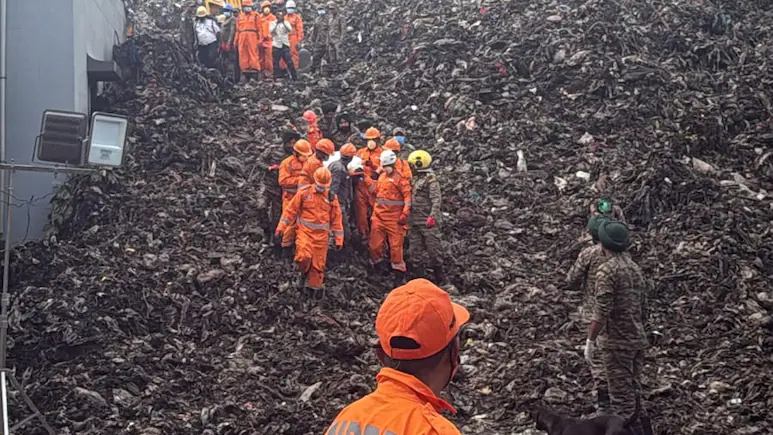
Rescue teams continue operations at the Moshi garbage depot in Pune after a massive garbage mound collapsed onto an administrative building. Image Credit: NDTV
Pune’s Moshi garbage dump collapse has turned into a major tragedy, with the death count now rising to eight after seven more bodies were recovered on Saturday from the damaged administrative building inside the waste-to-energy project. The collapse happened on Wednesday around 1:30 pm, when a huge heap of garbage gave way and crashed onto the building inside the Moshi garbage depot operated by the Pimpri-Chinchwad Municipal Corporation. One person remains untraced, and rescue teams are still searching through debris and unstable concrete.
The incident has drawn serious attention because it happened at a civic waste facility that was supposed to manage garbage, not become the site of a fatal disaster. The scale of the rescue effort and the number of agencies involved show how severe the collapse was. Yeh tragedy kaafi serious hai because it combines civic negligence, workplace danger and human loss in one event.
What Happened at Moshi
According to officials, 23 people were trapped when the garbage heap collapsed on Wednesday. Of them, 22 were inside the building and one was buried under a garbage mound next to the structure. Five people managed to escape immediately after the collapse, while rescue teams later pulled out nine more survivors on the first day itself. This story was also covered by NDTV.
On Thursday, rescuers recovered Bhavesh Wani from the collapsed building and rushed him to a hospital, where he was declared dead. After that, the rescue operation continued under difficult conditions because the structure was badly damaged and unsafe. The unstable building made it hard for teams to enter, so heavy machinery had to be used to clear debris carefully.
The seven bodies recovered on Saturday were identified as Akshay Sawant, 35, from Moshi; Sunil Korke, 40, from Alandi; Sunny Mane, 39, from Gandharvanagari in Moshi; Mahesh Kumbhar, 33, from Chhatrapati Sambhajinagar; Nagesh Gaikwad, 26, from Sanjay Gandhi Nagar in Moshi; Ranjit Patil, 22, from Moshi; and Rahul Gaikwad, 35, from Moshi. All seven were taken to a hospital in Pimpri, where medical officers declared them dead.
That brought the total death count to eight. One person is still missing, and officials say the search will continue without interruption until he is found.
Why Rescue Became So Difficult
The rescue effort has been unusually complex because this was not a simple building collapse. The structure was buried under a massive garbage heap, and the building itself was damaged in a way that made entry dangerous. A collapse involving waste is especially risky because the debris can shift, settle and hide trapped victims deep below the surface.
To speed up the search, 12 excavators, dumpers and JCB machines were deployed. On Friday night, two advanced demolition excavators were brought in, and under the technical guidance of the NDRF, rescuers removed the most dangerous concrete portions in a controlled way. That allowed teams to finally enter the structure more safely.
NDRF dog squads and specialized equipment are also being used to trace the missing person. This is important because in disasters like this, time and precision matter just as much as manpower. If debris is removed too aggressively, it can trigger another collapse. If it is removed too slowly, any remaining trapped person may not survive. That is why these operations are always delicate and exhausting.
Background and Context
The collapse took place inside the Moshi garbage depot, which is operated by the Pimpri-Chinchwad Municipal Corporation and linked to a waste-to-energy project. The site had already been active as a major civic waste-processing location, which makes the accident even more alarming. A facility meant to deal with city waste should ideally have robust safety systems, but this tragedy suggests that the risk environment was far more dangerous than it should have been.
Wednesday’s collapse happened when a massive heap of garbage came down onto the administrative building. The fact that one person was buried under a garbage mound next to the structure shows how large and unstable the waste mass must have been. This is not only an engineering issue but also a planning and safety issue. Urban waste sites, if not properly managed, can become hazardous zones very quickly.
There is also a wider lesson here for Indian cities. As urban waste grows, more municipalities are relying on large dumps, transfer stations and waste-to-energy facilities. But infrastructure alone is not enough. Safety protocols, site stability and emergency preparedness are equally important. In this case, the disaster has shown what can happen when those layers fail or become overwhelmed.
Timeline
Wednesday, around 1:30 pm: A massive garbage heap collapses onto the administrative building at the Moshi garbage depot.
Immediately after the collapse: Five people escape on their own.
Wednesday, first day of rescue: Nine people are pulled out alive by rescue teams.
Thursday: Bhavesh Wani is recovered and later declared dead at the hospital.
Friday night: Two advanced demolition excavators arrive to help stabilize and clear the site.
Saturday: Seven more bodies are recovered from inside the building.
Now: One person remains missing, and search operations continue.
Also Read: Pune Garbage Heap Collapse at Moshi Waste-to-Energy Plant Leaves 8 Workers Trapped After 40 Hours
Why This Matters
This matters because the collapse is not just an isolated local incident—it is a warning about how vulnerable workers can be at civic infrastructure sites. The victims were not in a remote accident zone; they were at a municipal waste facility in a major urban area. That makes the tragedy deeply relevant to public safety, worker protection and municipal accountability. Yeh issue kaafi important hai because people should not be dying at a place meant for garbage management.
It also matters because the numbers are now grim and concrete: eight deaths, one missing person and a large-scale rescue operation that has stretched across several days. Every recovered body adds to the human cost and intensifies the pressure on authorities to explain what went wrong. Families of the deceased are left with grief, while the public is left with questions.
There is also a broader civic lesson. If a garbage heap can collapse onto an administrative building and trap 23 people, then safety at such sites needs urgent review. This is especially important in Indian cities where waste management is becoming more industrialized, yet site-level protections may still lag behind the scale of operations.
India Angle
For Indian readers, this story hits close to home because waste management is a daily reality in cities across the country. In Hinglish, seedhi baat yeh hai: jab kachra manage karne ki jagah par hi jaan ka khatra ban jaaye, toh system ko seriously rethink karna padta hai. Municipal workers, contract staff and on-site employees often operate in risky conditions that do not get enough attention until something terrible happens.
The Moshi collapse also matters because it shows how fast a civic site can turn into a disaster zone. In many Indian cities, garbage depots, dump yards and landfill-edge facilities are part of the urban landscape. If safety checks are weak or slope stability is ignored, such incidents can happen anywhere. That makes the Pune tragedy relevant far beyond Maharashtra.
The incident will also resonate with Indian families because it involves ordinary workers and staff members, not distant industrial figures. People can relate to the fear of losing someone at work and the frustration of waiting for rescue teams to find answers. This is why the story is likely to remain in public discussion for some time.
Analysis
My opinion is that the biggest issue here is the combination of scale and delay. Once the building was buried under a huge garbage heap, the rescue became a race against time. But the difficulty of entering the structure also shows how dangerous the site had become. The use of advanced demolition excavators suggests that ordinary rescue tools were not enough. That should prompt authorities to examine whether the site was properly monitored before the collapse.
I also think the focus should stay on accountability and prevention. It is natural to report on the recovered bodies and missing person, but the larger story is why the heap became unstable enough to fall in the first place. If this was preventable, then the public deserves a clear explanation. If there were warning signs, they need to be identified. If the site design was weak, that needs to be fixed urgently.
The rescue response itself appears to have been large and coordinated, which is a positive point. NDRF, the Army, the civic body, fire services and police all worked together. But the need for such a massive response also underlines how serious the original failure was. In disaster reporting, the rescue is important, but prevention is the bigger story.
What Next
The immediate next step is the continuation of the search operation for the final missing person. Officials have said the operation will continue until that person is traced. Dog squads and specialized equipment are expected to remain active at the site while teams work carefully around unstable debris.
After that, there will likely be a detailed administrative and technical review of the collapse. Authorities may need to determine whether the garbage mound was unstable because of structural issues, poor maintenance, weather conditions or operational lapses. That review will be crucial in deciding who is responsible and what changes need to be made.
There may also be broader scrutiny of similar waste sites in Pune and other cities. If one facility could fail this badly, other landfill-linked or waste-processing sites may need closer safety checks. That could be one of the most important outcomes if the tragedy leads to stronger rules and better monitoring.
Conclusion
The Moshi garbage dump collapse in Pune has become a heartbreaking tragedy, with the death count now rising to eight and one person still missing under the debris. What began on Wednesday afternoon as a garbage heap collapse inside a municipal waste facility has turned into a prolonged rescue and recovery mission involving multiple agencies. The recovery of seven more bodies on Saturday confirms the scale of the disaster and the human cost behind it. As the search for the final missing person continues, the larger lesson is clear: civic waste sites must be made safer before another preventable tragedy occurs.
Written By A. Jack