
The collapse occurred about 1:30 p.m. July 8, when a large pile of waste fell down, covering the company’s administrative building. Rescue teams have extracted a number of survivors but officials have yet to clarify if the failure started at the plant or the adjoining landfill.
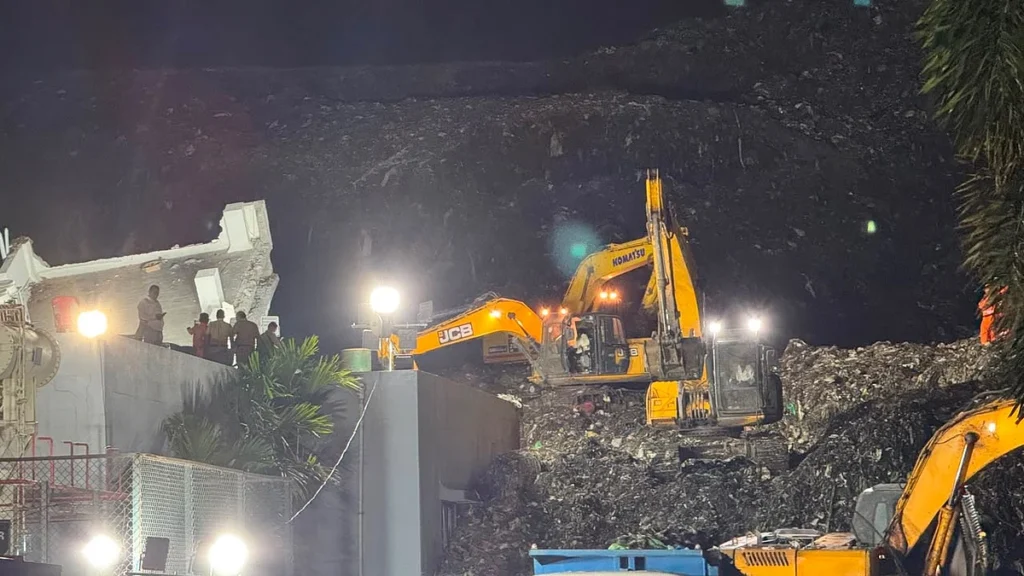
Rescue teams continue operations at the Moshi waste-to-energy plant in Pune after a towering garbage heap collapsed onto the administrative building. Image Credit: NewsLaundry
A major rescue operation is underway in Pune after a huge garbage heap collapsed at the Moshi waste-to-energy plant and buried the administrative building of the company operating the facility. More than 40 hours after the incident, eight workers are still believed to be trapped beneath the debris, even as teams continue to search through waste, sludge and unstable mounds of garbage. The collapse happened around 1.30 pm on July 8 and has turned a high-profile civic project inaugurated in 2023 into the centre of a troubling safety crisis.
The scale of the operation shows how serious the disaster is. The site is being worked on by the National Disaster Response Force, the Indian Army, firefighters, police, medical staff and excavators, all racing against time to locate possible survivors. Yeh incident kaafi serious hai because it combines industrial safety, municipal accountability and human tragedy in one event.
What Happened
According to municipal officials, around 23 people were inside the building when the garbage mound collapsed. Five workers identified as Ashok Gupta, Munendra Kumar, Chandrashekhar Singh, Dinesh Sutar and Shri Bala managed to escape. Others were trapped under the debris as the waste pile came down over the structure.
The rescue effort began around 3.30 pm on July 8, and by the early hours of July 9, nine people had been rescued alive. Later, one more person was located but could not be saved. By 8 pm on Tuesday, six more survivors had been pulled out and shifted to nearby hospitals. These included Somnath Shelke, Sachin Davadgaon, Dadasaheb Arade, Sujata Shinde, Rampratap Chavan and Ranveer Singh. The rescue operation continued through the night, and by around 1.30 am on Wednesday, three more survivors — Vijay Sapkal, Bhushan Patil and Mahesh Raut — had been rescued.
On Thursday morning, rescuers found Bhavesh Vani. He was pulled out in critical condition and taken to Yashwantrao Chavan Memorial Hospital in Pimpri, where doctors declared him dead. That discovery underscores how difficult and time-sensitive such operations are when debris includes loose waste, unstable layers and limited oxygen.
Why the Rescue Is So Difficult
The rescue teams are facing a complex and dangerous environment. This is not a normal building collapse where concrete slabs and steel beams are the main obstacles. Here, the debris is a huge mass of garbage that can shift unpredictably, release methane gas and reduce the chances of survival over time. NDRF Deputy Commandant Deepak Tiwari said fresh oxygen was being pumped into the debris to improve conditions for anyone still alive. This story was also covered by the NewsLaundry.
That detail is important because waste mounds are not inert. They can contain pockets of gas, moisture and compacted material that make rescue work far more hazardous. Workers and rescuers are exposed not just to collapse risk but also to toxic or suffocating conditions. In such circumstances, every hour matters.
Another challenge is uncertainty about the source of the collapse. Authorities have not yet clarified whether the incident was triggered by the functioning of the waste-to-energy plant itself or by conditions at the adjoining landfill area. That distinction matters because it determines whether the failure was operational, structural, environmental or a combination of all three.
Families Left Waiting
The human cost of the collapse is perhaps the most painful part of the story. Families of those feared trapped at the site have been waiting in fear for more than 40 hours, with no clear answers. Their statements reveal the emotional weight of the disaster and the long shadow it has cast over the affected households.
Nitin Sarode, brother-in-law of 33-year-old Sunny Mane, said his sister was told that her husband had been trapped under the debris and that the family had been at the site ever since. He described how their younger child is only two years old and the elder one is seven, adding that the elder child keeps asking where his father is. That is the kind of detail that makes this incident so heartbreaking.
Krishna Kasbe, nephew of 52-year-old Waman Kasbe, said his uncle worked in housekeeping and had moved to Pune nearly 20 years ago because drought had made life difficult in Beed and the Marathwada region. He said the family had rushed to the site after hearing the news and had still not received any sign of him even after more than 40 hours. His words reflect the desperation and uncertainty now hanging over several families.
Background and Context
The Moshi plant was inaugurated by Prime Minister Narendra Modi in August 2023 and was presented as a major waste-to-energy initiative for Pune. According to the Press Information Bureau, the project cost around Rs 300 crore and was designed to process 2.5 lakh metric tonnes of waste every year while generating electricity. At the time, it was described as having India’s largest boiler in a waste-to-energy plant.
The project was developed by Antony Lara Renewable Energy Pvt Ltd, with engineering, procurement and construction work carried out by a consortium led by Hitachi Zosen India Pvt Ltd, a subsidiary of the Japanese company Hitachi Zosen Corporation. That background is important because it shows the plant was not a small local unit but a high-visibility infrastructure project with national attention.
This makes the collapse more than just a local accident. It raises questions about waste management systems, landfill stability, plant safety and how such projects are monitored once they begin operating. India is investing heavily in waste-to-energy and urban waste processing, but incidents like this show how important safety and site discipline remain. Construction quality, mound management and drainage around such sites need close oversight.
Timeline
August 2023: The Moshi waste-to-energy plant is inaugurated by Prime Minister Narendra Modi.
July 8, 2026, around 1.30 pm: A garbage heap collapses onto the administrative building at the plant.
July 8, around 3.30 pm: NDRF begins rescue operations.
Early July 9: Nine people are rescued alive.
Tuesday evening: Six more survivors are pulled out and sent to hospitals.
Wednesday around 1.30 am: Three additional survivors are rescued.
Thursday morning: Bhavesh Vani is recovered in critical condition and later declared dead.
More than 40 hours after the collapse: Eight workers are still believed trapped.
Why This Matters
This matters because it exposes the vulnerability of workers in infrastructure and waste-management facilities. When a plant is built to process city garbage, safety standards must be as strong as the engineering itself. A single collapse can trap workers, stop operations and shake public confidence in the entire system. Yeh issue kaafi important hai because waste management is not just about cleanliness; it is also about occupational safety and public accountability.
It also matters because the plant is under the jurisdiction of the Pimpri Chinchwad Municipal Corporation and was inaugurated as a flagship urban project. When a major civic facility faces such a crisis, people naturally ask whether the system was being properly monitored. That question will likely remain central as more facts emerge.
For local residents, this is also a reminder that landfills and waste mounds can become dangerous if not managed correctly. Heavy rainfall, unstable heaps and poor drainage can all turn waste sites into high-risk zones. In a rapidly growing city like Pune, that makes the issue relevant beyond the plant itself.
India Angle
For Indian readers, this incident speaks to a bigger national challenge: cities are producing more waste than ever, and the infrastructure built to manage it must be safe as well as efficient. In Hinglish, seedhi baat yeh hai ki garbage plant ka kaam sirf kachra process karna nahi hota, usmein kaam karne wale logon ki safety bhi equally important hoti hai.
India is pushing waste-to-energy projects as part of modern urban governance, but these systems need robust checks. If a plant becomes dangerous for workers, then the promise of green infrastructure loses credibility. This story is therefore not just about Pune — it is about how Indian cities handle waste, safety and sustainability together.
It is also relevant to the broader public because many Indian towns and cities rely on similar landfill-based or waste-processing systems. If a collapse like this can happen at a high-profile facility, it raises concerns about conditions at less visible sites too. That is why people across India will be watching how Pune authorities respond.
Analysis
My opinion is that the biggest issue here is not just the collapse itself, but the uncertainty around the cause. Until officials clarify whether the failure came from the plant’s operations or the adjacent landfill, the public will naturally suspect deeper systemic problems. That ambiguity can damage confidence, especially when the site had already been presented as a modern waste solution.
I also think the human angle must remain central. Rescue operations often become technical stories, but at the heart of this one are workers and families waiting for news. The detail about methane gas and pumped oxygen shows how difficult the search is, but it also shows that every possible step is being taken to save lives. That balance between technical complexity and human urgency is what makes the story so powerful.
From an editorial standpoint, this incident will likely trigger scrutiny of waste mound management, site inspections and municipal oversight. If the collapse was linked to rainfall and unstable waste, then drainage and mound stability need urgent review. If it was linked to plant operations, then the safety protocols need even closer examination. Either way, the story is likely to have policy consequences.
What Next
The immediate next step is the continuation of rescue and search operations until the remaining workers are accounted for. NDRF, Army engineers, firefighters and medical teams will keep working through the debris with specialised equipment and canine support. Excavators will continue removing waste carefully to avoid further collapses.
After the rescue phase, there will almost certainly be an investigation into the cause of the collapse. Authorities may need to examine whether the landfill was stable, whether recent rainfall weakened the mound and whether safety protocols were followed at the facility. That investigation will be crucial for fixing responsibility and preventing a repeat.
There may also be a review of similar waste-to-energy or landfill-adjacent projects elsewhere in Maharashtra and across India. If this incident reveals a broader weakness, other facilities may come under closer inspection. That would be a necessary outcome, not just for accountability but for worker safety.
Conclusion
The collapse at Pune’s Moshi waste-to-energy plant is a grim reminder that urban infrastructure can fail in ways that put human lives at immediate risk. More than 40 hours after the garbage heap buried part of the facility, eight workers are still feared trapped, while rescue teams continue a difficult and dangerous search. With survivors rescued, one worker confirmed dead and the cause still unclear, the incident has raised serious questions about waste management safety, landfill stability and civic oversight. As the operation continues, the priority must remain clear: save lives, find answers and ensure this kind of tragedy is not repeated.
Written By A. Jack