A freak storm at Delhi’s Indira Gandhi International Airport on Sunday turned into a chaotic scene as ground support equipment was blown across the runway apron and collided with three parked Air India narrowbody aircraft at Terminal 2. Airports operator has confirmed the damage . The Directorate General of Civil Aviation ( DGCA ) has intervened to probe the matter .
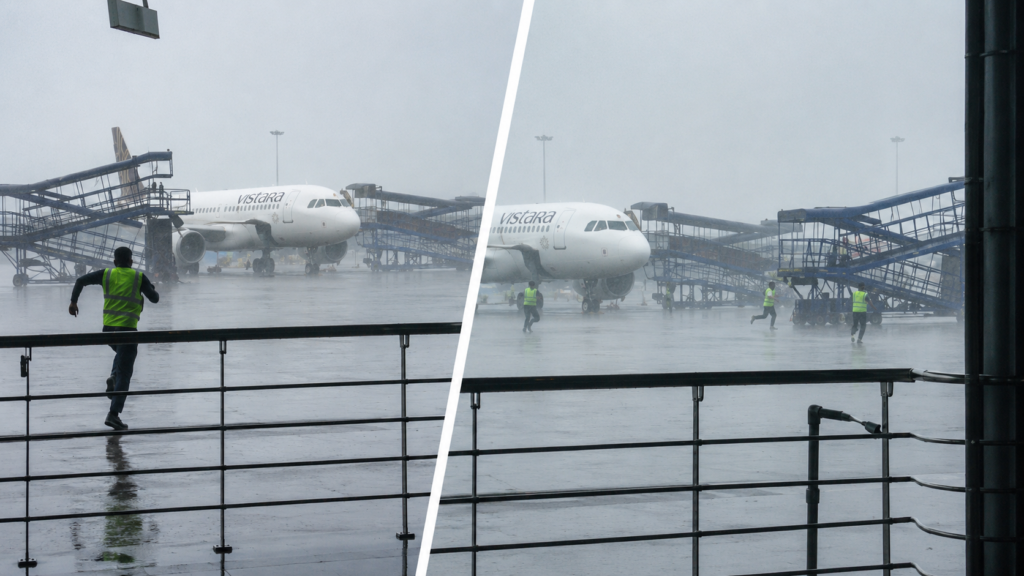
In a viral video, the ground support equipment can be seen rolling across the apron of Delhi airport amid strong winds and rain with the airport staff chasing it as planes stand parked. [Image Credit: India Today]
Storm at Delhi Airport
Sunday saw a violent weather spell at Delhi Airport turn into an aviation emergency as ground support equipment was blown off its position and struck three Air India narrowbody aircraft parked at Terminal 2. The airport operator said the equipment belonged to Air India Engineering and IndiGo and that the sudden storm caused the collision.
The incident unfolded during strong winds and rain, with a viral video showing equipment rolling across the apron while staff ran behind it, clearly trying to stop it. All three affected aircraft were immediately taken out of service, and one of them is expected to take longer to repair than the other two. The DGCA has now launched an investigation into how the equipment broke loose and who is responsible. Yeh incident kaafi important hai because it shows how rapidly weather can turn into a safety and operational crisis in aviation.
What Happened
The airport operator confirmed that ground support equipment was displaced due to sudden inclement weather and struck parked aircraft at Terminal 2. The equipment involved was said to belong to Air India Engineering and IndiGo, two major players in India’s aviation sector. The collision damaged three Air India narrowbody planes, all of which were parked at the same terminal. India Today has covered the full story.
A video of the incident quickly went viral on social media. In the clip, ground equipment is seen moving across the apron amid gusty conditions, while airport staff can be seen running behind it in an apparent attempt to halt its movement. The scene is chaotic and highlights the suddenness of the event. Staff were not slow to react; they were trying to catch and stop the equipment as it rolled dangerously close to aircraft.
The airport operator also said that Air Traffic Control (ATC) had not issued any warning to the airport operator or airlines about the sudden change in weather conditions. That detail is critical because it suggests the storm may have been unusually fast and unpredictable, leaving little time for preparation.
Damage to the Aircraft
All three Air India aircraft involved in the collision were taken out of operation immediately after the crash. According to an airline source, two of the impacted narrowbody planes are expected to return to service soon, but the third will take longer to repair. That means the airport will face a temporary reduction in available aircraft, which can affect flight schedules and passenger plans.
While Air India has not issued an official public statement, a source said aircraft belonging to other operators were also affected by the hostile weather. That adds another layer to the incident, suggesting the storm may have caused broader operational disruption beyond just the three Air India planes.
The damage itself is likely to be structural and external, given that the equipment struck the aircraft. Common points of impact could include wings, fuselage, nose sections, or landing gear areas. Repairing such damage can be time-consuming, especially if internal components are affected or if parts need to be replaced.
Why the Equipment Moved
The airport operator has blamed the sudden change in weather as the reason the ground equipment broke loose. Strong winds and rain can turn unsecured equipment into dangerous projectiles on the apron. If ground support machinery is not properly tied down, anchored, or restrained, it can be easily pushed or rolled by high-speed gusts.
The fact that ATC did not issue any warning further complicates the situation. Normally, airports and airlines prepare for weather changes by monitoring forecasts, securing equipment, and adjusting operations. If the storm arrived with no prior alert, staff may not have had enough time to secure all equipment completely.
That is why the DGCA investigation is so important. It will examine how the equipment was anchored, whether standard procedures were followed, and whether the weather warning system failed to detect the sudden change. The regulator will also look into whether the airport operator and airlines had adequate protocols to handle such extreme weather events.
Airline and Airport Response
Air India has not officially commented on the incident, but an internal source said the airline is aware of the damage and that the affected aircraft have been taken out of operation. The airline is likely assessing repair timelines and revising schedules as needed.
IndiGo, which also had equipment involved, has not issued a public statement yet. However, the airport operator confirmed that equipment from both Air India Engineering and IndiGo was displaced. That means both companies may face operational and financial consequences from the incident.
The airport operator has taken responsibility for reporting the damage and is now cooperating with the DGCA investigation. The operator is also likely reviewing its ground equipment security protocols to prevent similar incidents in the future. In a busy airport like Delhi, where thousands of flights operate daily, such a disruption can have ripple effects on the overall schedule.
Background and Context
Aviation is a highly weather-sensitive industry. Strong winds, rain, lightning, and sudden storms can cause delays, groundings, cancellations, and even equipment damage. This incident is unusual because it involved ground equipment moving into parked aircraft, not just wind affecting flight operations.
Delhi airport, like many major airports, uses a wide range of ground support equipment, including tugs, cargo loaders, baggage carts, and maintenance tools. These items are moved and stored on the apron, and they must be secured properly to prevent them from moving during bad weather. Normally, airports have strict procedures for this, but unexpected weather can disrupt even the best-planned protocols.
This is not the first time extreme weather has caused issues at Indian airports. Heavy rains, monsoon winds, and sudden storms have occasionally led to flight disruptions, but a case where equipment hits parked aircraft is relatively rare. That is why the DGCA investigation is important: it will help set clearer standards for equipment anchoring and weather response.
Timeline
Sunday: Strong winds and rain hit Delhi airport during the day.
During the storm: Ground support equipment belonging to Air India Engineering and IndiGo is blown across the apron.
Collision: The equipment strikes three parked Air India narrowbody aircraft at Terminal 2.
Immediately after: All three affected aircraft are taken out of operation.
Video goes viral: Social media shows staff chasing the rolling equipment.
Following the incident, DGCA announces an investigation into the collision and responsibility.
Also Read: Delhi Airport Bench Post Sparks Online Backlash After Man Calls Sleeping Passenger “Uncivilised”
Why This Matters
This matters because aviation safety depends on proper procedures, equipment security, and accurate weather monitoring. When ground equipment is not secured and strikes aircraft, it shows a gap in operational safety. Yeh issue kaafi important hai because it can affect not just this one incident but also the broader safety standards across Indian airports.
It also matters for passengers. With three aircraft taken out of service, flight schedules may be disrupted, and some passengers may face delays or rerouting. In a tight aviation market like India, where capacity is already stretched, losing even a few aircraft can cause operational headaches.
There is also a financial impact. Repairing aircraft takes time and money. Airlines must pay for the damage, and if the DGCA finds negligence, there could be penalties or regulatory changes. That is why the investigation is crucial.
India Angle
The India angle is very strong because Delhi airport is one of the busiest and most important aviation hubs in the country. A disruption here can affect flights across the nation. With India’s aviation sector growing fast, any safety incident can have wider implications.
In Hinglish, seedhi baat yeh hai: agar weather aisa ho jisme equipment bhi move kar jaye, toh yeh sirf accident nahi, safety system ka failure hota hai. This incident will be closely watched by airlines, regulators, and passengers across India. It will also raise questions about how weather warnings are shared and how equipment is secured in high-traffic areas.
For Indian readers, this is a reminder that even modern airports can face unexpected risks when weather is extreme. It also shows how quickly a small operational lapse can become a major incident.
Analysis
My opinion is that the incident is a clear example of how weather can expose operational weaknesses. Even if the weather was sudden, proper anchoring and securing of equipment should still prevent it from moving so dangerously. The DGCA investigation will likely focus on whether procedures were followed, whether warnings were sent, and whether the airport had adequate protocols.
If the investigation finds lapses, the aviation sector may see stricter rules for equipment security. In the long term, this could lead to more robust weather monitoring and better equipment anchoring standards.
What Next
The DGCA investigation will likely determine what caused the equipment to break loose and whether any party was negligent. Airlines and the airport operator may face scrutiny, and if negligence is found, there could be penalties or regulatory changes.
Airlines may revise their ground equipment protocols and improve weather monitoring. The damaged aircraft will undergo repairs, and two are expected to return to service soon, while the third will take longer.
Flight schedules may be adjusted temporarily, and passengers may face delays or rerouting as airlines work to recover capacity. The incident may also lead to more training for ground staff on securing equipment during extreme weather.
Conclusion
The Delhi airport storm that blew ground equipment into three Air India aircraft is a significant aviation safety incident that has triggered a DGCA investigation. The sudden weather change, lack of warning, and failure to secure equipment all point to operational gaps that need to be addressed.
While two aircraft are expected to return to service soon, the third will take longer to repair, and the incident may cause temporary flight disruptions. Yeh issue kaafi important hai because it highlights the need for better equipment anchoring, weather monitoring, and safety protocols across Indian airports. The DGCA’s findings will likely shape how such incidents are prevented in the future.
Written By A. Jack