Hope returns as Kabir Maharjan and Sanjay Shah survive underground ordeal; hundreds still missing across 12 projects
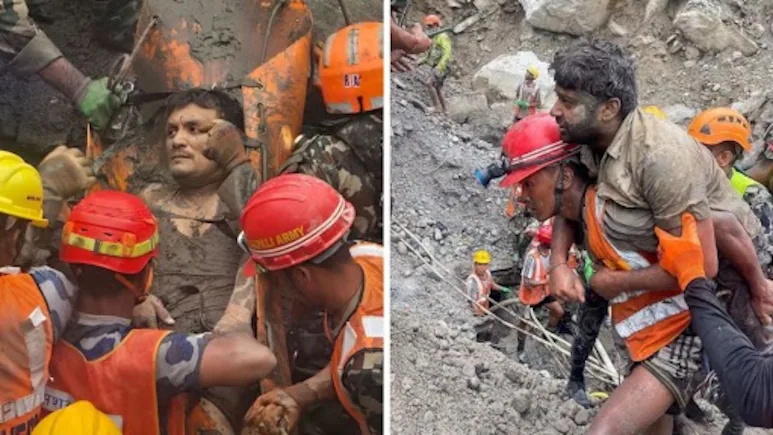
Rescuers carry mud-covered survivor Kabir Maharjan on their shoulders after pulling him alive from the debris-choked Trishuli-3A hydropower tunnel in Rasuwa district, Nepal. Image Credit: NDTV
Kathmandu, September 4, 2026 — In a moment that has reignited hope across Nepal, rescue teams successfully extracted two hydropower workers alive from the Trishuli-3A project tunnel on Friday, nine days after deadly flash floods swept through at least three districts. The survivors, identified as 45-year-old mechanical supervisor Kabir Maharjan and 30-year-old mechanical foreman Sanjay Shah, were pulled from the mud-filled tunnel in Rasuwa district, sending waves of relief through their families and the broader rescue operation.
Local television channels broadcast emotional footage of the mud-caked workers being carried on rescuers’ shoulders as they emerged from the tunnel entrance, their faces barely recognizable after nearly a week underground. Home Minister Sudan Gurung confirmed the identities and said both men were immediately airlifted for medical treatment—Shah to Battar hospital northwest of Kathmandu, while Maharjan was conscious and being transferred to Chhauni Military Hospital in the capital.
The Disaster That Trapped Hundreds
The rescue comes after an ice-rock avalanche and subsequent flash flood on August 26 devastated the Trishuli river valley, burying multiple hydropower projects under meters of mud, boulders, and debris. According to Nepal’s National Disaster Risk Reduction and Management Authority (NDRRMA), the floods—likely triggered by a glacier collapse near the Nepal-Tibet border—killed more than 1,000 people and left nearly 5,000 missing across affected regions.
At least 933 hydropower workers remain unaccounted for from 12 projects, with roughly 500 to 600 believed trapped inside tunnels that were inundated when floodwaters surged through the narrow Himalayan valleys. The Trishuli-3A site alone had 42 workers listed as missing before Friday’s breakthrough, according to army spokesperson Brigadier General Raja Ram Basnet. This story was also covered by NDTV.
Rescue operations have been extraordinarily challenging. Nepali Army engineers, supported by specialist teams from India and China, have used heavy excavators, drilling rigs, and controlled blasting to clear debris and widen tunnel access points. At Trishuli-3A, crews drilled into the upper section of the tunnel, pumped in fresh air, and lowered cameras to search for signs of life before finally reaching Maharjan and Shah. Local media reported that additional voices were heard inside the tunnel as the rescue continued, raising hopes that more survivors could still be found.
Voices From the Ground
“I am so happy; my heart is lighter,” Amir Maharjan, brother of rescued worker Kabir Maharjan, told AFP after learning his sibling was alive. Maharjan’s wife told the BBC that her husband was conscious when pulled out and was being prepared for transport to Chhauni Hospital.
Home Minister Gurung described the rescue as a “significant breakthrough” and said authorities were intensifying efforts to reach others potentially trapped in the same tunnel complex. Energy Minister Biraj Bhakta Shrestha’s office confirmed that both survivors were receiving medical observation and treatment, with Shah initially unable to speak due to his condition.
A senior rescue official, speaking on condition of anonymity, told reporters that teams were working around the clock despite dangerous conditions, including unstable debris, risk of further landslides, and limited access to remote sites. “Every voice we hear gives us hope,” the official said. “We will not stop until we have accounted for every worker.”
A Timeline of the Nepal Flood Crisis
August 26, 2026: A massive ice-rock avalanche near the Nepal-Tibet border triggers catastrophic flash floods along the Trishuli river, devastating Rasuwa and Nuwakot districts.
August 27–28: Initial rescue efforts begin; reports emerge of hundreds of hydropower workers missing, many believed trapped in tunnels.
August 30: NDRRMA confirms 933 hydropower workers unaccounted for across 12 projects; about 279 have been rescued so far, including 254 from Upper Trishuli-1.
August 31: Joint rescue teams from Nepal, India, and China deploy heavy equipment; blasting operations begin at Trishuli-3A to reach 42 missing workers.
September 1: Death toll crosses 1,000; electricity restored in some areas as rescuers reach remote locations via temporary bridges.
September 4: Two workers—Kabir Maharjan and Sanjay Shah—rescued alive from the Trishuli-3A tunnel after nine days underground; reports of additional voices heard inside.
Why This Matters
This rescue is more than a headline—it’s a reminder of the human cost behind Nepal’s ambitious hydropower expansion. The country has been aggressively developing hydro projects to meet domestic energy needs and export electricity to India, with dozens of facilities under construction in vulnerable Himalayan zones.
The disaster has exposed critical gaps in worker safety protocols, emergency response planning, and risk assessment for projects located in seismically active, flood-prone areas. With nearly 1,000 workers still missing and entire communities displaced, the economic and social fallout will reverberate for months, if not years.
For families waiting on the other end of phone lines that no longer connect, every hour counts. The psychological toll on relatives—many of whom have travelled from across Nepal and India to search for loved ones—is immeasurable.
India Angle
For Indian readers, yeh news sirf Nepal ki kahani nahi hai—yeh directly hamare national interest se juda hua issue hai. India has been a key partner in Nepal’s hydropower sector, with Indian companies investing heavily in projects along the Trishuli and other rivers. Moreover, Indian rescue teams—including specialists from the National Disaster Response Force (NDRF) and the Indian Army—have been on the ground since day one, working alongside Nepali and Chinese crews.
Several Indian nationals were among the hundreds of workers employed at these projects, and while many have been rescued, families back home are still waiting for confirmation about missing relatives. The disaster also raises questions about cross-border infrastructure planning, especially as India and Nepal deepen energy cooperation under bilateral agreements.
Agar aapko lagta hai ki yeh sirf ek tragic accident tha, toh sochiye dobara—climate change ke chalte aise extreme weather events ab common ho rahe hain, aur Himalayan region particularly vulnerable hai. India’s own hill states—Himachal Pradesh, Uttarakhand, and Sikkim—face similar risks, making this a cautionary tale for policymakers and engineers alike.
Analysis
The fact that Maharjan and Shah were found alive suggests that some tunnel sections may have remained partially intact, creating air pockets or voids where workers could shelter. It also underscores the importance of systematic, technology-assisted rescue operations—drilling, air pumping, and camera deployment likely made the difference between life and death.
However, the flip side is sobering: if two survived, how many others might still be alive in adjacent tunnels or sections that rescuers haven’t yet reached? The reported sounds of additional voices inside Trishuli-3A should be treated as a high-priority lead, not a rumor.
From a journalistic standpoint, this story also highlights the critical role of local media and international wire services in keeping pressure on authorities. Without continuous coverage, the urgency of the rescue could have faded from public consciousness, potentially slowing resource allocation.
The Road Ahead for Rescue and Recovery
In the immediate term, rescue teams will focus on:
Expanding tunnel access: Using drilling and blasting to reach other sections of Trishuli-3A where voices were reported.
Medical stabilization: Ensuring Maharjan and Shah recover fully and can provide details about conditions inside the tunnel, including the possible location of other survivors.
Scaling operations: Deploying additional equipment and personnel to other high-priority sites, including Trishuli-3B and Upper Trishuli-1, where dozens remain missing.
Family support: Setting up dedicated helplines and information centers for relatives of missing workers, many of whom have travelled from across Nepal and India.
Longer-term, expect:
Safety audits: A comprehensive review of worker safety protocols at all hydropower projects in flood-prone zones.
Policy reforms: Potential changes to environmental impact assessments and disaster preparedness requirements for new hydro projects.
International cooperation: Strengthened cross-border disaster response frameworks between Nepal, India, and China, given the transboundary nature of Himalayan floods.
Final Thoughts
The rescue of Kabir Maharjan and Sanjay Shah is a powerful reminder that hope, however slim, should never be abandoned. Nine days underground, surrounded by mud and debris, these two men held on—and thanks to the relentless efforts of rescue teams, they’re now on the path to recovery.
But their survival also casts a spotlight on the hundreds still missing, the families in limbo, and the systemic vulnerabilities that allowed this disaster to unfold with such devastating consequences. As rescue operations continue, the world watches—not just for more miracles, but for answers, accountability, and meaningful change.
Written By A. Jack