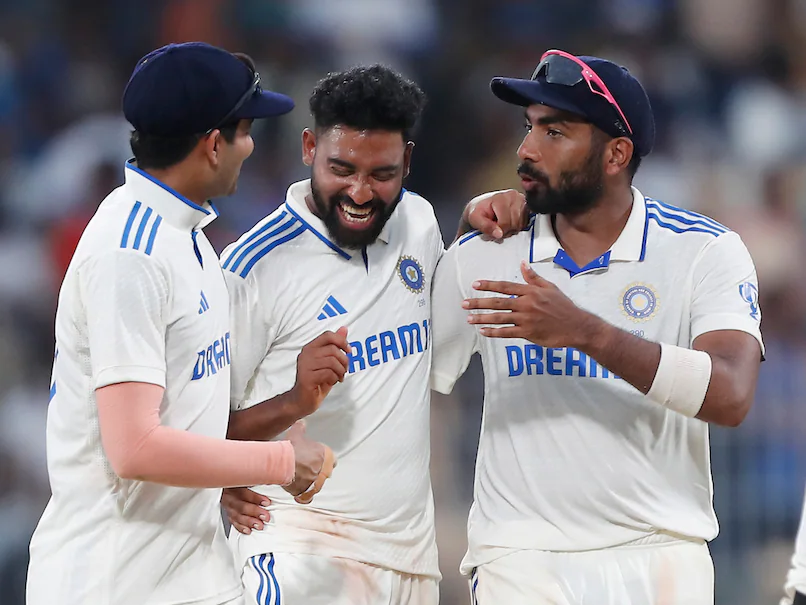
India’s three ICC trophies under Ajit Agarkar strengthen his record, but Mohammed Shami’s omission, Sarfaraz Khan’s limited opportunities, Abhimanyu Easwaran’s continued exclusion and Auqib Nabi’s late call-up remain contentious.
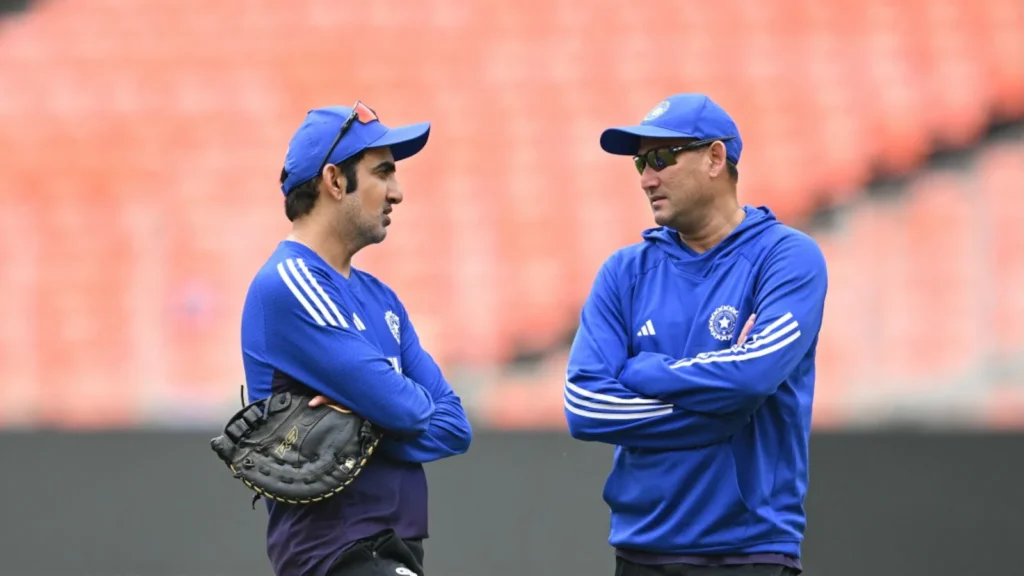
BCCI chief selector Ajit Agarkar and Coach Guatam Ghambhir. Image Credit: NDTV Sports
Ajit Agarkar became chairman of the BCCI’s senior men’s selection committee in July 2023, taking charge during one of the most important transition periods in Indian cricket. Since then, India have reached the 2023 ODI World Cup final, won two T20 World Cups, and also captured the Asia Cup and Champions Trophy. In limited-overs cricket, the results have been impressive.
However, India’s Test record during the same period has been far less convincing. The team suffered major defeats at home and abroad, including losses to New Zealand and South Africa at home and a heavy defeat in the Border-Gavaskar Trophy in Australia. That contrast has made the selection committee’s decisions more closely scrutinised.
Agarkar’s contract was due to end in June 2026, but the BCCI granted him a three-month extension. Whether he receives another extension remains uncertain. Amid that debate, former India opener Wasim Jaffer has identified several selection decisions that, in his view, can be discussed negatively: the continued omission of Mohammed Shami, the treatment of Sarfaraz Khan, the lack of clarity surrounding Abhimanyu Easwaran and Auqib Nabi’s late inclusion as Jasprit Bumrah’s replacement.
Agarkar’s record: success and criticism
Any assessment of Agarkar’s tenure must begin with India’s white-ball achievements. Under the current selection setup, India reached the ODI World Cup final in 2023, won the T20 World Cup in 2024, secured the Champions Trophy in 2025 and won another T20 World Cup in 2026. India also won the Asia Cup during this period.
Jaffer acknowledged those results and said Agarkar’s tenure should be considered successful when judged primarily by trophies. This story was also covered by NDTV Sports.
“I think if you talk about winning, then his tenure has been successful. You are judged by your results, so I believe the trophies we have won speak for themselves,” Jaffer said in a video posted on his YouTube channel.
However, he added that the way certain players had been handled was debatable. “There is no doubt about that. There is Mohammed Shami, then Sarfaraz Khan, and we keep mentioning Abhimanyu Easwaran’s name. Now Auqib Nabi, who wasn’t selected earlier, has been selected as a replacement,” Jaffer said.
The central question is therefore not whether Agarkar’s committee has achieved results. It clearly has in white-ball cricket. The debate is whether those results justify selection decisions that have left players and fans seeking clearer explanations.
1. Mohammed Shami’s omission
Mohammed Shami’s exclusion has been among the most discussed decisions of Agarkar’s tenure. The veteran fast bowler remains one of India’s most successful seamers, particularly in Test and ODI cricket, but his injuries and workload have complicated his availability.
When Shami was not picked for the Afghanistan series, Agarkar explained that the selectors had been informed that the pacer was currently ready only for T20 cricket. “As far as we have been told, at this point, his body is allowing him to play only T20 cricket,” Agarkar said after the squad announcement.
That explanation triggered criticism because Shami had played domestic cricket and remained a high-profile candidate for longer-format cricket. Wasim Jaffer questioned whether the same standard would be applied to other senior players and argued that the public deserved greater clarity about the medical and fitness assessment behind the decision.
The Shami debate is not simply about one selection. It reflects the difficulty of managing a senior player who has immense experience but whose body may no longer tolerate a full international workload.
For selectors, picking Shami carries the risk of injury recurrence. Leaving him out carries the risk of weakening India’s attack and creating the impression that his international career is being ended without a clear public explanation.
2. Sarfaraz Khan’s uncertain role
Sarfaraz Khan’s case has also raised questions. After years of strong domestic performances, he finally made his Test debut and showed that he could compete at an international level. However, his place in the playing XI and squad has not always been consistent.
Sarfaraz’s selection became a symbol of the tension between domestic performance and team balance. While his batting record earned him a place in the national setup, the selectors and team management have had to consider the presence of established players, the need for a left-right combination and the composition of the middle order.
Jaffer’s criticism is not necessarily that Sarfaraz must play every match. Rather, it is that a player who has performed consistently should receive a clear explanation about his position. A lack of communication can be damaging because it leaves the player unsure whether he is part of the long-term plan or merely being considered temporarily.
For a young cricketer, clarity matters. If the selectors want Sarfaraz to improve a particular aspect of his game, they should communicate that directly. If he is not being picked because of tactical considerations, the rationale should be transparent.
3. Abhimanyu Easwaran’s continued exclusion
Abhimanyu Easwaran has been a regular presence around the India Test squad but has struggled to convert repeated selection into an international debut. The Bengal opener has accumulated substantial domestic experience and has often been regarded as a reserve option.
His situation raises a familiar question in Indian cricket: how long should a player remain in the queue without being given a genuine opportunity?
Selection committees often prefer players who fit a particular tactical plan or who are already performing in international cricket. But repeated inclusion as a backup can become frustrating when the player is not selected even during periods of transition or injury.
Jaffer repeatedly mentioning Easwaran’s name reflects the perception that his case has not been clearly resolved. The selectors may believe other openers are better suited to the team’s needs, but the absence of a clear explanation has kept the debate alive.
4. Auqib Nabi’s late call-up
Auqib Nabi’s selection as Jasprit Bumrah’s replacement for the Sri Lanka Test series has created another point of discussion. The Jammu and Kashmir fast bowler earned his maiden India call-up after two excellent Ranji Trophy seasons, including a major contribution to his state’s maiden Ranji Trophy title.
However, Jaffer noted that Nabi had not been selected earlier despite being close to the Test squad. Agarkar later revealed that Nabi had been near consideration for an earlier assignment, while reports around his late selection raised questions about whether the selectors had initially underestimated his readiness.
Nabi’s call-up is understandable on merit. He took 104 wickets across two Ranji Trophy seasons and performed well for India A in Sri Lanka. But the timing made the decision appear reactive because it came only after Bumrah was ruled out.
The issue is not whether Nabi deserved selection. His domestic record strongly supports it. The question is why he was not already part of the wider Test plan if the selectors had identified him as a potential international bowler.
Jasprit Bumrah’s influence
Jaffer also stressed that Jasprit Bumrah has played a crucial role in India’s white-ball success since 2023.
“Apart from that, the presence of Jasprit Bumrah gives you an extra edge,” Jaffer said. “When he is not playing, our bowling looks lacklustre and ordinary. When he plays, our opposition is under pressure.”
That assessment is important because it complicates the evaluation of the selection committee. India’s trophy-winning sides were not built by selection decisions alone. They also benefited from exceptional performances by Bumrah, Virat Kohli, Rohit Sharma and other senior players.
Bumrah’s presence can transform India’s bowling attack, especially in high-pressure matches. His absence exposes weaknesses in depth and raises questions about whether the selectors have developed adequate alternatives.
Background and context
Agarkar took over after Chetan Sharma stepped down as chief selector in 2023. His appointment came at a time when India was trying to balance immediate success with long-term transition.
Since then, India has moved through significant changes. Senior players have retired from some formats, while younger cricketers have been integrated into the squads. The selection committee has had to manage workload, injuries, format specialisation and the demands of a crowded calendar.
The contrast between white-ball and Test cricket has become particularly important. India dominated limited-overs competitions but experienced a difficult Test phase, including home-series defeats and setbacks in Australia.
That record means Agarkar’s future may depend on which format the BCCI gives greater weight. If trophies are the primary benchmark, his case for an extension is strong. If Test rebuilding becomes the priority, the board may demand a different selection philosophy.
Timeline
July 2023: Ajit Agarkar becomes BCCI chief selector.
November 2023: India reaches the ODI World Cup final.
2024: India wins the T20 World Cup.
2025: India wins the Champions Trophy and Asia Cup.
2025–2026: India faces major Test setbacks at home and overseas.
June 2026: Agarkar’s original contract period ends; BCCI gives him a three-month extension.
2026: Mohammed Shami’s availability for longer formats becomes a selection issue.
August 2026: Auqib Nabi receives a Test call-up as Bumrah’s replacement.
Now: Questions continue over Agarkar’s future and the clarity of India’s selection policy.
Also Read: Ajit Agarkar’s Job Under Threat Over Rohit Sharma Saga, Could Be Replaced By VVS Laxman: Report
Why This Matters
This matters because selection decisions affect more than one player’s career. They shape the team’s transition plan, influence dressing-room confidence and determine whether domestic performers believe there is a genuine pathway to international cricket.
It also matters because India’s selection committee operates under intense public attention. Fans may accept difficult decisions if the reasoning is explained clearly. What creates controversy is uncertainty: a player is included, excluded or replaced without a convincing public rationale.
For Mohammed Shami, Sarfaraz Khan and Abhimanyu Easwaran, the issue is about opportunity and communication. For Auqib Nabi, it is about whether the selectors can identify talent early enough to build a stable pipeline.
Yeh issue kaafi important hai because India has an enormous talent pool, but talent alone is not enough. Players also need a transparent and predictable selection pathway.
India angle
For Indian cricket supporters, the debate reflects a wider national interest in merit, opportunity and performance. Domestic cricket remains the foundation of the Indian system, and players expect strong Ranji Trophy numbers to be considered seriously.
The India angle is especially visible in the contrasting cases of Shami and Nabi. Shami is an established international star whose body may limit his availability, while Nabi is a relatively new player whose domestic performances have opened the door. The selectors must manage both sides of that transition responsibly.
The debate also affects the credibility of the BCCI. The board is one of the most powerful sporting institutions in the world, and its decisions influence player careers, state associations and the structure of Indian cricket.
Analysis
Jaffer’s criticism identifies a genuine weakness: communication. Selection decisions can be tactical, medical or strategic, but players and supporters need to understand the reasoning.
The Mohammed Shami case is defensible if the medical team believes he is fit only for limited workloads. Sarfaraz’s exclusion may be explained by team balance. Easwaran may be competing with several established openers. Nabi’s late call-up may simply reflect the changing needs of the squad.
But when several such decisions occur without consistent explanations, they create a perception of confusion. The BCCI should publish clearer selection principles and ensure that the chief selector, team management and board officials communicate a common position.
What Next
The immediate question is whether Agarkar will receive another contract extension. The BCCI must decide whether to prioritise continuity ahead of the 2027 ODI World Cup or appoint a new selector with a mandate to rebuild the Test team.
The selection committee will also need to clarify its plans for senior players such as Shami and Bumrah. Workload management should be based on transparent medical assessments rather than media speculation.
For Nabi, the Sri Lanka series may determine whether he becomes a long-term Test prospect or remains a replacement option. A strong performance could accelerate his international career.
Sarfaraz and Easwaran will also be watching the next squad announcements closely. If they are not selected, the selectors may need to explain what improvements or conditions are required for their return.
Conclusion
Ajit Agarkar’s record as BCCI chief selector contains two very different stories. India has enjoyed exceptional success in white-ball cricket, winning major trophies and building one of the strongest limited-overs teams in the world. But Test results and several disputed selection decisions have exposed weaknesses in the transition process.
Mohammed Shami’s omission, Sarfaraz Khan’s uncertain role, Abhimanyu Easwaran’s continued wait and Auqib Nabi’s late call-up have all raised questions about consistency and communication. Wasim Jaffer’s assessment captures the balance: Agarkar’s tenure has been successful in terms of trophies, but some selection calls remain open to serious debate.
The next phase will test whether the BCCI values continuity, transparency or a complete reset. Whatever decision it takes, India’s selectors must ensure that the team’s success is supported by a selection system that is clear, credible and fair.
Written By A. Jack