
Five booth-level officers suspended after a BJP youth wing office-bearer was allegedly caught photocopying over 3,400 voter enumeration forms at a Kharghar shop, triggering a political confrontation and an FIR under the Representation of the People Act and BNS.
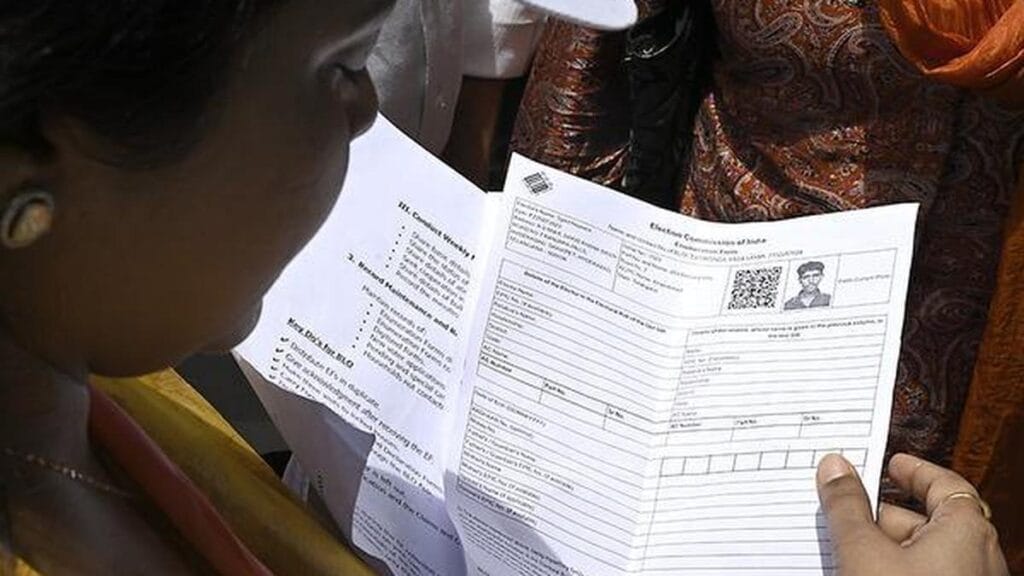
This image is only for illustrations. Image Credit: The Hindu
Five booth-level officers (BLOs) have been suspended after a local Bharatiya Janata Party (BJP) worker was caught photocopying more than 3,400 Special Intensive Revision (SIR) electoral forms containing voter details at a shop in Navi Mumbai’s Kharghar, officials said.
The incident came to light on Thursday, August 27, 2026, when Shiv Sena (UBT) activists allegedly confronted Suraj Patil, an office-bearer of the Bharatiya Janata Yuva Morcha (BJYM), at a photocopy centre in Sector 19, Kharghar, where thousands of SIR forms belonging to the Panvel assembly constituency were being reproduced.
A case was registered on the morning of August 28 under the Representation of the People Act and the Bharatiya Nyaya Sanhita (BNS), and the Raigad district collector suspended five BLOs pending disciplinary proceedings.
The episode quickly turned into a political flashpoint, with Shiv Sena (UBT) and BJP workers clashing over allegations of voter-data misuse and “vote chori” during the ongoing SIR exercise in Maharashtra.
What Happened
According to police and district administration accounts:
Location: A private photocopy shop in Sector 19, Kharghar, Navi Mumbai.
Date: Thursday, August 27, 2026.
Forms involved: 3,404 Special Intensive Revision (SIR) enumeration forms containing voter photographs and personal details from the Panvel assembly constituency.
Accused: Suraj Patil, identified as a nodal committee member of the BJP youth wing (BJYM).
Action taken: Five BLOs suspended; FIR lodged against Patil for illegal possession and photocopying of SIR forms.
Shiv Sena (UBT) activists claimed they caught Patil in the act of getting the forms photocopied in bulk. They alleged that the forms were official SIR documents meant for door-to-door enumeration and should not have been at a private commercial shop. This story was also covered by The Hindu.
Police said they verified the documents and confirmed they were original SIR forms that were the responsibility of the BLOs.
Why and How This Happened
The Special Intensive Revision (SIR) is a comprehensive exercise to update and clean electoral rolls. In Maharashtra, it involves:
Door-to-door verification by BLOs
Collection of filled enumeration forms from households
Verification of voter details, including name, age, address and family members
Uploading data into the Election Commission’s system
SIR forms contain sensitive personal information. They are meant to be handled only by authorised election officials and BLOs, not private individuals or commercial outlets.
In this case, the key questions are:
How did 3,404 filled SIR forms leave the custody of BLOs?
Who authorised or allowed them to be taken to a private photocopy shop?
What was the intended use of the photocopies—data harvesting, booth management, or something else?
Were other batches of forms similarly mishandled?
Raigad District Collector Kishan Jawale said: “Our officers verified the documents and found that they were indeed original and were the responsibility of the BLOs. Hence, we suspended five BLOs from that area.”
Police have registered an FIR against Suraj Patil for illegally possessing and converting SIR voter enumeration forms for “personal use” and for breaching the secrecy provisions related to voting under Section 314 of the BNS.
Quotes and Official Statements
Raigad Collector Kishan Jawale: “Our officers verified the documents and found that they were indeed original and were the responsibility of the BLOs. Hence, we suspended five BLOs from that area.”
Kharghar police: “A case was filed on the morning of August 28… The accused was caught photocopying over 3,000 SIR electoral forms containing voter details.”
Shiv Sena (UBT) allegation: Activists claimed a BJP youth wing office-bearer was copying SIR forms in bulk and raised questions about the transparency of the voter revision exercise.
BJP response: Party leaders have denied any organised attempt at voter-data misuse and called the incident an isolated case being politicised.
These statements show both the administrative action taken and the political contestation around the episode.
SIR Exercise and Past Controversies
The Special Intensive Revision (SIR) of electoral rolls is being conducted in several states, including Maharashtra, to:
Remove duplicate entries
Delete deceased or shifted voters
Add eligible new voters
Update addresses and other details
In Maharashtra, the SIR has been politically contentious, with opposition parties alleging that the exercise could be used to selectively delete or flag certain voter categories.
Similar concerns have been raised in other states:
Telangana: Chief Minister Revanth Reddy wrote to the Election Commission about nearly 92.86 lakh voter entries flagged across categories, warning that eligible voters might discover problems only at the polling booth.
Karnataka and West Bengal: State leaders have also questioned aspects of the SIR process and demanded greater transparency.
The Kharghar incident adds another layer of controversy: not just about who gets on the voter list, but also about how voter data is handled during the revision.
Timeline of the Kharghar SIR Forms Case
Before August 2026: Maharashtra launches the Special Intensive Revision (SIR) of electoral rolls; BLOs are assigned enumeration forms for door-to-door verification.
August 27, 2026 (Thursday): Shiv Sena (UBT) activists allegedly catch Suraj Patil, a BJYM office-bearer, at a photocopy shop in Sector 19, Kharghar, with over 3,400 SIR forms from the Panvel constituency.
Evening, August 27: The incident triggers a confrontation between Shiv Sena (UBT) and BJP workers at and around the shop.
August 28, 2026 (Friday): Police register a case against Patil under the Representation of the People Act and BNS; Raigad collector suspends five BLOs linked to the forms.
August 29, 2026 (Saturday): Media reports detail the suspensions, FIR and political clash; opposition leaders question the transparency of the SIR exercise.
Why This Matters
Yeh issue kaafi important hai because it touches on voter privacy, data security and trust in the electoral process.
Voter data protection: SIR forms contain names, addresses, dates of birth and family details. Unauthorised copying raises fears of data misuse.
Electoral integrity: If forms can be taken to private shops, questions arise about the sanctity of the entire SIR exercise.
Political trust: Allegations of “vote chori” or targeted deletion/addition of voters can deepen polarisation and reduce public confidence.
Accountability of BLOs: Suspending five BLOs signals administrative action, but voters want to know how such a large breach happened in the first place.
Precedent: If not handled firmly, similar incidents could recur in other constituencies during SIR.
For ordinary citizens, the core concern is simple: kya mera voter data safe hai, aur kya koi iska galat istemal toh nahi kar raha?
India Angle
India’s elections are among the largest in the world, and the credibility of the process depends heavily on trust in the voter list and the institutions managing it.
Key issues highlighted by the Kharghar case:
Physical data leaks: Even in a digital age, thousands of paper forms can be mishandled, copied or diverted.
Oversight gaps: BLOs are crucial but often overworked; weak supervision can enable misuse.
Political weaponisation: Every SIR controversy risks being framed as a partisan attack, making objective reform harder.
Legal framework: Cases are now being filed under the Representation of the People Act and the Bharatiya Nyaya Sanhita (BNS), showing that electoral data breaches are being treated as serious offences.
Yeh sirf Navi Mumbai ki baat nahi hai. Across India, similar questions about voter-list revisions, flagged entries and data handling are being raised in Telangana, Karnataka, West Bengal and other states.
Analysis
This incident is significant for several reasons:
Scale: 3,404 forms is not a small number; it suggests organised access, not a one-off mistake.
Location: A private photocopy shop is an unusual place for official electoral documents; it points to a breakdown in chain-of-custody protocols.
Timing: Occurring during a politically sensitive SIR exercise, the episode fuels existing narratives about voter-list manipulation.
In my view, the suspensions and FIR are necessary but not sufficient.
Authorities need to answer:
Were other constituencies affected similarly?
Is this part of a pattern or an isolated lapse?
What systemic changes will prevent recurrence—barcode tracking of forms, restricted photocopying, digital-only data entry, stricter BLO supervision?
Without such reforms, public suspicion will persist, regardless of which party is in power.
What Next
The case will now move through administrative and legal channels.
Likely developments:
Disciplinary proceedings against BLOs: The five suspended officers will face departmental enquiries; further penalties or transfers are possible.
Police investigation: Investigators will examine who handled the forms, how they reached the shop, and whether more copies or data sets exist.
Election Commission review: The ECI may issue fresh guidelines on SIR form handling, storage and transportation.
Political fallout: Opposition parties are likely to keep using the incident to question the transparency of the SIR exercise in Maharashtra and beyond.
Public awareness: Voters may become more cautious about sharing SIR details and more vigilant about verifying their entries on the electoral roll.
For citizens, practical steps include:
Checking your name on the official voter list portal
Reporting suspicious requests for SIR form photocopies
Ensuring that BLO visits are genuine and documented
Demanding accountability from local election officials
Conclusion
Five booth-level officers have been suspended and an FIR filed after over 3,400 SIR voter enumeration forms from the Panvel constituency were allegedly found being photocopied at a private shop in Kharghar, Navi Mumbai.
A BJP youth wing office-bearer, Suraj Patil, was named in the case, while Shiv Sena (UBT) activists claimed they caught him in the act, triggering a political clash and raising questions about the security of voter data during the SIR exercise.
While authorities have acted swiftly, the incident underscores a deeper problem: how to ensure that sensitive electoral data remains secure from the household to the election office.
This case should be a wake-up call for stricter controls, better oversight and greater transparency in the SIR process—so that voters can trust not just the final list, but the entire journey of their data.
Written By A. Jack