The patient, identified as Mohammad Akbar, was in Emergency Ward 27 when the fan reportedly detached and crashed onto his bed around 9.30 pm. While police said the matter is being examined, the hospital has denied that the fan incident caused his death.
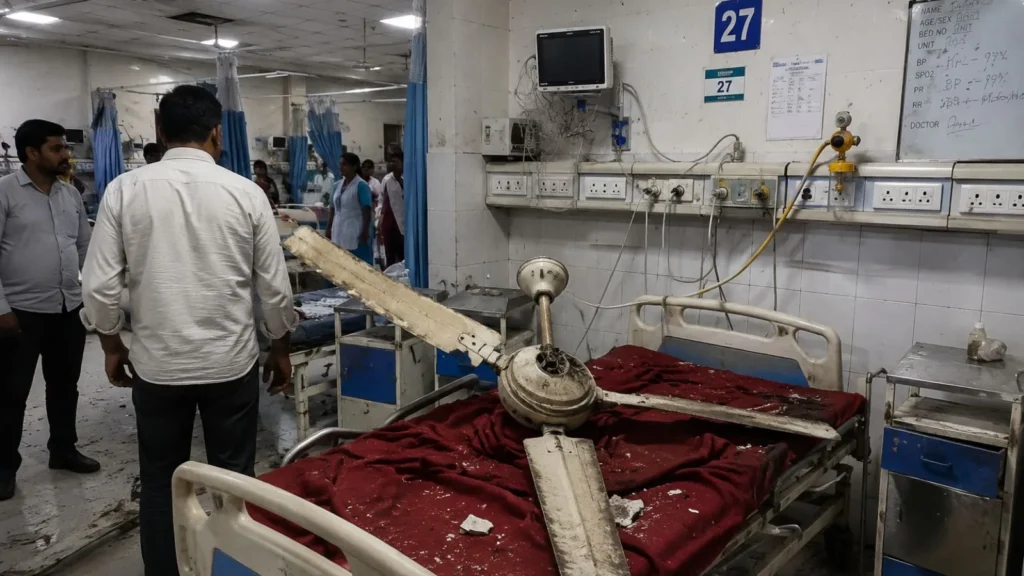
A safety scare at GTB Hospital in Delhi after a ceiling fan allegedly fell on a patient receiving emergency treatment. Image credit: The IndianExpress (AI Generated Image)
A shocking incident at Guru Teg Bahadur (GTB) Hospital in Northeast Delhi has raised fresh alarm over safety standards in public healthcare facilities after a ceiling fan allegedly fell on a patient in the emergency ward on Saturday night. The patient, Mohammad Akbar, 42, was reportedly receiving treatment in Emergency Ward 27 when the fan suddenly came loose and crashed onto his bed at around 9.30 pm.
Akbar died hours later, according to police. The case has now sparked anger and concern over whether proper maintenance checks were being carried out in the hospital. The hospital, however, has denied that the incident led to his death, saying his demise was due to underlying illnesses. Yeh incident kaafi important hai because it touches both public safety and the trust people place in government hospitals when they are already vulnerable.
What Happened in the Ward
According to officers, the incident took place in Emergency Ward 27, where Akbar was undergoing treatment. Eyewitnesses said a ceiling fan suddenly became detached and fell directly onto his bed. That is the most disturbing part of the case: the patient was in a medical facility, a place where he should have been safe, and yet the environment itself may have become a source of harm. This story was also covered by The IndianExpress.
The timeline suggests a severe emergency response issue as well. The fan reportedly fell at around 9.30 pm, and Akbar died hours later. While the exact medical sequence after the accident is still not fully clear from the available information, the case has already raised serious questions about whether the physical shock or injuries from the incident contributed to his condition. Police are likely to examine whether negligence, poor maintenance or a structural failure played any role.
At this stage, one thing is clear: this was not a normal hospital incident. A ceiling fan detaching inside an emergency ward is the kind of event that instantly raises concerns about infrastructure standards, routine safety inspections and administrative accountability. Seedhi baat yeh hai: if a patient can be harmed by a falling fan in a hospital, then the system clearly needs scrutiny.
Hospital’s Response
The hospital has denied that the fan incident caused Akbar’s death. Officials said the patient died due to underlying illnesses, not because of the falling fan. That statement is important because it creates an immediate difference between the physical accident and the medical cause of death.
Hospitals often distinguish between a triggering incident and the actual medical reason for death. However, even if the underlying illnesses were severe, that does not automatically erase concerns about the fan falling in the first place. A patient already receiving emergency care is especially vulnerable, and any additional trauma can worsen the situation or at least complicate treatment. So even if the hospital’s version is correct medically, the safety lapse still remains a legitimate public concern.
This is where communication becomes crucial. A clear, transparent explanation from the hospital can help reduce confusion, but if details remain vague, public suspicion usually grows. In such cases, people naturally ask whether maintenance checks were overdue, whether the fan had been reported earlier and whether the ward environment was properly monitored. Yeh bhi important hai because trust in public hospitals depends not just on treatment but on safe surroundings too.
Why This Incident Feels So Serious
The incident feels especially serious because it happened in a major government hospital in the national capital. GTB Hospital is one of Delhi’s large public healthcare institutions, which means the expectations around safety, infrastructure and upkeep are even higher. If a ceiling fan can detach in an emergency ward, citizens will understandably wonder what other hazards may exist in older public facilities.
Hospital safety is often discussed in terms of medicine, infection control and staffing. But physical infrastructure is just as important. Loose fittings, aging equipment and poor maintenance can all become risks when the system is under pressure. In a busy emergency ward, even a minor structural failure can turn into a major incident. That is why this case is not just about one patient’s death; it is about a broader safety culture.
There is also the emotional dimension. Families bring sick relatives to hospitals expecting care, not danger. When a tragedy like this happens, it shakes confidence far beyond one ward or one hospital. It becomes a question of whether public institutions are taking enough care of the spaces where patients are treated. Yeh issue kaafi important hai because healthcare safety should be non-negotiable.
Background and Context
India’s public hospitals carry a heavy burden. They serve large numbers of patients, often with limited space, aging infrastructure and high demand. In such environments, maintenance can sometimes fall behind clinical priorities. But that does not make safety failures acceptable. If anything, it makes routine inspection even more necessary.
Government hospitals across Indian cities often face complaints about overcrowding, broken fixtures, poor upkeep and delayed repairs. This incident at GTB Hospital fits into that wider pattern of concern. It may not be representative of every ward or every hospital, but it highlights how quickly neglected infrastructure can become a danger.
This also raises the issue of accountability in public institutions. If a fan was loose enough to fall, then who inspected it last? Was the problem known before? Were repair requests ignored? These are the kinds of questions that usually follow such incidents. Even when final medical findings point to an underlying disease, the safety failure itself still demands explanation. Public hospitals, especially in Delhi, must be seen as places of healing, not hazards.
Timeline
Saturday night, around 9.30 pm: A ceiling fan allegedly detaches in Emergency Ward 27 at GTB Hospital.
Immediately after: The fan crashes onto the bed where Mohammad Akbar was receiving treatment.
Hours later: Akbar dies, according to police.
After the incident: Concerns emerge about safety standards and maintenance at the hospital.
Hospital response: Officials deny that the fan fall caused the death, citing underlying illnesses.
Also Read: Four Arrested After Misbehaving With Delhi Poll Officer During Voter Revision in Chandni Mahal
Why This Matters
This matters because hospital safety is a public trust issue. When people go to a government hospital, they should not have to worry about whether a ceiling fan, a fixture or any other part of the building may fail on them. The incident shows how a maintenance lapse can have life-and-death consequences, or at the very least create the appearance of one. Yeh issue kaafi important hai because trust in healthcare is built on both treatment and environment.
It also matters for public health administration. If hospital infrastructure is not being regularly checked, the risk is not limited to one ward. Similar problems could exist elsewhere in the building or across other hospitals. One incident can therefore become a warning sign for a much wider system problem. That is why authorities should treat this as more than an isolated tragedy.
For the general public, the impact is deeply personal. Families across India rely on government hospitals for affordable care. If such institutions are perceived as unsafe, confidence drops and anxiety rises. In a country where many people have no easy alternative, that is a serious concern.
India Angle
For Indian readers, this story reflects a familiar and troubling reality: infrastructure lapses in public services often become headline news only after an accident. In Hinglish, seedhi baat yeh hai: log hospital mein ilaaj ke liye jaate hain, danger face karne ke liye nahi. The GTB Hospital case will resonate strongly because many families have experienced or heard about maintenance issues in public facilities.
This is also a Delhi story with a national message. The Capital’s hospitals are often seen as reference points for public healthcare standards. If a major Delhi hospital is facing such questions, people in other states will naturally ask whether their own systems are safer. The issue therefore goes beyond one ward or one city.
There is also a governance angle. In India, infrastructure failures often lead to inquiries, statements and then slow follow-up. Citizens now expect more than sympathy; they want preventive action. A hospital that serves thousands of patients must show that it can maintain basic physical safety, not just provide treatment.
Analysis
My opinion is that even if the hospital is correct that the patient died because of underlying illness, the incident still deserves strong scrutiny. The central question is not only what caused the death but also why a fan was able to fall in the first place. Public institutions cannot rely on medical explanations alone to dismiss physical safety failures. A hospital must be judged on the whole environment it creates.
I also think this case will raise broader questions about maintenance budgets, inspection schedules and engineering oversight in government hospitals. These may sound like technical issues, but they directly affect patient safety. A minor repair ignored today can become tomorrow’s tragedy. That is why regular audits and clear reporting systems matter so much.
From an editorial perspective, this story has strong public resonance because it feels preventable. Readers are likely to react emotionally to the idea of a patient being treated under a fan that then falls on him. Whether or not the fan was the direct medical cause of death, the image itself is enough to demand accountability. That gives the story urgency.
What Next
The next step should be a formal inquiry into how the fan detached and whether maintenance records were up to date. Authorities will need to establish whether the ward had any prior complaints, whether the fixture had been inspected and whether there was any negligence in upkeep. A clear investigation is essential because public trust depends on transparency.
The hospital may also need to review the safety of other wards and emergency rooms. If one fixture failed, others may require immediate checks. That could include ceiling fans, lights, fittings and other equipment in patient areas. Preventive maintenance should become an immediate priority, not a future promise.
For the family, the focus will likely be on understanding the exact circumstances of Akbar’s death and whether the incident worsened his condition. For the public, the question is bigger: can government hospitals guarantee basic safety alongside treatment? That is the question authorities will now have to answer.
Conclusion
The death of Mohammad Akbar hours after a ceiling fan allegedly fell on him at GTB Hospital has exposed a disturbing safety lapse in one of Delhi’s major government hospitals. While the hospital says his death was caused by underlying illnesses, the incident itself has raised urgent questions about maintenance, oversight and patient safety. In a country where millions depend on public hospitals every day, this is not a minor story — it is a warning. If healthcare institutions cannot guarantee a safe physical environment, then the system must act fast to fix what went wrong.
Written by A. Jack