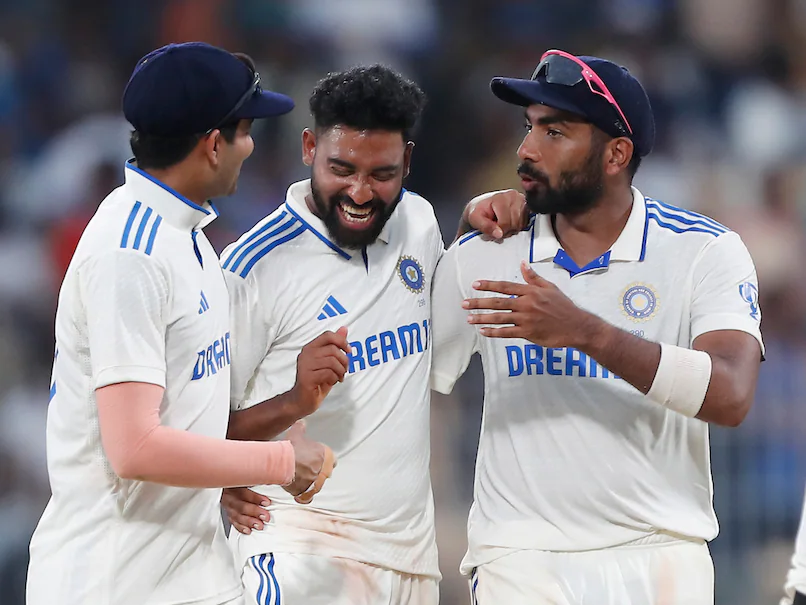
India needed a near-perfect chase after England piled up 387, powered by Ben Duckett and Jacob Bethell, and Rohit nearly delivered it. But England’s late surge with the bat and India’s bowling struggles proved decisive in the end.
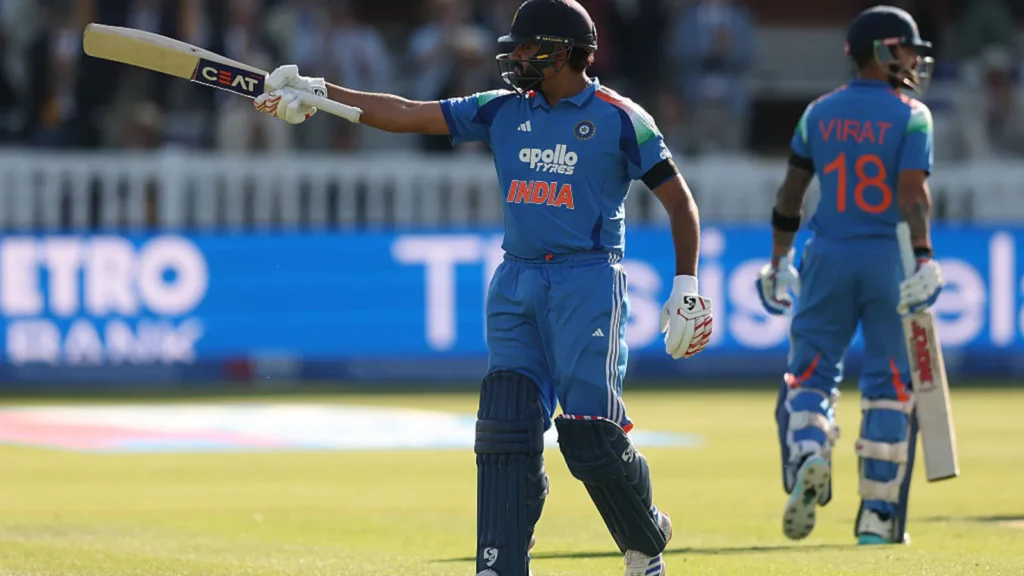
Rohit Sharma celebrates his century at Lord’s after producing a vintage ODI masterclass in India’s series defeat to England. Image Credit: NDTV
Rohit Sharma produced one of the most memorable ODI hundreds of his career at Lord’s on Sunday, but India still lost the third and final match against England by 27 runs and handed over the series 1-2. The 39-year-old former captain scored a brilliant 138, while Shubman Gill made 77 and Virat Kohli added 74, yet India finished on 360 for 7 in reply to England’s imposing 387.
The result was painful for India, but Rohit’s innings became the biggest talking point of the day because it came amid intense speculation over his future. Under pressure and with his legacy under scrutiny, he responded in the only way he knows how — with a commanding century on one of cricket’s most famous grounds. Yeh match kaafi important hai because it was not just a series decider; it was also a statement innings from a player many had begun to question.
How the Match Unfolded
England’s total of 387 was built around a career-best 142 from Ben Duckett and a fluent 91 from Jacob Bethell. The English innings started at a decent pace, but the real damage came in the middle and death overs. Jos Buttler’s explosive 13-ball 41 at the back end gave England the final push they needed, helping them score 82 runs in their last five overs. This story was also covered by NDTV.
That late acceleration mattered enormously. In a 50-over chase, the difference between 340 and 387 is often the difference between pressure and control. England’s batting unit managed the innings intelligently, kept the scoreboard moving and capitalised when India’s bowling lost its line and length. Joe Root’s unbeaten 74 and Buttler’s late assault pushed the score to a point where India needed a near-perfect chase.
India did respond strongly with the bat. Rohit and Gill stitched together a 147-run stand, and Rohit later added 113 with Kohli, raising hopes of a famous run chase. For a while, it looked like the innings was building toward something extraordinary. But cricket at this level often changes in a handful of overs, and that is exactly what happened when Sam Curran’s slower deliveries at the death triggered India’s collapse in momentum.
Rohit’s Special Innings
Rohit’s 138 was more than just a big score. It was a response to pressure, speculation and age-related doubts that have followed him in recent weeks. He walked into the match with questions hanging over his place in the side and whether selectors were already thinking beyond him. Instead of reacting emotionally, he let his bat do the talking.
His innings had authority, timing and patience. He struck 17 boundaries and five sixes, including three off Josh Tongue. The shot-making showed that he was not merely surviving; he was dictating the pace of the chase. The half-volley punishments, the pulls and the clean hits down the ground all reflected a batter still capable of producing top-level ODI output.
What made the century even more notable was his silence at the landmark. Rohit did not raise his bat after reaching his 34th ODI hundred, nor did he acknowledge the standing ovation from the Members’ Balcony. That detail stood out because the innings carried emotional weight. It felt like a man determined to let the result and the scoreboard speak for themselves. Seedhi baat yeh hai: Rohit did not need gestures; his innings itself was the statement.
Why India Fell Short
The biggest reason India lost was that the bowlers could not contain England’s top order or finish strongly enough at the death. Jasprit Bumrah’s absence due to an impact injury on his left knee was a major blow. Without him, India’s pace attack looked inexperienced and vulnerable against a high-quality batting lineup.
Prasidh Krishna, Arshdeep Singh, Prince Yadav and Gurnoor Brar formed a pace unit that lacked the control and experience needed on a difficult day. Prasidh took 2 for 69, Arshdeep went wicketless for 72, Prince Yadav conceded 79, and Gurnoor Brar was punished for 97. In a game where England scored 82 runs in the last five overs, those numbers tell the story clearly. India simply could not stop the momentum once England got rolling.
The lack of a second specialist spinner also hurt. With Axar Patel operating alone in the middle overs, India did not have enough variation to slow the scoring or force mistakes. Kuldeep Yadav was not used enough in the series, and that decision now looks even more questionable given the conditions and the England batting strategy. This is where tactical planning matters. In modern ODI cricket, teams need bowling variety, not just pace. Yeh issue kaafi important hai because if one match exposes a structural weakness, it usually means the system needs a rethink.
England’s Late Surge
England’s final five overs were decisive. Jos Buttler’s 13-ball 41 gave them the kind of acceleration that turns a strong total into a difficult one. Joe Root’s unbeaten 74 provided maturity, while Duckett and Bethell had already done the heavy lifting earlier in the innings.
Duckett’s 142 was the innings that set everything up. He was aggressive but controlled, and England’s batting powerplay produced 58 runs without panic. Bethell then helped maintain pressure as India’s bowlers struggled with their lengths and lines. By the 16th over, England had already crossed 100, and from there India were forced into damage-control mode.
The pitch and venue may have helped batting, but England used the conditions far better. They kept asking questions of India’s fielding and bowling, targeted weaker matchups and never allowed the chase to become manageable. That is the mark of a well-planned ODI innings. Not every big score is about raw power; sometimes it is about making sure the other team never gets back into the game.
Background and Context
This match also came with a larger storyline around Rohit and Kohli’s futures. The report suggests there has been speculation about whether selectors and the head coach want to move beyond Rohit in the near future. That made the Lord’s century even more significant, because it came in a moment where his place and legacy were being debated publicly.
Rohit is 39, and that naturally raises questions about the 2027 World Cup cycle. But after an innings like this, the conversation changes. Performances of this quality force selectors and critics to pause. Kohli, too, remains part of the wider conversation about India’s senior core, and his 74 in this chase reinforced the idea that both veterans still have value in ODI cricket.
The bigger context is India’s balancing act between experience and transition. Every major team eventually faces this problem: when do you move on from your biggest names, and when do you keep backing them? This match did not answer that question fully, but it certainly complicated any easy narrative about decline. Rohit’s innings was a reminder that class and timing can still matter a great deal in international cricket.
Timeline
England innings: Ben Duckett scores 142, Jacob Bethell makes 91, and Jos Buttler finishes with a quick 41 not out.
England finish: They post 387, with 82 runs coming in the last five overs.
India chase begins: Rohit Sharma and Shubman Gill build a 147-run stand.
Middle phase: Virat Kohli joins Rohit for a 113-run partnership.
Late overs: Sam Curran’s slower bowling breaks India’s momentum.
Final result: India close on 360 for 7 and lose by 27 runs.
Series result: England win the ODI series 2-1.
Also Read: ENG vs IND 2nd ODI in Cardiff: Joe Root’s Unbeaten 99 Guides England to Series-Levelling Win
Why This Matters
This matters because it shows both the value of senior players and the cost of bowling imbalance. Rohit’s century proves that experienced batters can still win big moments in pressure situations. At the same time, India’s loss exposes how dangerous a weak bowling day can be when chasing or defending in modern ODI cricket. Yeh issue kaafi important hai because series results are shaped not just by runs scored, but by how well a team manages its resources.
It also matters for the broader conversation around Indian cricket leadership and selection. If Rohit and Kohli are still producing at this level, any move to phase them out will need to be handled very carefully. Fans care deeply about transition stories, especially when they involve iconic players. This innings will therefore be discussed not only as a match performance but as a statement about longevity.
For the team, the defeat is a reminder that India cannot depend on batting alone. In a chase of 388, the batters did their part, but the earlier bowling performance had already put them under too much pressure. In high-level cricket, one weak link can be decisive.
India Angle
For Indian fans, this match hits several emotional points at once. Rohit Sharma’s ton at Lord’s is the kind of innings people in India will replay, discuss and celebrate, even in defeat. In Hinglish, seedhi baat yeh hai: jab senior player pressure mein century maar de, toh fans ko lagta hai abhi bhi bahut cricket baaki hai.
The series loss will sting, though, because India had moments where the chase felt possible. With Rohit, Gill and Kohli all contributing, fans had reason to believe. But the bowling concerns will worry viewers more than the defeat itself. India’s cricket audience is highly analytical now, and people will quickly ask whether the team has enough depth if Bumrah is unavailable.
This is also relevant because India are constantly preparing for future ICC tournaments. Every series becomes a test of balance, combinations and succession planning. Fans will watch closely to see whether India use this defeat to strengthen their bowling structure or simply move on to the next series without fixing the issue.
Analysis
My opinion is that Rohit’s innings may become one of the most important knocks of his late career because it came with so much pressure around him. Not every century has the same weight. Some are about momentum; this one was about relevance, legacy and resistance. That gives it a bigger emotional footprint than the score alone suggests.
I also think India’s bowling strategy needs serious review. Playing four pacers can work when there is one genuinely controlling fast bowler and good support from the rest. Without Bumrah, that balance fell apart. The lack of a second spinner, the poor lengths early on and the expensive death overs all point to a structural issue, not just a bad day. Teams at the top level cannot afford to be one-dimensional.
From an editorial perspective, this game is perfect for strong cricket coverage because it combines statistics and emotion. Rohit’s 138 is the headline, but the loss is the context that gives it meaning. That contrast is what makes sports journalism compelling — great individual achievement inside a team defeat.
What Next
India will now need to review both selection and bowling combinations before the next white-ball assignment. The immediate debate will centre on whether the current pace-heavy approach is sustainable without Bumrah. The team management may also have to think harder about spin options, especially if conditions demand control rather than sheer pace.
For Rohit and Kohli, the likely next step is more scrutiny but also more support. Performances like these make it difficult to argue that the senior pair should be pushed aside too early. At the very least, Rohit’s innings will strengthen the case for keeping experience in the side while India builds around younger players.
England, meanwhile, will take confidence from a series win built on top-order dominance and strong finishing. Their batting fired at the right moments, and that will encourage them going forward. The next time India and England meet in ODIs, this series will probably be remembered as the one where England out-bowled India’s structure and India’s batting brilliance still wasn’t enough.
Conclusion
Rohit Sharma’s magnificent 138 at Lord’s was a vintage answer to criticism, but it could not prevent India from losing the ODI series 1-2 to England. India’s batting was outstanding, with Gill and Kohli also making key contributions, yet England’s 387 proved too steep after Duckett, Bethell, Buttler and Root combined to build a winning total. The result exposed India’s bowling weaknesses without Bumrah and raised bigger questions about balance, selection and transition. Even so, Rohit’s innings will stand out as one of the most memorable of his career — a reminder that class can still roar loudly, even in defeat.
Written By A. Jack