The project, inaugurated on Thursday, is part of the Phase-IV expansion of the Delhi Metro and is expected to improve access to major hubs like New Delhi Railway Station, Delhi Gate, Kartavya Path and Sarai Rohilla. The initial construction work has begun at the proposed Sarai Rohilla station. Work on a diaphragm wall has already begun.
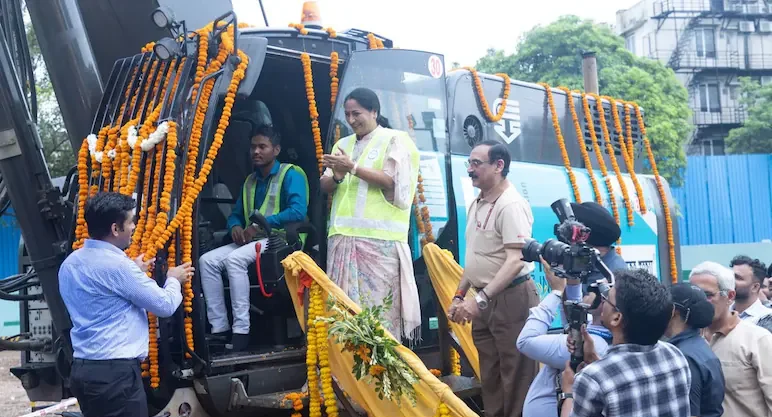
Construction begins on Delhi Metro’s new underground Inderlok-Indraprastha corridor, a 12.377-km link set to improve connectivity across Central Delhi. Image Credit: NDTV
Delhi Metro has officially begun work on a major underground expansion project, with construction starting Thursday on the 12.377-km Inderlok-Indraprastha corridor that will run through Central Delhi. The new stretch will include 10 underground stations and connect seven metro lines, making it one of the most ambitious interchange-heavy additions to the network. Chief Minister Rekha Gupta was present at the launch when the Delhi Metro Rail Corporation began its first construction activity at the proposed Sarai Rohilla station.
This is a big moment for Delhi’s public transport system because the corridor is not just another line extension. It is being designed to bridge critical gaps in the city’s metro map, improve cross-city movement and make some of the capital’s busiest destinations easier to reach. Yeh development kaafi important hai because it directly affects how lakhs of commuters will move around Central Delhi in the years ahead.
What the Project Includes
The new corridor will run entirely underground and is expected to connect some of the busiest and most strategically important parts of the city. According to the information provided, the 12.377-km stretch will have 10 stations and create interchange links with seven metro lines. That means passengers will be able to switch between multiple routes more efficiently, reducing the need for long detours and crowded surface travel. This story was also covered by NDTV.
The interchange stations will connect the Red Line and Green Line at Inderlok, the Magenta Line at Nabi Karim, the Yellow Line and Airport Express Line at New Delhi, the Violet Line at Delhi Gate and the Blue Line at Indraprastha. That network effect is what makes the project especially valuable. Instead of just adding another route, the corridor is being built as a connector, which is often what makes a metro system truly efficient.
Once operational, the corridor is also expected to improve access to places such as New Delhi Railway Station, Sarai Rohilla Railway Station, India Gate, Kartavya Path, Delhi Secretariat and Arun Jaitley Stadium. These are not minor stops. They are major civic, transport, administrative and cultural hubs that draw massive daily footfall.
Why This Corridor Matters
The biggest strength of this project is connectivity. Delhi already has a large metro network, but a large network does not automatically mean seamless travel. What people actually need is easy interchange, shorter travel time and fewer gaps between key areas. This corridor is designed to solve exactly that.
For example, someone travelling from one part of the city to another may currently have to make multiple changes or rely on road transport for part of the trip. Once this line is in place, such journeys could become much simpler. The result should be less pressure on road traffic, fewer long auto or cab rides between disconnected metro points and better integration across the system.
The project is also important because it strengthens Central Delhi, a part of the city that carries a huge concentration of political, commercial, transport and heritage activity. In metro planning terms, Central Delhi is not just another zone — it is the core that links many major parts of the capital. A well-designed underground corridor there can have a citywide impact.
How the Project Is Being Built
The first construction activity began at the proposed Sarai Rohilla Metro station, where DMRC started building the diaphragm wall. This is a critical structural element used in underground station construction. In simple terms, it helps create the station enclosure before deeper excavation begins. It is one of the first major steps in making an underground station stable and safe.
The launch of work at Sarai Rohilla signals that the project is now moving from planning to physical execution. Underground metro construction is always more complex than elevated work because it involves deep excavation, utility shifting, traffic management and safety planning in dense urban conditions. Central Delhi, in particular, presents a challenge because of its crowded roads, old neighbourhoods and high infrastructure load.
That is why such projects usually take time. But they also deliver long-term gains that are hard to match with road widening alone. Once completed, underground metro corridors tend to improve movement without adding visual congestion or taking up valuable surface land. That is a major advantage in a city where every square metre matters.
Magenta Line Set to Become the Longest
One of the most notable outcomes of the project is that the Magenta Line is set to become Delhi Metro’s longest corridor. With the extension from Botanical Garden to Inderlok, it will stretch to nearly 89 kilometres. That is a significant milestone for the network and shows how the metro is steadily evolving beyond its original core routes.
The Magenta Line already plays an important role in connecting parts of Delhi and the NCR, and this extension will make it even more central to the network. More length usually means more reach, but what matters here is not length alone. The added interchanges will turn the line into a far more powerful connector across the city.
According to DMRC, this corridor will also have the highest number of interchange stations and underground stations in the network. That combination suggests the line will become one of the most strategically important parts of Delhi Metro’s future operations. Driverless metro trains will operate on the entire corridor, further underlining the system’s push toward modern, automated transport.
Background and Context
Delhi Metro has long been one of India’s most important urban transport success stories. Over the years, it has expanded in phases, gradually knitting together different parts of Delhi and the NCR. Phase-IV is the latest big step in that process, aimed at filling missing links and improving travel efficiency in areas that already have high commuter demand.
The Inderlok-Indraprastha stretch is part of that larger Phase-IV vision. Its purpose is not just to add kilometres, but to improve the quality of connectivity between existing lines. That is a more mature phase of metro development. Earlier phases often focused on opening up new corridors. Later phases focus on fixing weak spots and making the entire system more useful.
Construction is also underway on other sections of the Magenta Line between Janakpuri West and RK Ashram Marg. The Janakpuri West-Krishna Park Extension and Deepali Chowk-Majlis Park sections have already opened to commuters, while the remaining stretches will be completed in phases. DMRC has also started work on the Central Vista section, showing that metro expansion is continuing on multiple fronts at once.
Timeline
Earlier phases: Delhi Metro expands across the city through multiple corridors.
Phase-IV planning: The Inderlok-Indraprastha corridor is identified as a key underground link.
Thursday, July 2026: DMRC begins construction work on the 12.377-km corridor.
Same day: The first activity starts at the proposed Sarai Rohilla station with diaphragm wall construction.
Ongoing: Other Phase-IV sections and the Central Vista stretch continue to move ahead in parallel.
Future stage: The corridor will eventually connect seven metro lines and improve access across Central Delhi.
Also Read: Delhi Gets 300 Electric Buses and Three New Depots as Push for Cleaner, Smarter Public Transport
Why This Matters
This matters because commuting in Delhi is often shaped by gaps, delays and transfer hassles. When a metro system becomes more connected, people save time and energy on their daily journeys. Yeh issue kaafi important hai because public transport is not just about convenience; it is about productivity, mobility and quality of life.
It also matters because underground projects in dense cities are difficult, expensive and disruptive in the short term, but they create long-term benefits. If Delhi can build and integrate this corridor successfully, it will strengthen the city’s transport backbone for years. That helps office-goers, students, tourists, traders and government employees alike.
For a city like Delhi, better metro connectivity also means less pressure on roads. More people using the metro usually means fewer private vehicles, which can reduce congestion and pollution. That is why transport infrastructure stories are also environmental stories.
India Angle
For Indian readers, the Delhi Metro expansion has a broader national significance because it often sets the benchmark for other cities. In Hinglish, seedhi baat yeh hai: agar Delhi Metro apna network aur smarter banata hai, toh doosre Indian cities bhi us model ko dekhte hain. That includes not just route length, but how well the system connects stations, institutions and major transit points.
This project also matters because Indian cities are growing rapidly, and transport planning has to catch up. People no longer want just a metro line; they want easy interchanges, shorter travel times and better access to workplaces, educational centres and railway stations. The Inderlok-Indraprastha corridor reflects that modern urban demand.
The inclusion of driverless trains is another sign of where Indian metro systems are heading. Automation, underground integration and network design are no longer futuristic ideas — they are becoming part of everyday urban life. Delhi is helping push that change forward.
Analysis
My opinion is that the real importance of this project is not simply the 12.377-km length, but the network logic behind it. A metro system becomes truly powerful when it reduces transfer friction. This corridor does exactly that by connecting seven lines in one underground stretch. That is smart planning, not just expansion for the sake of expansion.
I also think the Sarai Rohilla start point is symbolically meaningful. It shows that the project is entering a visible construction phase, which matters for public confidence. People often hear about metro projects for years before they see any physical work. Starting the diaphragm wall construction makes the project feel real and measurable.
From a civic perspective, this corridor could become one of Delhi’s most useful transport additions if it is executed well. The challenge will be construction speed, coordination and minimal disruption to surrounding areas. If DMRC handles those well, this line could become a model for future urban transport work in India.
What Next
The next step will be continued construction at Sarai Rohilla and other points along the corridor. Underground work will likely move through stages such as excavation, station box development, tunnel construction and system installation. These projects usually take time, so commuters should expect progress in phases rather than a quick finish.
DMRC is also expected to keep advancing the other Phase-IV sections already under construction. As those pieces come together, Delhi Metro’s overall network will become more interconnected. The Magenta Line extension, in particular, will be watched closely because it will change route maps and travel patterns once complete.
For commuters, the practical takeaway is simple: the city is building toward a more connected metro future. The benefits will not appear overnight, but when they do, they are likely to be significant. Better interchange, shorter trips and smoother cross-city movement are the long-term goal.
Conclusion
Delhi Metro’s new Inderlok-Indraprastha corridor marks a major step in the capital’s transport evolution. With 10 underground stations, seven line connections and a focus on key destinations across Central Delhi, the project is designed to improve how the city moves. The start of construction at Sarai Rohilla, the Magenta Line’s growth and the use of driverless trains all point to a more modern and connected network ahead. For Delhi commuters, this is not just another metro project — it is a major upgrade in how the city will function in the years to come.
Written By A. Jack