
What began as a hospital assault case has quickly evolved into a statewide issue of medical staff safety, political accountability and public trust in civic healthcare. Resident doctors in government hospitals will continue services today but will wear black ribbons as a symbolic protest.
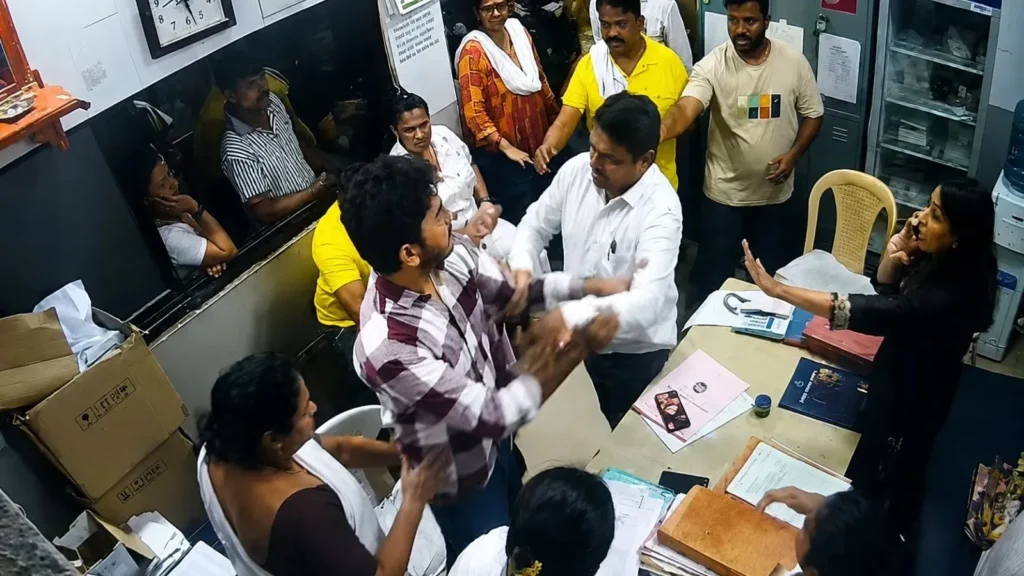
Doctors at a civic hospital in Dombivli are under pressure after an alleged assault case led to protests and police action. Image Credit: Indian Express
Doctor Assault Triggers Statewide Protests: A shocking alleged assault on doctors and nurses at a civic hospital in Dombivli has set off a political storm in Maharashtra, drawing strong reactions from the medical community and putting the state government under pressure. The main accused, Shiv Sena corporator Ramesh Mhatre, surrendered before Thane police after three of his associates were arrested on Wednesday. The incident has now moved far beyond a local law-and-order matter and become a broader debate about safety in hospitals, political influence and the rising anger of healthcare workers.
Resident doctors and nurses have announced protests across the state, while healthcare organisations have warned that the agitation could turn indefinite if the accused are not dealt with firmly. The Maharashtra State Association of Resident Doctors, or Central MARD, welcomed the arrest but said doctors across government medical colleges and hospitals would wear black ribbons on Thursday while continuing to work. Yeh issue kaafi important hai because it touches both public health and the dignity of medical professionals.
What Happened
According to the report, the alleged assault took place at a civic hospital in Dombivli and involved doctors and nurses being targeted in a way that has deeply unsettled the medical fraternity. The case quickly gained political weight because one of the accused is a sitting corporator, Ramesh Mhatre, a Shiv Sena representative. His surrender before Thane police came after three of his associates were arrested, suggesting that law enforcement had already begun tightening the net around the group. This story is also covered by The IndianExpress.
The most immediate consequence of the incident has been outrage from resident doctors and nurses. Rather than stay silent, they have decided on a visible but non-disruptive form of protest: wearing black ribbons while continuing to provide medical services. That choice is significant. It reflects anger without abandoning patients, which is often the strongest possible statement from healthcare professionals.
The protest also shows that the issue is not being treated as an isolated assault. Medical groups are framing it as part of a wider pattern of violence against healthcare workers. This is why the response has spread statewide so quickly. The incident has become symbolic of a deeper problem — the vulnerability of doctors and nurses when workplace security is weak or when political power is involved.
Why the Reaction Is So Strong
The medical fraternity is reacting strongly because violence in hospitals is not just a personnel issue; it affects patient care, staff morale and the functioning of the health system itself. Doctors and nurses already work under pressure. When they feel unsafe, the whole atmosphere of care changes. In this case, the assault allegation has triggered a rare and united pushback from residents, nurses and healthcare organisations.
The symbolism of black-ribbon protests is also important. It communicates protest without stopping essential services. That balance matters because hospitals cannot simply shut down without harming patients. At the same time, the protest makes it clear that the staff will not normalise the attack. In simple terms, the message is: service continues, but silence does not.
Healthcare workers in India have long complained that assaults on medical staff are often treated as isolated incidents rather than urgent systemic failures. That is why this case has struck a nerve. If an elected representative and his associates are involved, even allegedly, it raises the stakes further. The issue is no longer just about one confrontation — it becomes about whether power can intimidate those who are expected to serve the public.
Political Pressure and Public Trust
The political angle in this case is unavoidable. Because the main accused is a Shiv Sena corporator, the matter has immediately taken on a party and governance dimension. When a political office-holder is accused in a hospital assault, people naturally begin asking whether the system protects the powerful more than the vulnerable. That question is now hanging over the case.
Public trust in civic hospitals can also take a hit when such incidents become headline news. Patients come to these hospitals expecting care, not conflict. If doctors and nurses feel threatened, patients may worry about how safe and stable the environment really is. Even if services continue, the atmosphere of tension is enough to affect confidence.
At the same time, the police response matters. The arrest of Mhatre’s associates and his eventual surrender indicate that the case is being pursued. But for the medical community, the real test is not just arrest – it is whether accountability will be visible, timely and consistent. If the process appears slow or diluted, anger in the hospitals may grow again.
Background and Context
Violence against doctors has been a recurring concern in India for years. Emergency rooms, civic hospitals and public health centres often see the highest pressure, and tensions can rise quickly when families are distressed or when hospital systems are overstretched. But the problem becomes especially serious when aggression crosses into physical assault.
Maharashtra has seen repeated concerns over the safety of resident doctors and hospital staff. Resident doctors are often the backbone of government medical colleges and civic hospitals, especially during long shifts and high patient loads. When they announce protests, it is usually because they feel the issue is not just emotional but structural. The fact that Central MARD has supported a black ribbon agitation suggests that the medical community wants both immediate action and longer-term safeguards.
This is also not the first time hospitals have faced pressure from outside violence, crowding and political interference. Every such case revives the same debate: how can public hospitals be made safer for the people who work there? That question becomes even more urgent when the accused is linked to local political power.
Timeline
Earlier this week: Alleged assault on doctors and nurses takes place at a civic hospital in Dombivli.
Wednesday: Three associates of Shiv Sena corporator Ramesh Mhatre are arrested by Thane police.
Later on Wednesday: Mhatre surrenders before police.
Same day: Resident doctors and nurses announce statewide protests.
Thursday: Central MARD asks government hospital doctors to wear black ribbons while continuing medical services.
Coming days: Healthcare organisations warn of further agitation if strict action is not taken.
Also Read: Navi Mumbai Car Accident Kills 2, Injures 8 in Taloja Sector 10 Hit-and-Run
Why This Matters
This matters because hospitals must be safe places for both patients and staff. When doctors or nurses are assaulted, the damage goes beyond the immediate victims. The whole healthcare system becomes more cautious, more tense and less effective. Yeh issue kaafi important hai because if people who save lives do not feel protected, the quality of public healthcare suffers.
It also matters because this is a test of rule of law. If an elected representative can be linked to an assault case and the response is weak, it sends the wrong signal to the public. On the other hand, a firm and transparent response can reassure both citizens and medical workers that no one is above accountability.
For ordinary people, the issue may look like a political clash. But at the ground level, it is about whether someone working a night shift in a hospital can do their job without fear. That is a basic expectation in any civil society.
India Angle
This story resonates widely in India because violence against doctors is not a localised problem — it is a national concern. Across the country, medical staff often face pressure from angry relatives, poor infrastructure and overcrowded public hospitals. In Hinglish, seedhi baat yeh hai: agar doctor aur nurse safe nahi rahenge, toh patient care bhi risk mein aa jaati hai.
India’s public hospitals are already under strain. Resident doctors are stretched thin, nurses are overworked and civic facilities often struggle with crowd control. In that environment, any assault becomes more than a criminal act. It becomes a warning about how fragile the system is.
The political aspect also has an India-wide relevance because it raises the question of how local power intersects with public institutions. Citizens across the country watch such cases closely because they reveal whether institutions can act firmly, regardless of who is involved.
Analysis
My opinion is that the response from Central MARD is smart and disciplined. By continuing services while wearing black ribbons, the doctors are making a strong point without harming patients. That is an effective form of protest because it keeps the moral high ground while applying pressure.
I also think the incident may become a larger conversation about hospital security. If one assault can trigger statewide unrest, then the system clearly has a trust deficit. The authorities will now need to do more than make arrests; they will need to show that hospitals are safer than before. That could involve better policing, tighter visitor controls and faster response mechanisms.
The political sensitivity is obvious, but the core issue should remain the safety of healthcare workers. If that focus gets lost in party debate, the public will see the process as yet another power struggle. The best outcome would be a transparent investigation and visible institutional reform.
What Next
The immediate next step is likely to be further police action and possible legal proceedings against the accused. The investigation will need to establish the exact sequence of events, the roles of each person involved and whether the assault was premeditated or spontaneous. That will determine the seriousness of the charges and the direction of the case.
At the same time, doctors and nurses may continue symbolic protests if they feel the response is inadequate. If healthcare organisations escalate their agitation, the issue could grow into a wider statewide strike threat. That would put additional pressure on the government to intervene and reassure the medical community.
There may also be calls for long-term protection measures in civic hospitals. Those could include security deployment, stricter entry controls and better complaint mechanisms. If the state takes the issue seriously, this case could lead to reforms that protect staff beyond just this one incident.
Conclusion
The Dombivli doctor assault case has quickly turned into a statewide issue because it sits at the intersection of healthcare safety, political accountability and public trust. With Shiv Sena corporator Ramesh Mhatre surrendering and his associates arrested, the legal process is moving forward, but the medical community is demanding more than just arrests.
Resident doctors and nurses have made it clear that violence inside hospitals cannot be normalised. Their black ribbon protest is a reminder that the people who keep public healthcare running need protection, respect and a safe workplace. In the end, this is not only about one assault case — it is about the kind of system Maharashtra wants to build for its healthcare workers and its citizens.
Written By A. Jack