Classes were disrupted as students demanded an independent probe, accountability and stronger mental-health support following the death of a 31-year-old Physics student; IIT Delhi has announced an external inquiry panel.
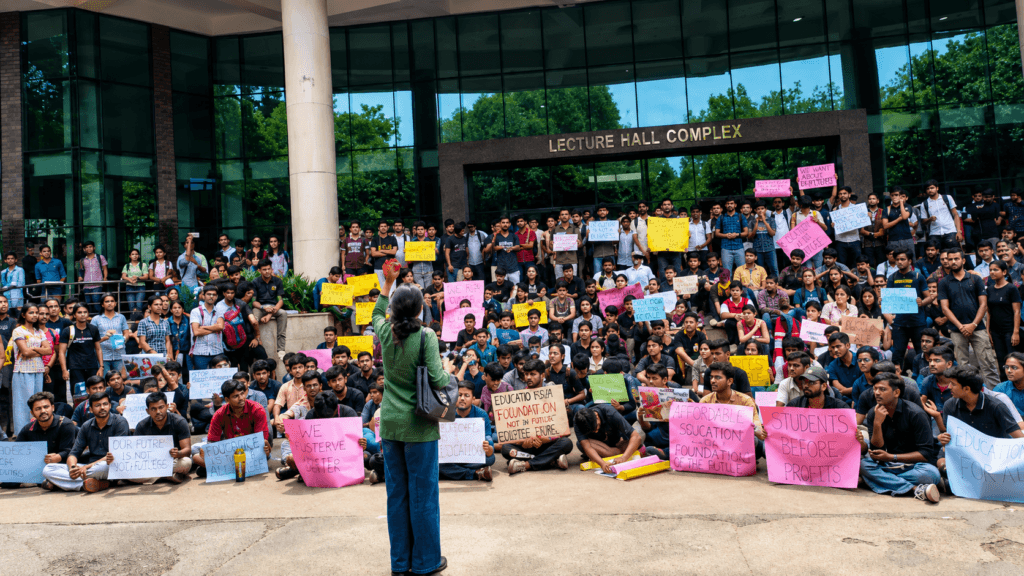
IIT Delhi students gather near the Lecture Hall Complex during a protest following the death of an MSc Physics student. Image Credit: The Hindu
Students at the Indian Institute of Technology (IIT) Delhi boycotted classes and held a protest on Monday, August 24, demanding an independent investigation into the death of a 31-year-old MSc Physics student on campus two days earlier.
The protest began near the Lecture Hall Complex (LHC), where the student’s body was found, before students moved towards the office of IIT Delhi Director Rangan Banerjee.
Students alleged that administrative lapses—including non-allocation of hostel accommodation, denial of academic projects and inadequate welfare support—may have contributed to the student’s distress. These are allegations raised by protesting students and have not been established. IIT Delhi has announced an external inquiry to examine the circumstances leading to the death and the concerns raised by students.
Classes were called off by midday as students gathered for the protest.
What Students Demanded
The protesting students submitted a note to IIT Delhi Director Rangan Banerjee outlining a series of demands.
Their key demands included:
An independent investigation into the student’s death
Suspension of classes at the Lecture Hall Complex
Resignation or suspension of officials alleged to be responsible for negligence
A review of hostel-allocation processes
Greater transparency on counselling and mental-health services
Clear guidelines for academic-project allocation and supervisory decisions
Protection from disciplinary action for students participating in the protest
Compensation of at least ₹1 crore for the student’s family
Students said that classes should not resume at the LHC as if “business as usual” had returned to campus. This story was also covered by The Hindu.
“The system needs to take a pause,” the students wrote in the note submitted to the director.
They also demanded that the institute communicate clearly about what measures it has taken to prevent student distress and suicide on campus.
Allegations of Administrative Lapses
A student who spoke on the condition of anonymity alleged that the administration had focused on the student’s mental-health condition while failing to acknowledge institutional factors that may have added to his distress.
The student alleged that the deceased had been referred to VIMHANS for treatment and was later not allotted a hostel room after returning. According to the protesters’ account, he was staying off campus, which may have created financial pressure.
Students also sought an explanation for alleged issues related to:
Non-allocation of hostel accommodation
Denial of academic projects
Course-withdrawal or academic-support concerns
Hospital administration response
Communication between student-welfare officials and the studentthehindu+2
These allegations are now part of the public concerns surrounding the case. They have not been confirmed by the inquiry, police or IIT Delhi administration.
The institute and the inquiry panel will need to examine documentary records, welfare communications, counseling referrals, hostel-allocation history and academic decisions before reaching any conclusion.
Eight Student Deaths Alleged in 30 Months
In their note, students said that eight IIT Delhi students had died by suicide on campus over the past 30 months.
“This pattern points to a systemic problem,” the students said.
The figure is an allegation from the protesting students and would need verification through official institutional and police data. However, the concern reflects a broader anxiety among students about mental-health support, academic pressure, social isolation, housing uncertainty and the accessibility of counseling.
The latest death is the second reported suicide at IIT Delhi since March, when a 19-year-old first-year BTech student died in a separate incident.
Repeated deaths on a campus can deeply affect students, staff and families. They also require institutions to examine not only individual crises but also the systems that determine whether someone in distress receives timely help.
IIT Delhi Announces External Inquiry
Following the protests, IIT Delhi announced an external inquiry into the circumstances surrounding the death and the concerns raised by students.
The institute has formed a five-member panel to investigate the matter. The panel is expected to:
Examine circumstances leading to the student’s death
Interact with students, faculty and administrative offices
Review counselling and welfare systems
Assess whether institutional processes need improvement
Submit a report within two weeks
Director Rangan Banerjee said the inquiry would look into the circumstances leading to the tragedy.
The administration has appealed for classes and academic activities to resume. However, students have expressed concern that an inquiry initiated by the institute may not be sufficiently independent.
Their demand remains for an external, transparent investigation with accountability for anyone found responsible.
Protests at the Lecture Hall Complex
Students initially assembled at the LHC around 9 am, where they called for a pause in academic activity at the site.
As rain intensified, students moved inside the Lecture Hall Complex but continued their sit-in.
By evening, the demonstration shifted near the director’s office, where a student delegation met Rangan Banerjee and senior faculty members.
The protest was described as involving hundreds of students.
Students also demanded that the administration guarantee no disciplinary action against those taking part in the protest.
The institute cancelled scheduled classes by midday, indicating the scale of disruption and the urgency of the situation.
The Student’s Death
The 31-year-old MSc Physics student died on Saturday after an incident on the sixth floor of the Lecture Hall Complex. Delhi Police are investigating the death.
Police had earlier said no suicide note was recovered and that investigators were examining the student’s mobile phone, counseling records, and other relevant information.
The student has been identified in subsequent reports as Rishikesh Kumar, a second-year MSc Physics student from Patna, Bihar.
IIT Delhi initially issued a statement expressing grief and saying it was providing support to the family.
The latest student protest has moved the conversation from individual tragedy to questions about campus support systems, academic pressure and institutional accountability.
Also Read: IIT Delhi Student Dies by Suicide on Campus; Second Such Case Since March
Timeline
Saturday, August 22, 2026: A 31-year-old MSc Physics student dies after an incident on the sixth floor of IIT Delhi’s Lecture Hall Complex. Police begin an investigation.
After the death: Police collect evidence, examine the student’s phone and seek counseling and other relevant records. No suicide note is recovered.
Sunday, August 23: JNUSU stages a protest outside IIT Delhi demanding accountability and an independent inquiry into the death.
Monday morning, August 24: IIT Delhi students boycott classes and gather at the Lecture Hall Complex to protest.
Monday afternoon: Classes are called off as students continue a sit-in and submit a note of demands to Director Rangan Banerjee.
Monday evening: Protest shifts near the director’s office; student representatives meet institute officials.
After protests: IIT Delhi announces an external inquiry and forms a five-member panel to investigate circumstances surrounding the death.
Next two weeks: The inquiry panel is expected to interact with stakeholders and submit its report.
Why This Matters
Yeh issue kaafi important hai because it concerns student welfare, mental-health access and accountability at one of India’s leading academic institutions.
Campus welfare: Students are asking whether hostel, counseling, and academic-support systems are adequate for people facing distress.
Institutional accountability: An inquiry must establish whether administrative processes contributed to the student’s isolation or stress.
Mental-health support: Students want transparent information about counseling availability, referral systems and emergency response.
Academic pressure: Research projects, housing, supervisor relationships and course decisions can significantly affect postgraduate students.
Trust in the inquiry: The credibility of the five-member panel will depend on its independence, transparency and willingness to hear students.
The protest is not only about one event. It reflects a broader demand that institutions treat mental health and student welfare as core responsibilities, not secondary services.
India Angle
The IIT Delhi protest has national significance because student deaths and mental-health concerns have been reported across IITs, NITs, medical colleges, coaching centers, and universities.
Students in highly competitive institutions often face the following:
Academic workload and performance pressure
Financial stress
Hostel and housing uncertainty
Isolation from family and friends
Research delays
Supervisor conflicts
Career anxiety
Stigma around mental-health treatment
Elite institutions may have better resources than many colleges, but resources only work when students can access them without fear of stigma, academic penalty or administrative delay.
Campuses need systems that go beyond counseling posters. They need 24-hour crisis support, independent grievance redressal, timely hostel allocation, academic flexibility, peer-support networks and faculty training.
For students in distress, India’s Tele-MANAS service offers free 24/7 mental-health support at 14416 or 1-800-891-4416. The KIRAN helpline can be reached at 1800-599-0019.depwd.gov+2
Analysis
The important question is not whether mental illness and institutional failure are mutually exclusive. They are not.
A student may be experiencing serious mental-health distress and also face external pressures such as housing insecurity, academic rejection, financial burden or poor institutional communication. A responsible inquiry must examine the full context.
The administration should avoid reducing the case to one medical label. At the same time, protesters should avoid drawing definitive conclusions before the inquiry reviews the records.
A credible investigation should ask the following:
Was hostel accommodation handled fairly and promptly?
Were academic projects, course options and supervisor decisions transparent?
Did the student receive adequate welfare follow-up after clinical referral?
Was there coordinated communication between medical, counseling, and academic teams?
Were emergency mental-health protocols activated when concerns emerged?
Do current systems allow students to seek help confidentially and without fear?
In my view, the panel’s report should be made public in an anonymized form. Without transparency, students may not trust the findings.
What Next
The next phase will include:
Five-member inquiry: The panel will investigate the circumstances of the death and review student-welfare systems.
Police investigation: Delhi Police will continue examining forensic evidence, communications and other relevant records.
Student negotiations: Protesters may continue seeking resignations, external oversight and written commitments from the administration.
Mental-health review: IIT Delhi may revisit counseling capacity, hostel policy, academic support and crisis intervention procedures.
Compensation demand: Students have demanded ₹1 crore compensation for the family, which the institute will have to address.
Class resumption: The administration has appealed for academic activities to resume, but students may continue protests until they receive a satisfactory response.
National attention: The case may prompt wider review of suicide-prevention systems across higher-education institutions.
Conclusion
The death of an MSc Physics student at IIT Delhi has triggered a major campus protest and renewed questions about institutional responsibility, mental-health support and academic welfare.
Students have alleged that housing, project allocation and hospital-administration issues may have worsened the student’s distress. These allegations have not yet been established and will now be examined by an external inquiry panel.
The institute’s response will be judged not only by the inquiry’s findings but also by whether it makes meaningful improvements in counseling access, hostel systems, academic support and emergency intervention.
IIT Delhi ke students ka message clear hai: tragedy ke baad sirf condolences nahi, accountability aur systemic change chahiye.
Written By A. Jack