
In Bhoom taluka, investigators say, artificial milk was prepared using low quality milk powder, detergent powder and palm oil. Seven accused have been booked, but all remain absconding as raids are on.
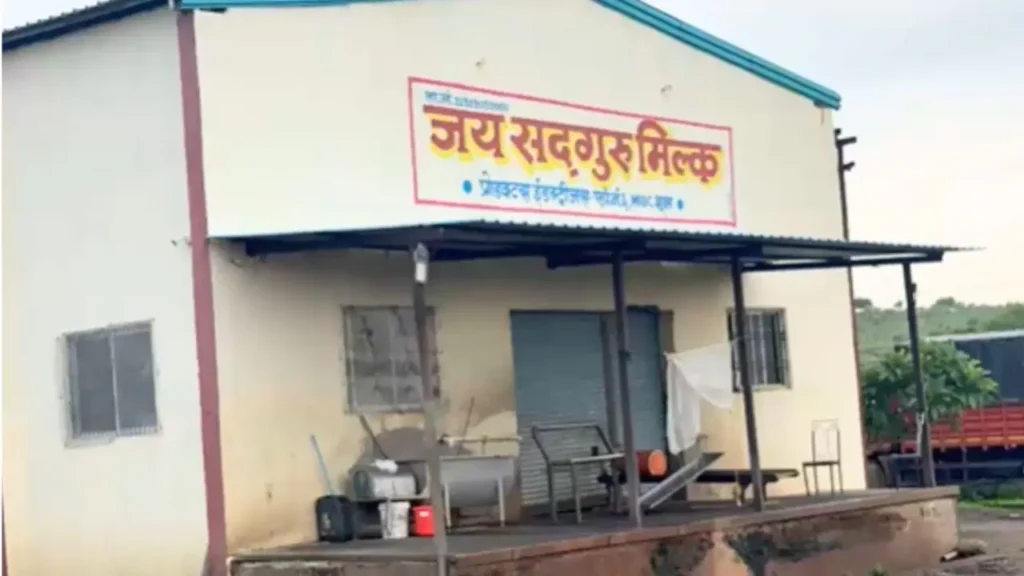
Officials investigate a major milk adulteration racket in Maharashtra’s Bhoom taluka after seizure of adulterated milk powder and evidence of synthetic milk production. Image Credit: NDTV
A disturbing milk adulteration case from Bhoom taluka in Maharashtra’s Dharashiv district has revealed the alleged production of more than 2.3 crore litres of synthetic milk over the past six months. According to police and Food and Drug Administration (FDA) investigators, the racket involved the use of low-quality milk powder, detergent powder, palm oil and other chemical substances to prepare fake milk that may have been distributed across the state.
The scale of the scam is what makes this case truly alarming. Officials say seized sales registers indicate that around 230,470 kilograms of milk powder were used for adulteration, generating about 2,304,070 litres of synthetic milk. Based on a suspected 10% adulteration ratio, investigators believe the actual quantity of contaminated milk that entered Maharashtra’s market could exceed 2.3 crore litres. Yeh case kaafi serious hai because it is not just a food fraud story — it is a direct public health threat.
What the Investigation Found
The investigation began after police and FDA officials raided the accused and seized records that helped them reconstruct the operation. Those sales registers reportedly showed how much milk powder had been used over six months and how it was converted into synthetic milk. The estimated value of this fake milk has been pegged at Rs 9.21 crore, which suggests this was not a small local fraud but a large organised racket. This story was also covered by NDTV.
One of the most disturbing details is how the synthetic milk was allegedly made to look authentic. Officials say detergent powder and palm oil were added to make the mixture appear like real milk and maintain the required fat levels. This is dangerous because consumers are often unable to detect adulteration by sight or taste alone. The milk may appear normal, but the ingredients can be toxic.
According to police, the racket was reportedly operating under the guise of selling cattle feed. That is a clever but deeply deceptive cover because cattle feed businesses can easily come and go in rural supply chains without drawing immediate suspicion. By using that cover, the accused allegedly created a channel to move adulterated material into the milk supply network.
Police Inspector Shriganesh Kanagude said during the raid that officials seized 61 bags of adulterated milk powder. He also said preliminary investigations suggest that Balasaheb Godge was supplying the adulterated milk powder to several dairy units in the Bhoom region for the preparation of adulterated milk. The probe has also indicated the involvement of multiple milk collection centres, although those who allegedly purchased the milk are still being identified.
Why This Scam Is So Dangerous
Milk is one of the most sensitive food items in India because it is consumed daily by children, elderly people, pregnant women and families across income groups. When milk is adulterated with detergent powder and palm oil, the danger is not just low quality; it becomes a direct health hazard. Such substances are not meant for human consumption and can cause serious damage over time.
Medical experts have warned that repeated consumption of chemically adulterated milk can harm the liver, kidneys and digestive system. For children, the risk is even greater because their bodies are still developing and are more vulnerable to toxins. For pregnant women and older adults, the danger can be even more severe. That is why food adulteration cases always trigger deep concern. Yeh issue kaafi important hai because a contamination problem in milk is not limited to one household or one village; it can affect entire communities.
The suspected volume also matters. More than 2.3 crore litres is an enormous quantity, which means the impact may not be localised. If the estimate is accurate, the fake milk could have moved through a wide supply chain involving collection centres, dairy units and downstream buyers. That makes this not just a criminal case but a food safety emergency.
How the Racket Likely Worked
Based on the available facts, the operation appears to have followed a simple but dangerous formula. Low-quality milk powder was used as the base, and then detergent powder, palm oil and other low-grade chemicals were added to mimic the appearance and thickness of real milk. The mixture was then supplied through dairy channels under the label of legitimate production.
The use of powder as an input is especially significant because it allows the accused to control cost and volume. Powder can be mixed with water and other ingredients to create a white liquid that resembles milk. Palm oil may have been used to imitate the fat content, while detergent could help produce the foamy or textured appearance that might trick buyers or collection agents.
What makes such scams difficult to detect is that they often do not rely on one big fake batch. Instead, the process can be distributed through multiple centres and transport points. Even small adulteration percentages can become a major public issue if they are repeated across thousands of litres every day. In this case, the suspected 10% adulteration ratio means that for every 100 litres of genuine milk, 10 litres of synthetic milk may have been added. That is enough to distort quality and potentially endanger consumers.
Legal Action and Investigation Status
Police have registered a case against seven individuals under stringent sections, but all the accused remain absconding even eight days after the case was filed. This means the investigation is still in an active manhunt phase, with Special Investigation Team (SIT) teams conducting raids at suspected hideouts.
The formation of an SIT indicates that authorities view the matter as serious enough to warrant focused investigation. That is appropriate given the scale of the alleged scam and the possible health risk to the public. In food adulteration cases, speed is important because the more time passes, the harder it becomes to trace the supply chain and recover evidence.
The legal consequences can also be severe. Under the Food Safety Act, those found guilty of such life-threatening adulteration can face fines of up to Rs 10 lakh and even life imprisonment. That reflects how seriously Indian law treats food safety crimes when they put public health at risk. If the allegations are proven, this case could become a major example of how food fraud is punished in the state.
Background and Context
Maharashtra is one of India’s major milk-producing states, and areas like Bhoom taluka are important to the dairy economy. Bhum taluka reportedly exports lakhs of litres of milk every day and produces around 70 to 80 tonnes of khoya. That gives a sense of why the area is commercially important and why a racket there is so alarming.
When a district known for dairy output becomes linked to adulteration, public trust takes a hit. Consumers begin to question whether the milk they buy from local vendors, collection centres or dairy brands is actually safe. That is especially troubling in a state where dairy is central to household nutrition and the food industry.
Food adulteration is not new in India, but cases involving milk always attract strong reactions because milk is seen as a staple and often as a symbol of purity. From homes to tea stalls to sweet shops, milk is used everywhere. So when a scam like this emerges, it becomes a wider social issue, not just a law-and-order case.
Timeline
Over the last six months: Officials say adulterated milk powder was allegedly used on a large scale.
During the same period: Around 230,470 kg of milk powder was allegedly diverted for synthetic milk production.
Recent raid: Police and FDA teams seized 61 bags of adulterated milk powder.
Eight days after case registration: All seven accused remain absconding.
Now: An SIT is conducting raids and tracing supply links across Bhoom and beyond.
Also Read: FDA Suspends Licence of Iconic Mumbai Ice Cream Outlet K Rustom Over Food Safety Violations
Why This Matters
This matters because milk adulteration is one of the most dangerous forms of food fraud. Unlike a luxury item or a non-essential product, milk is part of everyday consumption for millions of Indian families. If a child drinks contaminated milk regularly, the health consequences can be long-term and serious. Yeh issue kaafi important hai because food safety failures at this scale can quietly harm people before anyone realises something is wrong.
It also matters because the scam appears to have exploited trusted supply channels. Milk collection centres, dairy units and distribution networks are built on confidence. Once that confidence breaks, honest producers and sellers are also affected because customers start doubting the entire system. That can hurt the dairy economy as a whole.
There is also a governance angle. If such a large racket could operate for months, it raises questions about inspection gaps, enforcement delays and monitoring at collection points. Public safety depends not just on catching criminals after the fact but also on preventing such networks from growing in the first place.
India Angle
For Indian readers, this story hits close to home because milk is a daily necessity in almost every household. In Hinglish, seedhi baat yeh hai: jab doodh hi unsafe ho jaye, toh ghar ka bharosa hil jaata hai. India’s food economy runs on trust, and milk is one of the biggest trust-based products in that system.
This case also reflects a broader Indian challenge — the gap between food production and food regulation. Rural supply chains are often large, fragmented and hard to monitor closely. That makes them vulnerable to fraud when there is profit to be made. The Maharashtra case shows why local enforcement, surprise checks and strong record-keeping are so essential.
The public reaction is likely to be strong because the reported ingredients are so disturbing. Detergent and palm oil in milk sounds unbelievable to most consumers, but such scams have appeared in different parts of India before. That is why people need transparent reporting, stronger penalties and regular testing. The more visible the crackdown, the more likely it is that confidence can be restored.
Analysis
My opinion is that the most important part of this story is the estimated scale. Millions of litres of suspected adulterated milk suggest that this was not a one-off act of cheating but a structured supply operation. That makes it far more serious than ordinary food fraud. If the 10% adulteration estimate is accurate, then the impact could extend far beyond the initial point of production.
I also think the case highlights a weakness in how the dairy supply chain can be exploited. When a racket can operate under the cover of cattle feed sales, it shows how easily illegal activity can hide inside legitimate rural commerce. That is why the investigation must not stop with the first arrests. The bigger network, if it exists, needs to be identified.
From an editorial perspective, the story has strong public relevance because it affects a basic product consumed every day by millions. It is not a niche scandal. It is a trust story, a safety story and a governance story all at once. That combination makes it one of the most important consumer fraud cases to watch.
What Next
The next step will be the search for the absconding accused and the tracing of buyers who allegedly purchased the adulterated milk. Police and FDA investigators will likely continue examining sales records, collection centre activity and transport links to map the full route of the racket. If additional evidence is found, more arrests could follow.
Authorities may also increase testing of milk samples in the region to identify whether adulterated stock has already entered the wider market. That would be crucial for public safety and for limiting further distribution. The state may also have to review how collection centres are monitored and whether current checks are strong enough.
If the case expands, it could lead to broader action against the dairy network in the area. That may include licensing scrutiny, compliance checks and tighter penalties. The goal now will be not just punishment, but preventing a repeat of the same kind of scam.
Conclusion
The alleged milk adulteration scam in Maharashtra’s Bhoom taluka has exposed what may be one of the most alarming food fraud cases in recent times. Officials suspect that more than 2.3 crore litres of synthetic milk could have entered the market after being made with low-quality milk powder, detergent powder and palm oil. With seven accused still on the run and an SIT now investigating, the case has become a major public health and law-enforcement issue. For consumers, the message is clear: milk safety is not a small matter, and the system must do far more to protect people from such dangerous adulteration.
Written By A. Jack