Nepal begins mass burials of hundreds of unidentified victims in Chitwan while rescue teams race to reach hydropower workers believed trapped inside mud-filled tunnels; fresh flood warnings issued as Bhotekoshi water levels rise again.
Rescue workers and volunteers search through debris along flood-hit riverbanks in Nepal. Image Credit: The Hindu
Nepal Flash Floods: The death toll from catastrophic flash floods in Nepal rose to 788 on Sunday, August 30, 2026, with authorities warning that more bodies are likely to be recovered as search teams reach remote areas and continue pulling victims from rivers and debris.
The National Disaster Risk Reduction and Management Authority (NDRRMA) said at least 2,502 people remain missing, while 9,435 have been rescued from flood-affected districts so far.
On the Chinese side of the border, 16 people have been confirmed dead and 546 are still missing in Tibet’s Gyirong County, bringing the combined death toll to at least 804 and the total number of missing to more than 3,000.
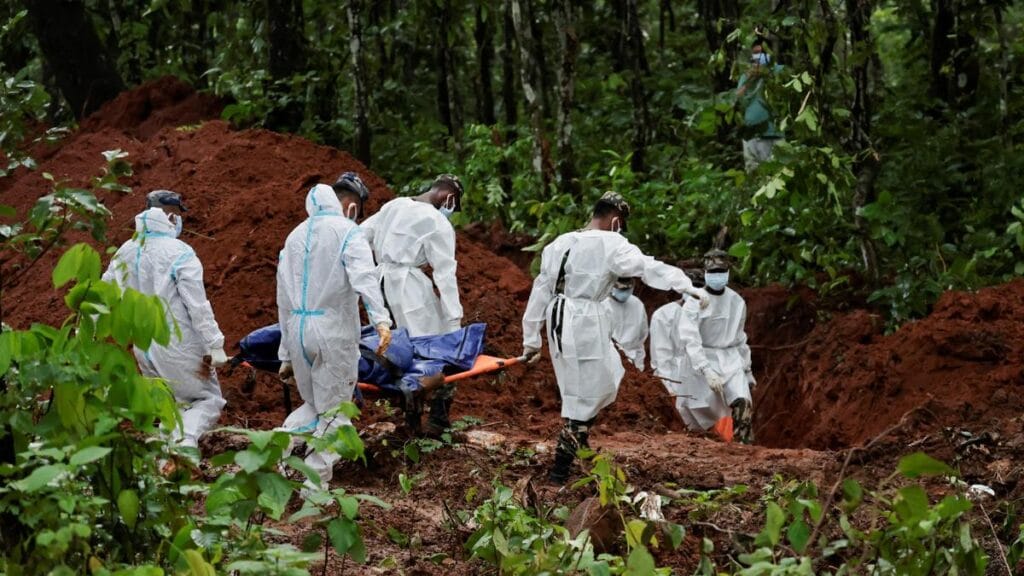
As the humanitarian crisis deepens, Nepal has begun mass burials of hundreds of unidentified flood victims in the scenic Chitwan district, while rescue teams drill through mud and debris to reach hydropower workers believed to be trapped inside tunnels.
What Happened
The disaster began on Wednesday, August 26, 2026, after a massive ice-rock avalanche and glacial collapse in the high Himalayas near the Nepal–Tibet border. This story was also covered by The Hindu.
A sudden surge of water, ice and boulders swept through the Bhotekoshi and Trishuli river valleys, destroying settlements, hydropower project sites, roads, bridges and tourism infrastructure.
By Sunday night, official figures showed:
Death toll in Nepal: 788 confirmed dead, according to NDRRMA.
Missing in Nepal: 2,502 people unaccounted for, including 592 foreign nationals.
Deaths in Tibet (China): 16 confirmed dead.
Missing in Tibet: 546 people, including 261 foreign nationals from 23 countries.
Total missing (Nepal + Tibet): More than 3,048 people.
Rescued in Nepal: 9,435 people evacuated or brought to safety.
Hydropower workers missing: At least 933 workers across more than 11 project sites; authorities believe around 100 may still be alive inside tunnels. The Red Cross and other agencies estimate that as many as 93,000 people may have been affected by the catastrophe, with the death toll expected to rise further.
Rescue Operations
One of the most critical and technically challenging aspects of the rescue effort is reaching hydropower workers believed to be trapped inside tunnels that were buried under mud and debris.
Nepalese authorities estimate that at least 933 workers are missing from more than 11 hydropower construction sites, and they have not ruled out the possibility that about 100 of them remain alive, trapped inside tunnels.
At the Trishuli 3A hydropower site, where the largest number of people is believed to be trapped, Nepalese army rescuers succeeded overnight in drilling through the top of a tunnel buried under mud and debris, Home Minister Sudan Gurung said.
Key developments:
Access point created: Rescue teams drilled into the upper section of the tunnel, breaking through far enough to begin pumping in air and lowering a camera.
Objective: Establish whether anyone is alive inside, provide oxygen and food if possible, and plan extraction.
Challenges: Unstable debris, risk of further collapse, limited space, difficult terrain and adverse weather.
India has intensified its assistance by deploying specialised tunnel rescue and forensic teams to support Nepalese authorities.
China has also mobilised more than 1,000 rescuers, including firefighters, police and military personnel, along with helicopters and heavy equipment, to assist in search operations on the Tibetan side.
Mass Burials in Chitwan
Nepal’s scenic Chitwan district, known for its forests and rivers, has become the site of mass burials for hundreds of unidentified victims whose bodies were swept away by the flash floods.
Authorities buried 96 unidentified bodies in the forest on Saturday and planned to bury more than 100 others on Sunday, as recovery teams continue to retrieve victims from rivers and piles of debris.
Key details:
Location: Devghat forest in Chitwan, nearly 200 km from the disaster zone.
Number of bodies: Some 250 bodies were awaiting identification, with hastily dug trenches for temporary burial.
Reason for mass burial: Forensic teams are overwhelmed; decomposition is making storage untenable, necessitating temporary interment while DNA samples are preserved for future identification.
Families of missing persons have been travelling to Chitwan, hoping to identify loved ones through photographs, clothing or other personal effects before burial.
For many, the mass graves are a painful symbol of the disaster’s scale and the difficulty of identifying victims carried hundreds of kilometres downstream by the Bhotekoshi River.
Fresh Flood Warnings
In a statement issued on Sunday, the NDRRMA warned that water levels in the Bhotekoshi River had risen again, urging residents and rescue personnel to take precautionary measures.
“The water level in the flooded Bhotekoshi River has risen to some extent; all concerned are urged to take precautionary measures,” the agency said, adding that it would provide updates after receiving additional information.
This warning has left residents in flood-hit villages worried and confused as they try to understand the continuing risks after the initial disaster.
Concerns include:
Secondary flooding: Additional rain or upstream releases could trigger new surges.
Rescue disruptions: Rising water may hamper search operations along riverbanks and debris fields.
Evacuation needs: Some communities may need to be moved again if water levels continue to climb.
The repeated warnings underscore that the disaster is not over, even as the focus shifts from immediate rescue to recovery and identification.
Quotes and Official Statements
NDRRMA: “The death toll has surged to 788… at least 2,502 individuals remain missing, while 9,435 people have been rescued from the flood-affected areas thus far.”
Home Minister Sudan Gurung: “At the Trishuli 3A hydropower plant… the Nepalese military rescue team successfully drilled an access point into the upper section of the tunnel buried under mud and debris… we are moving forward with determination to save the lives of our citizens.”
Chinese authorities: 16 dead and 546 missing in Gyirong County, with 261 foreign nationals from 23 countries unaccounted for in Tibet.
Forensic teams in Chitwan: DNA samples are being preserved from unidentified bodies before burial to aid future identification as decomposition makes storage untenable.
These statements highlight both the human tragedy and the enormous logistical challenges facing responders.
Also Read: Nepal Flash Floods: Death Toll Rises to 675, Nearly 3,000 Missing as Rescuers Battle Mud and Rain
Why the Floods Were So Devastating
The disaster began with a glacial collapse and ice-rock avalanche in the high Himalayas near the Nepal–Tibet border.
Such events can release massive volumes of water, ice and debris in a short time, creating a wall of floodwater that moves rapidly down narrow river valleys.
Key factors that increased the impact:
Steep terrain: The Bhotekoshi and Trishuli valleys are narrow and steep, amplifying the speed and force of the flood.
Settlements near rivers: Many hotels, guesthouses, hydropower sites and villages are located close to the riverbanks.
Cross-border infrastructure: Roads, bridges and the Gyirong border crossing complex were heavily damaged or destroyed.
Tourist and pilgrim traffic: The area is a key route for Kailash Mansarovar pilgrims and adventure tourists, increasing the number of people at risk.
Hydropower projects: Several under-construction and operational projects in Trishuli and Rasuwa were hit, trapping workers in tunnels and camps.
The combination of natural forces and human settlement patterns turned a geological event into a humanitarian catastrophe.
Timeline
Wednesday, August 26, 2026: Ice-rock avalanche and glacial collapse trigger catastrophic flash floods in the Bhotekoshi and Trishuli river valleys.
Immediate aftermath: Hundreds killed, roads and bridges destroyed, hydropower sites damaged, many tourists and workers stranded.
August 27–29: Death toll rises past 700; more than 2,000 reported missing; rescue operations intensify.
August 30 (Sunday): Nepal reports 788 dead; 2,502 missing; 9,435 rescued.
August 30: Mass burials of unidentified victims begin in Chitwan; 96 bodies buried on Saturday, more than 100 planned for Sunday.
August 30: NDRRMA warns that Bhotekoshi water levels have risen again, urging precautionary measures.
August 30–31: Rescue teams drill into the Trishuli 3A tunnel to reach trapped workers; India deploys specialised tunnel rescue and forensic teams.
Why This Matters
Yeh disaster kaafi important hai because it affects not only Nepal but also India, China and the wider region.
Human cost: Nearly 800 confirmed dead and more than 3,000 missing mean thousands of families are waiting for news of loved ones.
Regional connectivity: The floods damaged a key border crossing and major highways, disrupting trade and travel between Nepal, India and China.
Energy infrastructure: Hydropower projects in Trishuli and Rasuwa were hit, potentially affecting Nepal’s power generation and investment climate.
Tourism and pilgrimage: The Kailash Mansarovar route and adventure-tourism circuits were severely disrupted, impacting livelihoods and travel plans.
Climate-risk warning: Glacial collapses and flood surges are likely to become more frequent as the Himalayas warm, making disaster planning critical.
For India, the impact is direct: many Indians were in the affected zone, and floodwaters have carried debris and bodies into Indian rivers downstream.
India Angle
India has a strong stake in this disaster.
Indian nationals affected: Hundreds of Indians were reported missing or stranded in the initial phase; 113 Indians were among the 163 foreigners evacuated in earlier updates.
Pilgrims and tourists: A significant number of Kailash Mansarovar pilgrims and adventure tourists from India were travelling through the affected routes.
Downstream impact: Floodwaters from Nepal flow into Indian rivers, raising alert levels in border districts of Bihar and Uttar Pradesh.
Rescue cooperation: India has deployed specialised tunnel rescue and forensic teams to assist Nepal, in addition to offering other aid.
Diaspora concern: Families across India are tracking updates on missing relatives, with Indian missions and state governments coordinating information.
This situation shows how closely linked India and Nepal are in terms of people, rivers and disaster response.
Analysis
The drilling into the Trishuli 3A tunnel is a technically complex and emotionally charged operation. If even a few workers are found alive, it will be a major morale boost. If not, it will underscore the tragedy’s scale.
In my view, the mass burials in Chitwan are a heartbreaking but necessary step. With hundreds of bodies decomposing and forensic capacity stretched, temporary interment with DNA preservation is a pragmatic approach to balance dignity, public health and the hope of future identification.
What Next
The coming days and weeks will focus on:
Continued search operations: Teams will keep looking for missing persons in remote valleys and along riverbanks.
Tunnel rescue: Efforts to reach trapped hydropower workers will continue, with air, food and possible extraction if survivors are found.
Weather monitoring: Fresh rain or rising water levels could trigger new floods or landslides, so alerts will remain active.
Identification efforts: DNA samples, photographs and personal effects will be used to identify as many victims as possible before and after burial.
Rehabilitation: Temporary shelters, food, medical care and psychological support will be needed for survivors.
Infrastructure repair: Roads, bridges, power lines and communication networks will be prioritised.
International aid: Nepal is likely to receive financial and technical assistance from India, China, multilateral banks and other partners.
For Indians, the focus will remain on tracing missing relatives, supporting evacuation efforts and preparing for any downstream flood risk.
Conclusion
Nepal’s flash floods have killed at least 788 people, left more than 2,500 missing and forced the rescue of over 9,400 individuals as operations enter their fifth day.
Rescue teams are drilling through debris to reach hydropower workers believed trapped inside tunnels, while mass burials of hundreds of unidentified victims have begun in Chitwan as forensic teams struggle to cope.
With fresh flood warnings issued and water levels in the Bhotekoshi River rising again, the crisis is far from over.
Yes, the disaster is a stark reminder of the Himalayas’ vulnerability and the need for stronger regional cooperation. For now, the priority remains saving lives, finding the missing and supporting survivors.
Written By A. Jack